

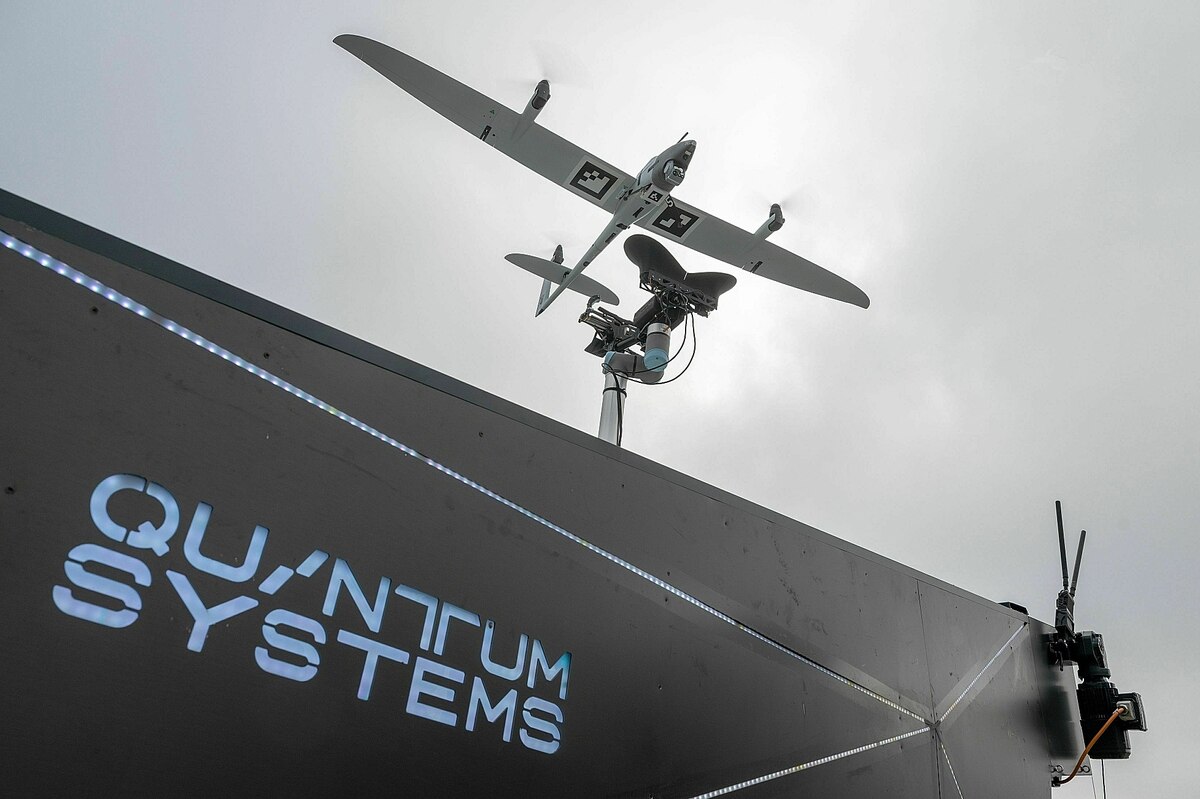
It is an inconspicuous suitcase that the Liebherr company presents at the well-attended exhibition of defense companies. Not much bigger than a piece of hand luggage, two batteries fit inside. It is a charging station for drones from the Bavarian defense startup Quantum Systems. The “Vektor” reconnaissance drone, which is also used in Ukraine, can be supplied with mobile power via the charger.
The Association of the Aerospace Industry (BDLI) organized the trade fair and an associated conference at the end of January. Aim: to give company representatives the opportunity to meet members of the Bundeswehr and, above all, politicians. The rush is big.
The Liebherr group of companies has been working for a long time in the broad spectrum between civil industry and defense production. Liebherr-Aerospace, based near Lindau, specializes in landing gear and control technology and supplies central components for the A320 civil short-haul aircraft from Airbus – but also for the Eurofighter-Typhoon fighter aircraft.
A new field of activity for the company is electronic manufacturing systems, with which Liebherr produces contract work for other companies. In addition to the charging case, Liebherr also built parts for the elementary control of the “Vektor” drone according to Quantum Systems’ plans. In Berlin, Liebherr is also exhibiting a small semiconductor board called the unmanned system’s flight control system.
We are still hovering around ethical debates, but we are threatened by Putin’s system, which does not have ethical debates.
Thomas Röwekamp, CDU
The civilian industry is also interested
But it’s not just representatives of defense companies who talk to each other and politicians at the reception over pike perch fillet, beef shoulder and green smoothies. Among the guests are employees of the German semiconductor manufacturer Infineon.
Representatives of an industrial construction company or engineering service providers also came. Some people here openly admit that taking part in an arms trade fair is a good idea Russia’s attack on Ukraine would have been unthinkable for them. “To be honest, we would have expected 100 guests, now we are at 250,” says BDLI managing director Marie-Christine von Hahn happily as a welcome.
Im Fokus: Dual Use
The chairman of the Defense Committee in the Bundestag, Thomas Röwekamp, sets the tone for the debate in his speech. “In Germany there are many civilian things that we can make militarily usable,” says the CDU politician. “We are still hovering around ethical debates, but we are threatened by Putin’s system, which does not have ethical debates.”
It’s about that To make production capacities in Germany usable for military purposes. “It’s not that we have a lot of money, but we can have a lot of money,” he says, alluding to the exemption from the debt brake. which has been in effect for defense spending for less than a year. In order to speed up defense projects, parliament has just passed a planning acceleration law. Now it’s a matter of analyzing which offers are already available on the market – including in the civilian sector.
The deputy head of the Bundeswehr’s planning office, Matthias Damm, also argues in a similar direction. It’s good that the financial foundation in Germany is now in place, he says. High on the wish list Bundeswehr stands loitering ammunition. These weapons, known colloquially as “kamikaze drones,” can remain in the air until a target presents itself and only then obliterate it – usually self-destructing.
Hundreds of millions for kamikaze drones
70 to 90 percent of losses in Ukraine were caused by unmanned systemssays Damm. “Loitering ammunition is a consumable item.” The Bundeswehr doesn’t need a huge amount of it waiting in the depots to be used.
Nevertheless, it looks as if a preliminary decision has already been made about two systems that the Bundeswehr also wants to procure in the future. According to consistent media reports, the German military wants to buy kamikaze drones from the two German startups Helsing and Stark for several hundred million euros. The arms giant Rheinmetall, which also applied for the contract, could therefore come away empty-handed. The Bundestag still has to seal the purchase in the budget committee.
The drone manufacturers Helsing and Quantum Systems are promoting more flexibility – i.e. more adaptable systems, but also less regulation and “bureaucracy”. Simon Pfeiffer, program manager at Helsing, cites the Ukraine as a role model, where the cycles for innovations in drone technology are extremely short.
Ukraine as a testing ground
Die Welt quotes a Ukrainian soldier in a recent report, who claims to have done “the dirty work” for Helsing on the battlefield. The use of the HF-1 kamikaze drone was a “fiasco” because the drones were unable to take off or crashed immediately. The report quoted a Ukrainian Air Force officer as saying about Helsing: “Little done, but excellent marketing.” In the article, Helsing denies the allegations and points out that it was clear “that iteration would take place in use with this product type, which was completely new at the time”.
The representatives of traditional arms companies in Berlin, of all people, are arguing against making new types of weapons more flexible. When building drones, Ukraine also accepts a deadly risk for its own soldiers, says the sales manager of the guided missile manufacturer MBDA in Germany, Guido Brendler. The comparison is made several times that limitless innovation in Germany does not mean that hand grenades are mounted on hardware store drones, as is sometimes the case in Ukraine with a “high personal toll”.
How much Ukraine has become a development and testing ground for German weapons production is demonstrated by Quantum Systems, which has its own production line in the country – inaugurated in 2024 in the presence of then Economics Minister Robert Habeck (Greens). And the company also goes further and carries out reverse imports: With Quantum Frontline Industries, the company recently announced industrial foreign production of Ukrainian drones in Germany.