

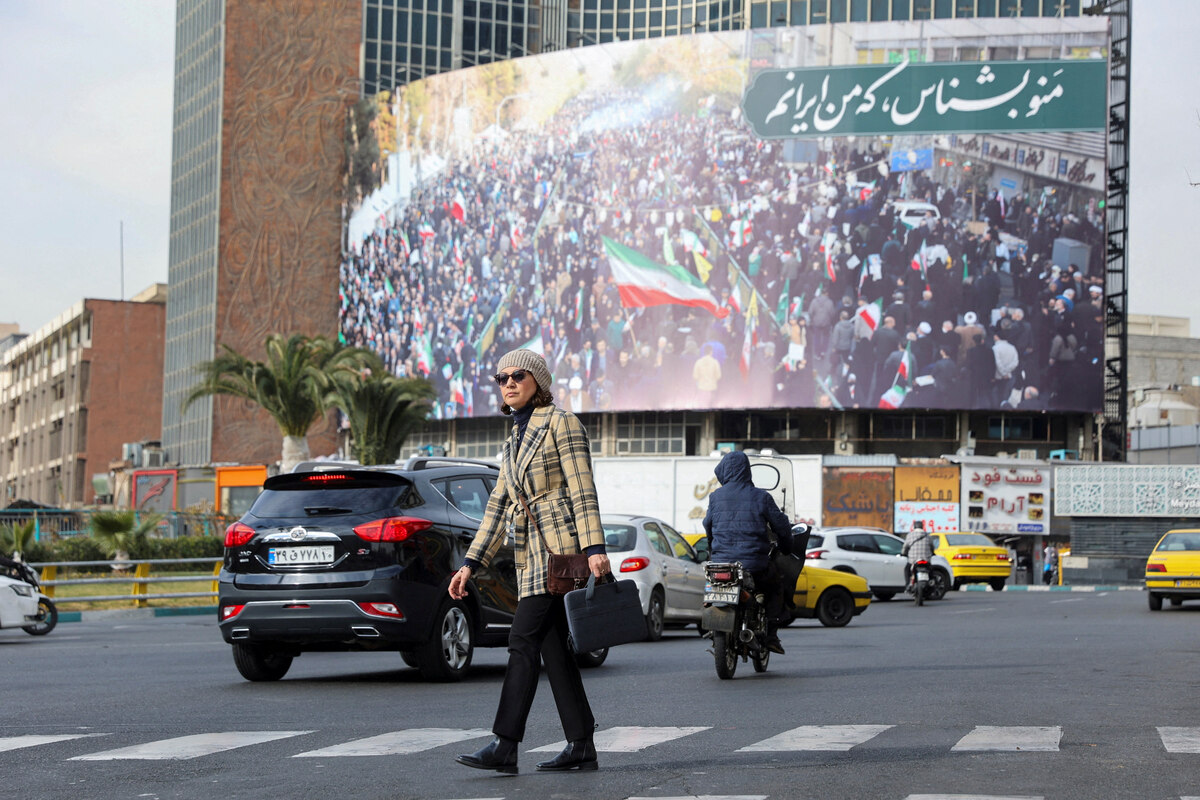
E There are 1,001 reasons to be against the regime in Tehran – and for its end. The Iranians themselves know this best, which is why they take to the streets despite all the dangers. But the hope for an end to the mullahs’ regime should not lead to neglecting the possible consequences – in Iran and in the region. Iran is a hollowed-out system. Decades of internal reforms were missed. Economic mismanagement, corruption, and the regime’s unwillingness to allow even small social reforms have led the country to a dead end. Like many times before, those in power are now relying on bloody repression to replace their waning legitimacy. They were already successful in previous uprisings and were able to buy time. But the mullahs never used this to then address the reasons that brought people to the barricades.
As people’s anger grows, every repression eventually has an expiration date. The regime has never been as weak as it is today – and yet the outcome is uncertain. The pictures from the country should not hide the fact that Regime and its ideology are deeply rooted in parts of society is that there are enough profiteers who are therefore sticking with it. And so the most likely scenarios after the fall of the regime are not democratic ones.
Part of the security apparatus could separate from the regime. The Praetorians overthrow the rulers they were founded to protect. The Revolutionary Guards could see the mullahs as a burden on their continued power and simply take it over themselves. That would be a classic end to an uprising for the region – see Arab Spring: Mullah-Dictator gone, replaced by direct military rule, which throws off the ideology of “Wilayat al-Faqih”, the “rule of the clergy”, as ballast. In another scenario, the multi-ethnic state could slide into total chaos, even leading to a prolonged civil war, for example along the lines of Syria or Iraq. The regime collapse would then be followed by a long phase of violence and instability.

The two states that are discussing possible intervention, the USA and Israel, have different interests. Both would have no problem working with the Praetorians. If they dropped their anti-Israel and anti-American rhetoric. The case of Venezuela shows that the US president cares most about access to resources and oil. He is not concerned with a democratic restructuring of the country, but only with having free access to resources.
The regime and its ideology are deeply rooted in parts of society and especially among those who profit from it
However, when it comes to the second scenario, possible chaos in Iran, Israeli and American opinions differ. Israel could live well with further fragmentation of the region. It would seek to expand its spheres of influence in the region without resolving the Palestinian issue. US President Trump, on the other hand, is not interested in fragmenting Iran. The resulting instability would primarily affect its important alliance and business partners, the Gulf monarchies. In the region itself, the uprising in Iran is not only accompanied by cheers, but is also viewed with great concern. Even though the mullahs’ regime has few friends here, other than those the regime itself has built up.
Shiites lose their protective power
The so-called Axis of Resistance – Tehran, Hezbollah, Iraqi militias, Houthis in Yemen – would lose its Iranian sponsor. For them it is a question of existence. This would mean that the Shiites in the region would lose their protective power. The failure of Iran as one of the most important regional powers would catapult the region as a whole into completely unknown spheres. The result of these power struggles and fragmentation would probably be that the other regional powers such as Saudi Arabia, Turkey and Egypt would move closer together. None of these regional powers has an interest in their region and neighborhood becoming even more unstable.
What would happen in Tehran after a US military intervention that worked in favor of the demonstrators? If this is not chaos and instability, what has emerged would be associated with the stigma of having been bombed into power with the help of the US military – with all the consequences for Iran and the region. If the Iranians remain the sole driver of change, the outcome is equally uncertain. But he would have something that a US-Intervention can never produce: the legitimacy of one’s own people.