
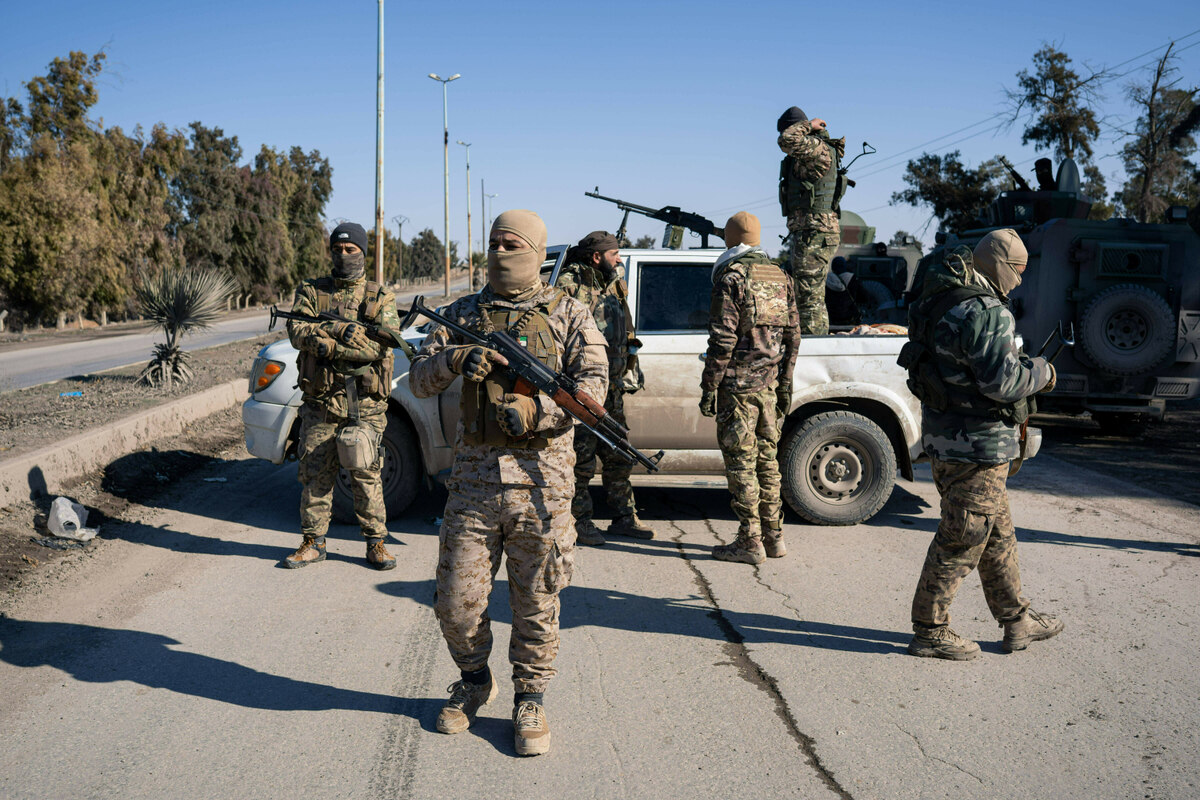
A fragile ceasefire hovers over the banks of the Euphrates in northeastern Syria. Since Tuesday evening, for The weapons in the Kurdish areas were silent for four days. Four days in which the leaders of the Kurdish autonomous administration are supposed to decide on the Syrian central government’s proposal and thus the future of Rojava.
On the one hand, there is the Syrian army and the government led by Ahmed al-Sharaa, who has been trying for months to bring the Kurdish armed forces, their administration and ultimately the entire region under the control of the new Syrian republic. In his most recent proposal on January 18, al-Sharaa promised to “protect the special character of the Kurdish areas” in return for the integration of Kurdish soldiers into the state security apparatus, but as individual fighters and not as Kurdish units. The Kurds should give up control over the regions of Deir al-Sor and Raqqa as well as over the external borders and the oil fields of Rojava.
Opposite Al-Sharaa are the Kurdish forces of the Syrian Democratic Forces (SDF) led by General Mazloum Abdi and the self-administration of northern and eastern Syria. This has so far been an autonomous region whose administration is based on principles such as equality, sustainability and direct democracy, derived from the teachings of Abdullah Öcalan, the controversial leader of the Kurdistan Workers’ Party (PKK). Because of previous attacks on civilians, the PKK is classified as a terrorist organization by the USA and the European Union.

This text comes from the weekday. Our weekly newspaper from the left! Every week, wochentaz is about the world as it is – and as it could be. A left-wing weekly newspaper with a voice, attitude and the special taz view of the world. New every Saturday at the kiosk and of course by subscription.
There is a lot at stake for the self-government: the future of a model of government that it has fought hard to achieve, the loss of control over almost a third of Syria’s land and over resources such as the Tabqa dam and the profitable oil fields. Last but not least, there is the fear of a rise in religious fundamentalism and, despite all al-Sharaa’s assurances, the loss of women’s and minority rights.
These are fateful days for the Kurds
Fear, frustration and dissatisfaction
It’s four fateful days. A deadline that sounds like an ultimatum. In the past few weeks, the Syrian army has been able to take over large areas of northeastern Syria, such as those with Arab influences Raqqa, Deir al-Sor and parts of the province around Hasakah. It is questionable whether the Kurds would be able to hold their cities in the event of another offensive. Especially since the USA has now sent clear signals in favor of the central government. “The greatest opportunity for the Kurds in Syria lies in the transition to Assad, under the new government led by President Ahmed al-Sharaa,” wrote US Ambassador Tom Barrack on X on Tuesday.
If you want to understand the current struggles, you have to look at Rojava’s past. Kurds were discriminated against under Assad. The authorities stripped thousands of families of their citizenship, lost civil and political rights, were evicted and their land was given to Arab families. Their language was not recognized, nor was their culture.
But with the Arab Spring in 2011, Kurds rose up against Assad and demanded more autonomy. In the fight against the “Islamic State” (IS), the female combat units in particular were able to assert themselves and gained supporters, primarily the USA. Self-government was officially born. Little by little, Arab cities like Raqqa also came under their control. The Kurds ruled there in an authoritarian manner. Reports of human rights violations and restrictions on freedom of expression came to light.
Then comes December 8, 2024, and the autocrat Bashar al-Assad falls. In the power vacuum, the SDF conquers areas beyond the previous borders. There are tumults and deaths. There is fear, frustration and dissatisfaction among Arab tribes towards the SDF. Some observers say ignoring this frustration was a strategic mistake.
Fear of a return of IS
The rebel coalition that ousted Assad from power on December 8 consists primarily of the Sunni terrorist group Hai’at Tahrir ash-Sham (HTS), led by Ahmed al-Sharaa, and the pro-Turkish militias of the Syrian National Army (SNA). Turkey has always fought the Kurdistan Workers’ Party and sees the SDF as linked to the PKK. A long-running conflict flares up on the northern border. The Kurds continue to fight against the SNA in the north and against the defeated but never disappeared IS in the east.
In March, al-Sharaa and Abdi agreed to integrate Kurdish combat units into the state army. The agreement will never be implemented. The SDF is withdrawing from the Kurdish neighborhoods of Aleppo, but the Kurdish police remain. In December the situation escalated here, with battles shaking the streets. At the beginning of January, the districts came under heavy fire, and the Syrian army gradually gained control of the districts and the surrounding villages. The SDF must withdraw to the Kurdish areas.
The former IS stronghold of Raqqa is also being abandoned, along with the al-Hol refugee camp and several prisons in which IS fighters are held. The wives and children of former women live in al-Hol foreign fighters the Islamists. You are not allowed to leave the camp without being checked. Foreign women are said to be particularly cruel; many apparently long for the caliphate. Your future is now unclear. The day after the takeover, the camp’s director, Jihan Hanan, wrote: “Yesterday I was the director. Today I don’t know what the administrative instructions will be.”
The fear of a return of IS is great among the Kurds. The Syrian Defense Ministry confirms that several IS members have escaped from prison. The USA has announced that it will transfer 7,000 ex-IS fighters to Iraq.
The SDF has little leeway
Although al-Sharaa has distanced himself from his jihadist past and declared war on IS, some of his supporters still harbor Salafist thoughts. After the takeover, a military posted an AI-generated video of fully veiled women in al-Hol with the caption “The joy of liberating women is great.” The violence against Alawites and Druze last year has fueled further fear among Kurds.
But now the SDF has little leeway. The northern city of Kobanê is under siege. If they don’t compromise, they risk a bloodbath and the loss of Kurdish cities. “Protecting the Kurdish areas is a red line. We will defend them without hesitation,” Abdi announced on Tuesday. But fighting on multiple fronts without international support will be difficult.
Al-Sharaa does not want weapons in the hands of minority militias and could make good economic use of the oil fields. A new Syria could emerge – but also a new Rojava.