

A
America was the country that defined my concept of pleasure in the first place. Everything seemed open there.” Wim Wenders
Can we imagine life without the USA? The majority of films that Germans see in cinemas and streaming channels come from the USA. Hollywood has shaped our perception of what stories should look like in pictures, right down to the ramifications. Production companies from Amazon to Disney are US-owned. The digital infrastructure that we use every day was largely invented in the USA and is owned by US companies.
Almost all globally popular pop styles, from rock’n’roll to rap, were invented in the slums or suburbs of American cities. Germans prefer to listen to Taylor Swift on Spotify. One and a half million Germans eat at McDonalds every day. Militarily, Germany is dependent on US weapons, digital data and intelligence information.

German culture, politics and society have been shaped more strongly by the USA than those of other European countries over the past 80 years. For many people born after 1945, US pop culture appeared to be a replacement for the national identity that had been destroyed by the Nazi terror. Jazz and blues, Miles Davis and Elvis exuded a casual hedonism that was an antidote to the sculpted Nazi bodies and dreariness of the 1950s.
Americanized subconscious
The director Wim Wenders, born in 1945, has precisely explored the profound fascination of American culture. “Without rock music I would be stupid,” he said and a line of lyrics from Velvet Underground quoted. “Rock’n’Roll has saved my life”. Wenders’ melancholic, harsh black and white film “In the Course of Time” from 1976 is about the journey of two men that leads along the inner-German border. Bruno (Rüdiger Vogler) once tells Robert (Hanns Zischler) that during an argument with his wife he heard the melody of Elvis songs “Mean Woman Blues“had in my ear.
“The Americans have colonized our subconscious.” A sentence that is not familiar from French cinema. “Over time” is a road movie, a genre that was invented in the USA. Wenders bows to the US director Nicholas Ray, whose films he quotes in it. Like many in the post-fascist republic, Wenders looked for morally and aesthetically useful father figures. The Nazi regime had erased or corrupted lines of tradition.
US culture was a way to fill this gap. It is perhaps no coincidence that Wenders and Werner Herzogboth very German characters, lived and worked in Hollywood – unlike Godard, Truffaut, Fellini, Kaurismäki, Almodóvar, Ozon. What was fashionable in the USA later came to Germany. Start-ups and Nike shoes, Milkshakes, Onlineshopping and Marvel films. Cultural Americanization is a global phenomenon. But in the Federal Republic it was special.
The Germans absorbed what came from overseas. They were the good child and the democratic model student, the USA the role model to emulate and who played the role of the respected (and only secretly or on the political fringes cursed) father. The USA was the superego of the Federal Republic. Jan Phillip Reemtsma astutely pointed out a long time ago that the “culturally extensive identification with the USA” was also a subjugation, not just a liberation of bodies through consumption and pop culture.
France became independent early on
After 1945, West Germany submitted to the authority of the powerful victorious power. Nazi Germany had the greatest crime in human history committed – the USA embodied the power that could punish, but (unlike in Japan) refrained from doing so. The Cold War ensured that the USA firmly occupied the role of protective power in the West German psychological household, which guaranteed that the feared punishment, “the revenge of the Russians”, would not occur.
This is a psychodynamic basis for the fixation on the USA. That’s why the end of the West that we are currently experiencing is also a drama of the old Federal Republic, which people in the East are watching with more interest. In 1962, the US ambassador in Paris visited President Charles De Gaulle and reported that the US was mining the ports in Cuba. De Gaulle interrupted the US ambassador with the sentence: Are you telling me this or are you asking me? In Bonn and Berlin, this sentence would hardly have crossed the lips of a chancellor. (Gerhard Schröder 2003 was the exception.)
It almost went without saying that the USA did not need to consult the Federal Republic in geopolitical matters. France armed itself with nuclear weapons in the 1960s and withdrew militarily from NATO for decades. In the Federal Republic, the withdrawal of the US military in 2026 is still considered a stroke of fate that must be prevented at all costs. In view of the threats from Moscow against Europe, there may be reasons to consider US soldiers to be advantageous – but the panic fear of being abandoned by the protecting power has irrational components.
Former SPD Foreign Minister Heiko Maas says: “In a family relationship, the USA would have the role of the parents, we would have that of the child.” This quote is in Holger Stark’s book “The adult country – Germany and America a historic opportunity”, which traces the stages of transatlantic alienation.
Tough adherence to NATO
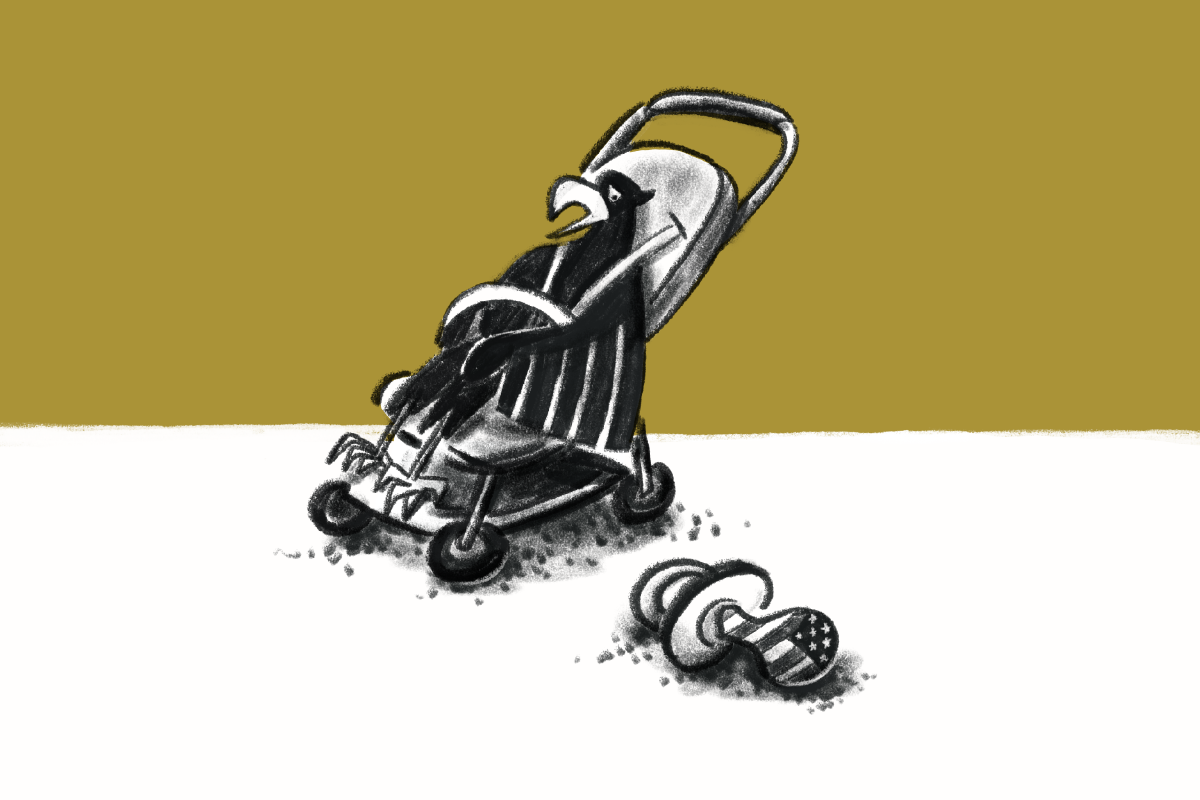
The West is broken. The Trump USA has shed the role of protective father like an old coat. Everything that was taken for granted is shaking, including the Federal Republic’s self-image. The master narrative of the Federal Republic, designed by the historian Heinrich August Winkler, was the successful connection to the West: After 1945, under the leadership of the USA, the Germans completed the long journey to the West, tamed the authoritarianism, and ended the Sonderweg.
Since 1990 the German question has been resolved; Germany has become civil, friendly and rich. This celebrated self-narrative was not a sober description, it was a story of redemption that raised the question: What actually comes after the happy ending? Nothing good. In any case, the West German narrative of a happy arrival in the civilian West evaporates the moment one can only speak of the West in the past tense.
US President Donald Trump wants to smash the EU and dissolve NATO, at least sometimes. In the face of these threats, the local political class usually seems intimidated, rarely defiant, and always at a loss. If Trump likes to adopt a friendly tone, there is hope in Germany that he can be made to feel favorable with gifts. Or that all of this is just a bad dream and when you open your eyes everything is as it was before.
At best, it is announced that Europe should now really become independent of the USA so that it can then buy billions of dollars worth of weapons there. The political class consists of clever, strategically thinking people who use sophisticated analytical devices. But the end of the West is an affective overload. For the political elite of the Federal Republic, all of them more or less boomers, the special transatlantic relationship was a given.
Associations with the late GDR
The left-wing liberals held the USA, despite Abu Ghraib and the Iraq War, always for the guarantor of Western democracy. Anti-Americanism was a phenomenon of the left-wing extremists and especially the ethnic right, who insisted on national identity without a real break with National Socialism. In the Trump era that has imploded. Vance & Co have declared the liberal transatlanticists to be their opponents. The AfD is currently the pro-American party.
In short: the end of the West is not an event that can be dealt with through a decisive renovation of our worldview. The end of the West is the end of this worldview itself. The brooding helplessness of the political class, the fleeting hope that things won’t get that bad and the paralyzing attentism may be reminiscent of the end times of the GDR. The SED leadership found itself in a dilemma after 1985. On the one hand, she suspected that Michail Gorbatschow started a revolution that could bring down the post-war order.
On the other hand, the GDR owed its existence to the Soviet Union, the victorious power of the Second World War, and it was the GDR’s raison d’être to obey Moscow. This contradiction was irresolvable. There was no way out. The self-aggrandizement of the USSR, overwhelmed by its role as a superpower, went beyond the imaginable. Until the evening of 9. November 1989 The political elite of the GDR did not understand what was happening.
Of course, the Federal Republic of 2026 is more stable than the GDR in 1989. It is a functioning democratic state, with a vital economy and public sphere and embedded in the EU. But there are a few similarities. Trump, like Gorbachev, is a reaction to an imperial overextension of a superpower that entails a radical redefinition of the international order. The West German politicians who, after every humiliation from Washington, declare their alliance with the USA or mumble warnings about a US invasion of Greenland, are reminiscent of the deaf SED Politburo in their ideologically distorted suppression of reality.
Europe must decouple from the USA. French President Emmanuel Macron proposed this almost ten years ago. After 2017, people in Berlin found this rather annoying and clung to the role of the USA’s model student. For some Germans, the end of the West may feel like their second skin is being peeled off.
Perhaps only younger people will carry out the transatlantic separation coolly, without affect or the piercing pain of parting, and recognize what the USA is – an unpredictable competitor in the new, violent world order.