

A year ago Goma fell to the M23. It’s not the fights that stick in my mind, but the pace. Within days, Congo’s army retreated, authorities disappeared, and a new armed force took control.
The Fall of Goma is not the past, not a day of remembrance. It is a condition, a reality, that shapes how you move, how you work, how you speak – and above all, what you don’t talk about.
Fear and uncertainty dominated the first few weeks. Goma fell into chaos. The M23 rebels were not very numerous, the defeated Congolese army FARDC and the Wazalendo (local militias on the government side) had not completely disappeared – some were in hiding or marauding in the surrounding areas. Crime flourished – night raids, looting, sometimes murder.
The overwhelmed rebels shot suspected criminals, saying they had no courts or prisons. These scenes left a lasting impression on the collective memory and established an order based on deterrence with weapons.
New soldiers, old police officers
Then they gradually adapted. Offices reopened. Taxes were collected again. There were new uniforms. But the mechanisms of power have remained strangely familiar.
Security in Goma today relies on the presence of weapons. First of all, there are the soldiers of the M23: mostly very young, they patrol in green camouflage uniforms on captured pick-ups and off-road vehicles that still have the army’s FARDC logo on them. Their presence is a constant reminder that power now comes from the barrels of guns.

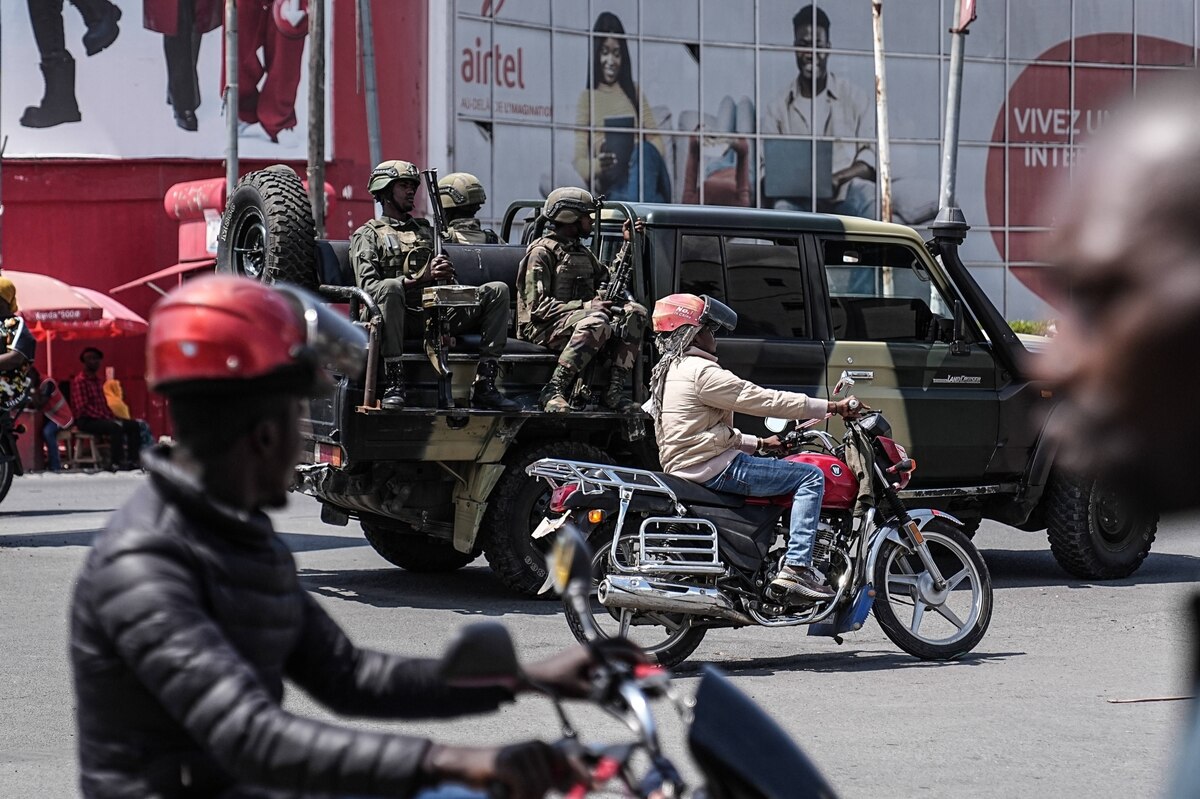
Then there are the M23 police in their blue uniforms; Not only do they look very similar to the Congolese police PNC, most of them are also officers of this same agency, integrated by the rebels after an “adjustment”.
Finally, at street intersections, the uniformed traffic police with their white armbands direct the traffic: their restraint is completely different from the constant harassment of the past, but they carry weapons of war. It is a normalization of militarization.
Much has been said about the involvement of the Rwandan army in the conquest of Goma. Today there is no visible or official Rwandan presence in the cityscape. Patrols and checks are carried out by the M23 and the police. The influence is expressed differently: the discipline, the tight command, the territorial control indicate that the M23 receives external support that is not visible, and this perception feeds the diffuse feeling in Goma that decisions are made elsewhere, that this city is not just governed from within the city, but Part of a regional balance of power is that is dedicated to its residents largely removed.
Forced loyalty
The M23 didn’t just occupy Goma. She rules. All authorities were replaced, from the provincial governor to the mayors to the traditional kings and village chiefs. Locally known people who were viewed as loyal were deployed after ideological cadre training.
The provincial governor of North Kivu is a Hutu from the ranks of the M23, his deputy a Tutsi from the Congolese diaspora in Canada – a surprise for a province that has been led by a member of the Nande ethnic group since the first gubernatorial election by the provincial parliament in 2006 was conducted. The police were similarly restructured.
The public employees remained at their posts – the teachers, doctors, nurses, water and electricity engineers. The M23 only took over the management levels. This partial continuity enables the continued functioning of state services, under close political control.
Very few people are really behind this project. But almost no one dares to say that. Open contradiction is risky. People are silent. They join in and accept positions, not out of conviction but out of necessity. To survive. To feed their families. Loyalty is forced.
External references are made to the improved security situation. In fact, crime has decreased in some neighborhoods. But the stabilization is fragile. Attacks and raids by local militias, now called Wazalendo, and Rwandan FDLR rebels on the highways, especially north towards Rutshuru and Butembo reached its peak before the conquest of Goma and initially largely disappeared after the M23 took over. But in recent months, some sections of the route have become dangerous again, although it remains unclear who is responsible. New uncertainty undermines the M23’s most important argument, namely its effectiveness in security matters.
State salaries are beyond the front line
The isolation of Goma from the sphere of influence of the Congolese government in the country is putting a great strain on the people. The airport is closed, which drastically limits travel – a big problem, especially for those who need specialized medical treatment. In addition, the central state in Kinshasa does not recognize travel documents issued by authorities under rebel control – and vice versa, which also extends to certain visas. Even if you overcome this hurdle, the lack of cash makes travel almost impossible.
Money is a daily headacheas Congolese banking does not operate in rebel territory. Government workers in Goma continue to be paid by the Congolese state, but to get their salaries they have to drive to Beni, 350 dangerous kilometers of road north, where the previous provincial government, which fled Goma, is based, and then back again.
Mobile payments are taking off, with very high commissions paid to informal traders. For larger transactions, some go to Gisenyi in Rwanda. The M23 manages its finances through the financial cooperative Cadeco, which it took over, but which has difficulty gaining the trust of the wider public.
There is plenty of food in the markets and prices have not skyrocketed. But imported goods have become rare – because of financial difficulties and also because when the city was taken, large companies were looted and many business people went into exile. Purchasing power has collapsed and taxes on retailers are high. The shelves are full, the customers are missing.
What is most depressing after a year is not the Gomas case itself. It’s the feeling that nothing is progressing. That the violent takeover of power becomes normalized over time. That the created facts simply continue.
Goma is alive – but survival does not mean consent. What I see every day is: You can just endure it.
Goma didn’t just fall. It falls further and further – into habituation, exhaustion, indifference.
Translated from French by Dominic Johnson. The author is known to the editorial team. He is Congolese and lives in Goma