

After the fighting of the past few days, there is another ceasefire agreement between the interim government in Damascus and the Kurdish-dominated Syrian Democratic Forces (SDF) in the northeast of the country. It should be valid for four days, according to a document published on Telegram by the Ministry of Defense in Damascus. The ceasefire “in all sectors of the Syrian Arab Army’s operations” is scheduled to begin from 8 p.m. local time on Tuesday.
The fighting beforehand was fierce. This is what footage from the night of Monday to Tuesday shows: Kurdish YPG units in retreat, triumphant fighters from the interim government, and Kurdish families fleeing in between. While the general of the military alliance of the Syrian Democratic Forces (SDF), Mazlum Abdi, negotiated in Damascus with interim President Ahmed al-Sharaa for five hours without results on Monday evening, the SDF collapsed on the front.
After the Islamist-influenced troops of the interim government had already taken the province of Deir al-Sor with its capital of the same name and the largest oil fields in Syria in the southeast almost without a fight on Monday, they also conquered Raqqa, the former stronghold of the so-called Islamic State on the Euphrates, after heavy fighting. Since then things have continued at high speed. During the night the government troops advanced on Kobanê.
They also advanced in the Hasakah area. The Al-Hol camp is also located there, where tens of thousands of family members of ex-members of the terrorist group “Islamic State” still live. They withdrew on Tuesday afternoon SDF returned from Camp al-Hol, which they had previously controlled. It is said on social networks that those living there then began to leave the camp. There are also reports that the SDF released them. Neither can be independently confirmed. The Defense Ministry in Damascus wrote on Telegram: They are ready to “take over the Al-Hol camp and all IS prisons in the region.”
Hoping for the core area
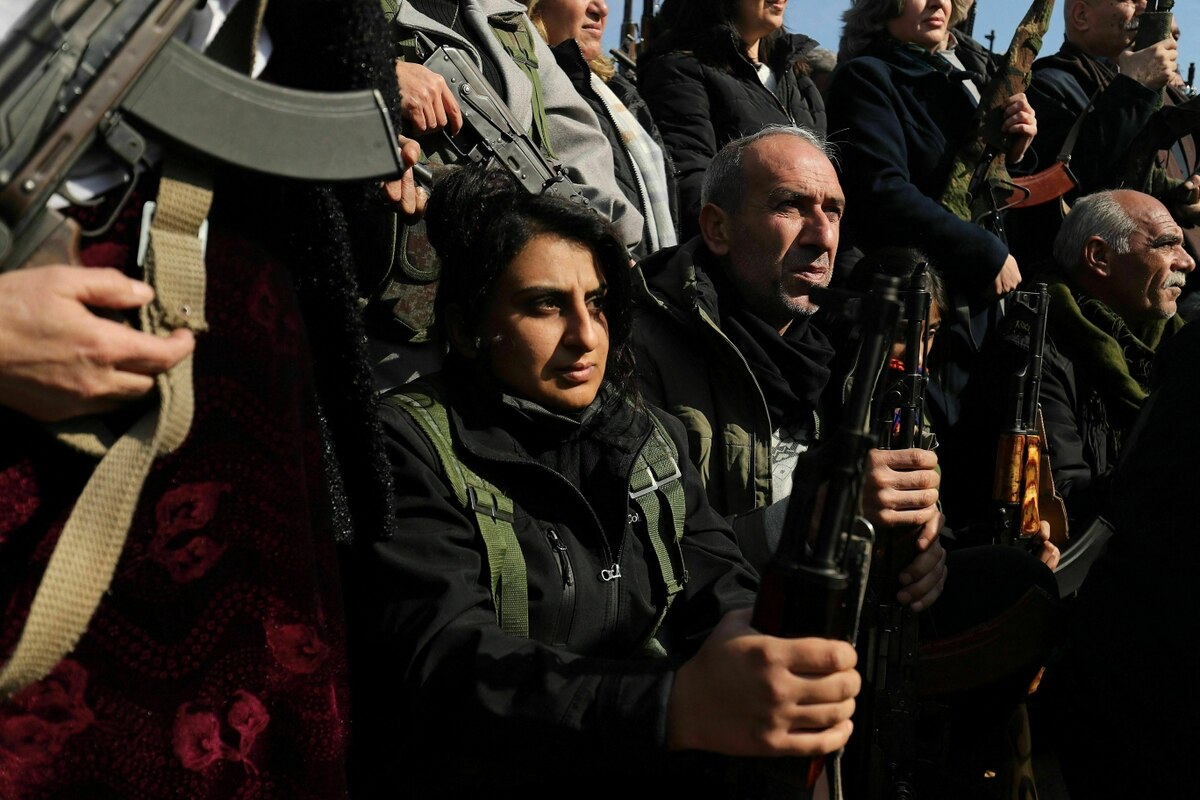
Now a ceasefire agreement has been declared again. But the government troops’ rapid gains in territory meant that the situation for the Kurds became increasingly precarious: in Hasakah, the seat of the Kurdish autonomous administration, Kurdish civilians were armed. And in a dramatic call, all young men who can fight were ordered to take up arms.
This was followed according to the Kurdish news agency ANF also hundreds who crossed the Turkish-Syrian border despite blockades by Turkish forces in Nisêbîn. Thousands of people had previously protested in the border town against the Syrian government’s war against the SDF – as well as in numerous other Kurdish places in Turkey.
Thousands of Kurds fled from government troops, for example in the direction of the cities of Qamishli and Amude. Ultimately, whether the SDF can defend these refuges against government troops will probably depend on US President Donald Trump, US Ambassador to Turkey and Syria Tom Barrack, and the remaining US troops in the region.
After all, the SDF was not least a creation of the USA: After the then US President Barack Obama came to the aid of Kurdish fighters in Kobanê against IS with his air force, the USA formed the powerful ground force from the Kurdish YPG militias and Arab associations, which also saw themselves threatened by IS. This ultimately defeated IS in Syria. The Kurdish self-governing region of Rojava emerged from the area that the SDF ultimately controlled.
Assad left the Kurds in their region largely alone during the war, so that they were able to expand their structures. The situation changed dramatically when the HTS militia managed to conquer Damascus and end Assad’s dictatorship in December 2024 under interim president Ahmad al-Sharaa – then called Abu Mohammad al-Jolani.
Erdoğan shares al-Sharaa’s goal
While the Kurds dreamed of at least as much autonomy as the Kurds have in northern Iraq, the interim government in Damascus wanted a unified, centrally run state with a new Syrian army in which all existing militias would be absorbed. This was massively supported by Turkey, which under no circumstances wanted to have an autonomous region on its border that was influenced by the Turkish Kurdish guerrilla PKK – a partner of the SDF.
The cooperation between Damascus and the Kurds initially raised hopes: in March 2025, al-Sharaa and SDF leader Mazlum Abdi signed an agreement that was intended to regulate the integration of the Kurds in the new Syria. Al-Sharaa promised the Kurds equal rights, the Kurdish language should be recognized, and schools and other cultural institutions should be maintained. To achieve this, the Kurdish militias should be integrated into the new army and SDF commanders should be given important positions in the army and in the Ministry of Defense.
But the Kurds did not want to implement this – also out of fear of the transitional government’s troops, some of whom are considered Islamist. They wanted to keep their civilian structures: their militias should join the army as three intact divisions and remain in their area. Damascus rejected this and Turkey put pressure on it to implement the agreement.
While al-Sharaa was on the world stage and reaching an agreement with Trump, the Kurds still believed they were under the protection of the US army. The Americans, on the other hand, urged the Kurds to come to an agreement with the interim government in Damascus and to accept the conditions of al-Sharaa. For US President Donald Trump, cooperation with al-Sharaa is more important than the fate of the Kurdish anti-IS fighters who are no longer needed.
Trump on the side of al-Sharaa
On Monday evening, al-Sharaa had his advance into the Kurdish areas secured by Trump on the phone. But Rojava failed not only because of the betrayal of the USA, but also because of its internal constitution. In Rojava, idealized by many leftists in the West, Arab residents felt oppressed and many quickly defected to government troops.
For the Kurds in Syria, the collapse of their military forces is dramatic. They are justifiably afraid of the transitional government’s fighters. The Kurdish agency Rudaw reports that Kurdish fighters were beheaded by the HTS in the style of IS, and videos of this are already circulating. Rudaw also reports on a call in Syrian mosques, where, on the instructions of the responsible minister, a call is made to fight against the “infidel” Kurds.
The collapse of Rojava is also shocking among Kurds in Turkey and northern Iraq: the co-chair of the Kurdish party DEM in Turkey, Tuncer Bakırhan, said in an interview that a peaceful agreement in Syria had been prevented “from outside”. The Kurds have now retreated to their “natural settlement areas”. The DEM is calling for mass protests, but most rallies have already been banned.
The PKK fighters remaining in Iraq have now been deprived of their last alternative to disarmament. You can no longer escape to Syria. The Kurds in Turkey want to continue peace talks with the Turkish government together with PKK founder Abdullah Öcalan. Even though many say that Turkish President Recep Tayyip Erdoğan cannot talk about peace in Ankara and at the same time wage war in Rojava, the DEM leaders see no alternative to continuing the talks.
The big winner from developments in Syria is Erdoğan. He got what he wanted for years: the destruction of Rojavano Kurdish autonomous area on the Turkish border and therefore no longer a role model for the Kurds in their own country.
Collaboration: Lisa Schneider, Lotte Laloire