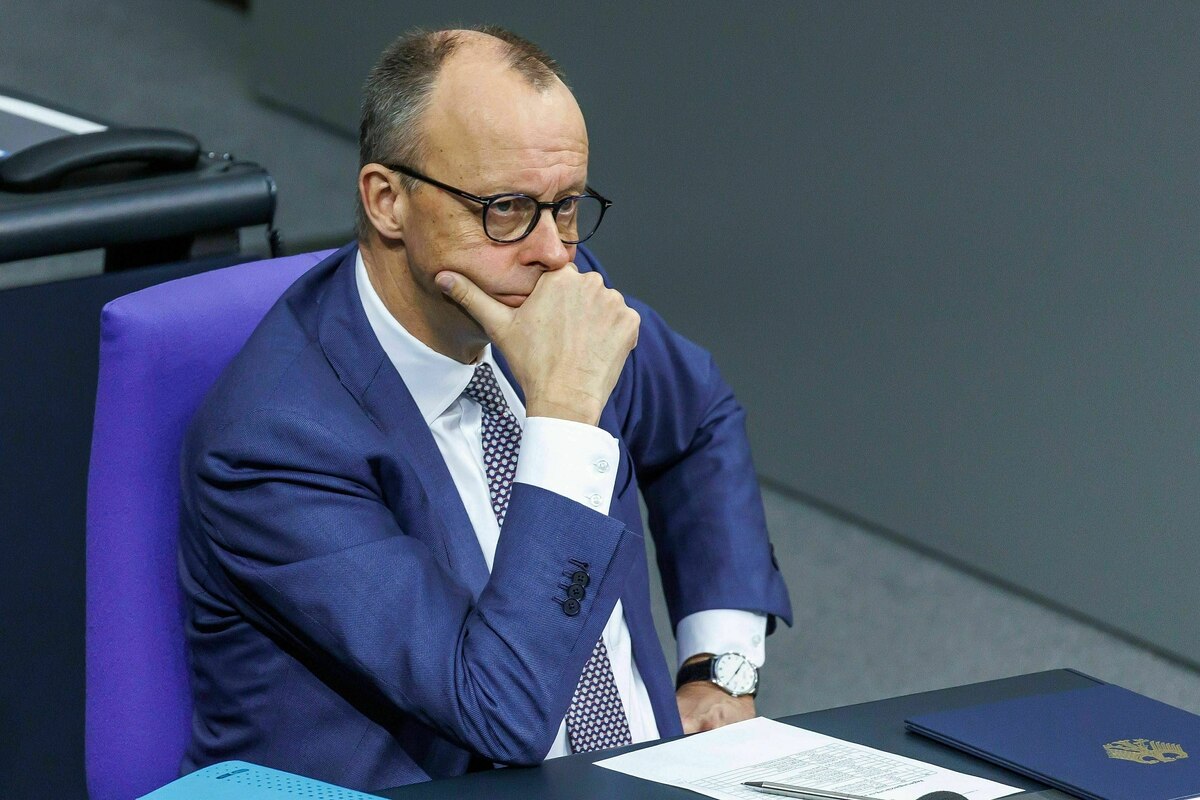
Friedrich Merz obviously wants to do two things in the Bundestag this Thursday morning: radiate the will for European strength – and confidence. “We have seen more and more clearly in the last few weeks that a world of great powers is beginning to emerge. A harsh wind is blowing in this world,” says the Chancellor at the beginning of his government statement on the foreign policy situation. But then he talks about the opportunities that arise from these changes.
About the determination and strength, which the European Union has just demonstrated – and had the effect. And he demands more political self-confidence from the EU.
In doing so, the Chancellor is shifting his own tone a little further: away from appeasement with regard to the Trump administration in the USA and towards European resistance. In the alliance with the USA it must be clear: “As democracies, we are partners and allies and not subordinates.”
The background to the government statement is US President Donald Trump’s announcements that he will annex Greenland, which belongs to Denmark – and the associated tariff threats against Germany and other European countries. This Trump has since dropped it again. One reason for this, and not just from the Chancellor’s point of view, is that the EU has previously signaled its willingness to take clear countermeasures.
Europe has something to offer
“The transatlantic alliance is still a value in itself today,” says Merz, briefly sounding like it did before. But this only fills a short passage in his speech. The focus is on the call to the EU – and therefore also to Germany itself – to show unity and self-confidence. “Only if we learn to speak the language of power politics ourselves, if we ourselves become a European power,” will Europe be able to enforce its ideas.
The current changes could also create opportunities for a Europe that operates on the basis of law and is committed to international cooperation. “We are also a normative alternative to imperialism and autocracy in the world,” says Merz. “We have something to offer our partners around the world economically and, above all, intellectually.” Europe can be a power, “particularly on the basis of the values that we do not want to give up”. Of course, the Chancellor does not say that Germany has recently lost a lot of trust in the world through its support of Israel.
Europe must take its security into its own hands and reduce dependencies in the technological areas and defense capabilities. The European economy must be made competitive. And Europe must appear united. “In these weeks we have been able to feel something of the happiness of self-respect,” says Merz. On the one hand, that sounds unusually pathetic. But this also shows how challenging, if not desperate, the situation is.
More clarity
Ukraine hardly played a role in Merz’s speech, criticized the Green parliamentary group leader Britta Haßelmann in the subsequent debate: “Mr. Chancellor, one sentence about Ukraine is not enough for me.” In the fourth winter of the war, people there often had to endure the bitter cold without heating. Haßelmann recalled that Merz, as opposition leader, had always called for more support for the attacked country. “More clarity” towards Trump is needed, Haßelmann continues. In the afternoon, a motion from the Greens will be discussed in the Bundestag.
Left-wing parliamentary group leader Sören Pellmann is also calling for a tougher approach towards the US President, whom he calls the “behavioral boor from the White House”. Pellmann also criticizes the numerous breaches of international law the USA in the past.
AfD parliamentary group leader Alice Weidel, however, says remarkably little about foreign policy. Instead: the well-known program from social abuse to nuclear power to “mass migration”. This is a foreign policy debate, she reminds SPD parliamentary group leader Matthias Miersch, who speaks after her. But the AfD is “blank” because it has “thrown itself at the dividers”.