

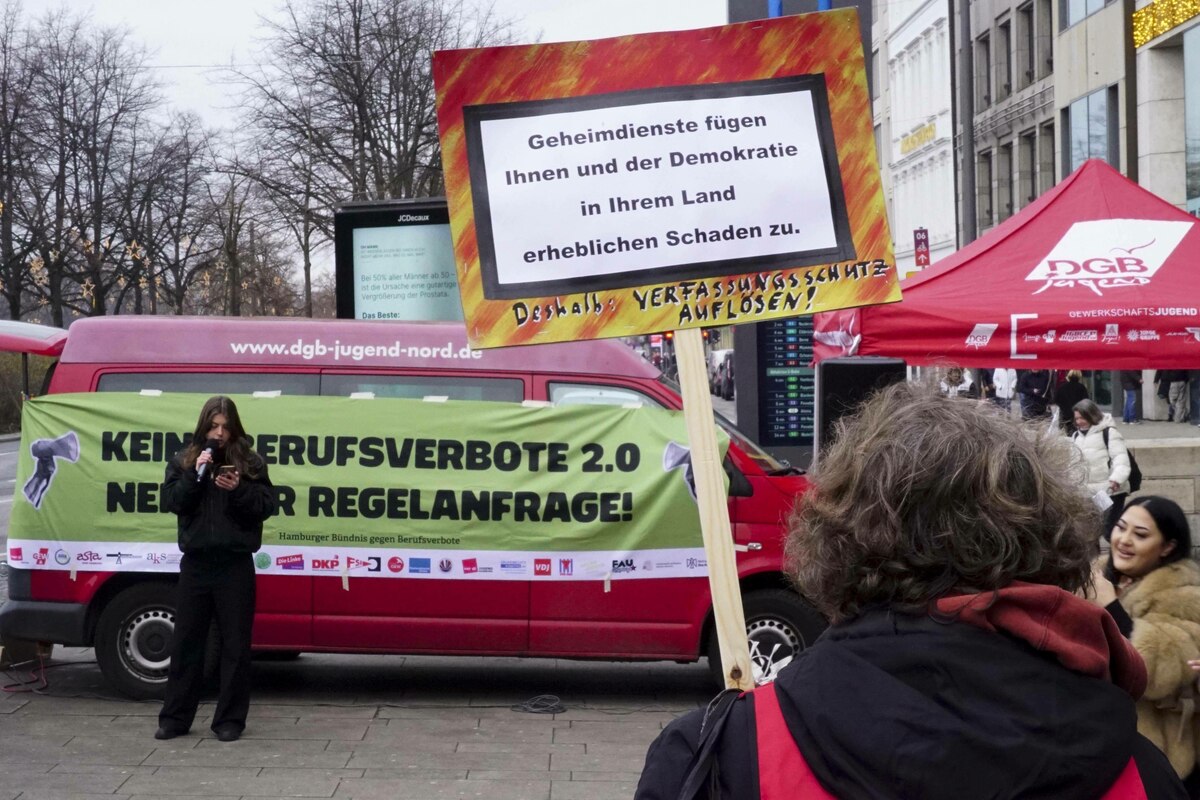
There is concern about the way Hamburg wants to protect its public services. As the taz reported, the city introduced a kind shortly before the end of the year Confession coercion a. Applicants must sign that they do not belong to any group mentioned in the Constitutional Protection Report. A lie, the statement says, could later lead to expulsion. On top of that, Hamburg is planning a standard inquiry for all applicants to the Office for the Protection of the Constitution.
“We are currently experiencing a revitalization of the idea of the radical decree,” warns Maximilian Pichl, chairman of the Association of Democratic Lawyers (VdJ). The lawyers criticize that the Office for the Protection of the Constitution is given too much power.
Specifically, prospective civil servants in Hamburg must now sign that they do not belong to any “group of people” that the Constitutional protection report mentioned. The employees are also instructed accordingly in a leaflet. A circular from the Human Resources Office states that the aim is to “sensitize people”. This also makes it easier to “separate yourself from staff”.
A list of groups was “consciously avoided” and instead there was a “non-exhaustive reference to the Office for the Protection of the Constitution report”. In this way, those affected received “indications as to which organizations are meant to be exemplary”.
“Initiation to snooping on attitudes”
But according to Pichl, that is “not a viable option”. This gives the authorities too much discretion as to who falls under this regulation. “This can be a deterrent for people who want to work in the public service,” fears Pichl. The Hamburg lawyer Gerhard Strate says it this way: “This is a return to the radical decree, which was abolished in 1979. The soft formulations give a strong impetus to snooping on opinions.”
The VdJ criticizes the fact that the reports for the protection of the constitution serve as a benchmark. They often treated organizations as objects of observation that pursue goals consistent with the constitution. “The reports are often based on the political status quo,” says Maximilian Pichl. For example, the suspicion of unconstitutionality is derived from anti-capitalist demands.
“The Basic Law is open in terms of economic policy,” says the legal scholar, who teaches at the Frankfurt University of Applied Sciences. This emerges from Articles 14 and 15 as well as case law. The Federal Constitutional Court made it clear that “the core issue is the guarantee of human dignity”.
The taz also showed the documents to Bremer Rolf Gössner. The journalist and lawyer says: “Basically, the information sheets and declarations cannot be objected to as far as rights and obligations are concerned.”
In Bavaria, the left-wing political anti-fascist involvement in the legal aid association ‘Red Help’ can become a problem because the Office for the Protection of the Constitution classifies it as left-wing extremist
Rolf Gössner, human rights activist
However, there is a lack of legal clarity here because the mere reference to the Office for the Protection of the Constitution is too vague. “So there should be a completed list,” says Gössner. “But then we have a problematic regulation like in Bavaria.”
Applicants would have to tick whether they are active in, were active in or support one of over 200 organizations or parties that are classified as extremist or influenced in this way. “The left-wing anti-fascist political commitment, for example in the legal aid association ‘Rote Hilfe’, can become a problem because the Office for the Protection of the Constitution classifies it as left-wing extremist.”
Gössner, who has been publishing the fundamental rights report for 20 years, considers the direct reference to the domestic secret service “Verfassungsschutz” to be a problem, especially since this itself must be considered a “problematic case of democracy” due to a lack of democratic transparency and control.
Ronald Prieß from Hamburg, who co-founded the “Tu was Hamburg” alliance as an “ambassador for street children,” has another concern. The leaflet for civil servants says that even “support” is not acceptable. Should cooperation with observed groups in alliances lead to professional bans again, as in the 1970s?
No obligation to denounce
“Is there a contact debt?” he asks. “Am I obliged to denounce?” Together with other tightening measures such as the threatened withdrawal of non-profit status for left-wing associations, something like this is putting a strain on civil society engagement in the city.
The taz asked whether applicants also have to specify alliance partners who are being monitored? The Senate replies that, in principle, “personal and immediate affiliation alone” is taken into account.
Rolf Gössner also points out that not everything that the Office for the Protection of the Constitution classifies as extremist actually is. He himself also became Observed by the Federal Office for the Protection of the Constitution for 38 years and complained about it when he found out about it.
“After 15 years, it was legally established that this ongoing investigation was contrary to fundamental rights from the start,” he says. “If I had tried for a job in the public service at that time, I would have been unfairly rejected.” This could happen again and again. “If Hamburg also has the law by law Rules request to the Office for the Protection of the Constitution “The danger will become even greater,” he warns.