

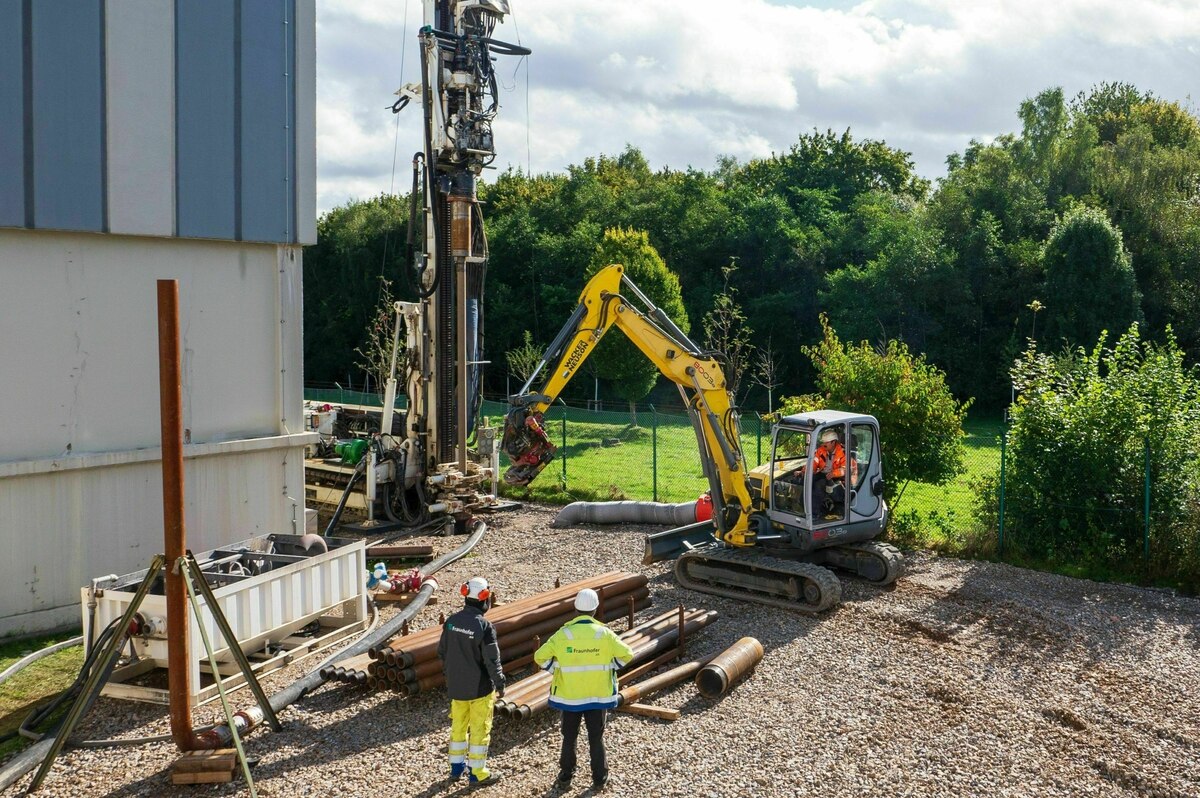
The narrow drilling tower rises almost five meters in height. Like a forgotten, oversized toy, it stands on the edge of the grounds of the Ruhr University in Bochum. Its drill head digs through the cold, wet underground bit by bit until it reaches a depth of 120 meters in a few days.
There is a shaft from the former Mansfeld colliery. Wearing a mud-spattered neon jacket, Stefan Klein runs past a bright yellow excavator to his colleagues at the drilling site. Were there any problems? Is everything going as planned? Now yes. At first the electricity wasn’t quite there.
Klein is a geoscientist and works for the Fraunhofer Institute for Energy Infrastructures and Geotechnologies (IEG). Mine Thermal Energy Storage, or MTES for short, is the name of the technology they are researching here. A pilot project. The goal: Old mines should become a kind of stone battery for heat. In summer they store warm energy to release it in winter.
A tangle of mines and shafts runs hundreds of kilometers beneath the Ruhr area, the extent of which even the mining authorities in North Rhine-Westphalia can only estimate. It assumes 60,000 entry points on the surface. Water has seeped into the cavities for decades through cracks and crevices. Reservoirs that the researchers now want to exploit.
There are two large chambers beneath the ground in the former Mansfeld mine near Bochum, 10,000 cubic meters, enough for four Olympic swimming pools. In spring 2026, the researchers want to test whether the chambers are connected, whether they are tight and whether there are currents. The first has already been researched, now the second follows.

This text comes from the weekday. Our weekly newspaper from the left! Every week, wochentaz is about the world as it is – and as it could be. A left-wing weekly newspaper with a voice, attitude and the special taz view of the world. New every Saturday at the kiosk and of course by subscription.
Like inside a marble cake
The ground above the shaft vibrates. A box-shaped machine, the separator, loudly separates the water washed out of the borehole from the rock. Geoscientist Klein leads to a small white container into which the researchers repeatedly bring samples of the drilling water.
He digs out oversized, laminated pieces of paper from a corner. “This cross section of the Bochum subsoil shows why hard coal regions are so suitable for MTES,” he explains. Like the inside of a marble cake, light and dark layers alternate: sandstone and claystone, 300 million years old.
Sandstone is naturally porous and has many hollow chambers, explains Klein. If you heat the mine water, it flows directly into the rock and heats it up. The fact that MTES works is due to the surrounding mudstone. This is a poor conductor of heat and thus insulates the heated sandstone.
The result is a kind of thermos flask made of rock that stores heat in summer and provides heat in winter. The location is secondary. The geological conditions where coal was mined are almost identical. Be it the Ruhr area, East Germany or Spain.

You are reading a text from our future department. If you want more positive perspectives, Subscribe to TEAM FUTUREthe constructive newsletter on climate, knowledge, utopias. Every Thursday you will receive an email from us with strong thoughts for you and the planet.
The heat dissipates unused
Klein puts the laminated pieces of paper away and steps out of the container into the icy cold despite the bright sun. His gaze wanders to a chimney in the background of the drilling site. Thick clouds of steam billow into the blue sky. “Do you see that?” he asks, pointing to the white clouds. “The combined heat and power plant at the front heats the entire campus,” explains Klein.
And in summer? “From here, cold water flows through a network of pipes across the campus and cools the lecture halls and laboratories. The water absorbs the heat.” The separator drones constantly as he speaks. He takes a break. “Heat that then dissipates unused.”
Every summer, Stefan Klein calculates, enough energy is lost to heat 480 unrenovated single-family homes. It is this heat that will be stored in the mine in the future in order to heat these lecture halls and laboratories in winter.
The MTES project is part of an international research community worth 20 million euros. Since 2018, researchers have been working on storing heat underground. In mines, away from mines – in Germany, the Czech Republic, Slovakia.
They model substrates, calculate and drill. According to their calculations, 500 terawatt hours could be achieved are stored in German mines – energy, which is rich for millions of householdst. At least in theory.
Summer surplus production could be stored deep underground and used in winter
Winter is the problem
Thomas Kohl, Professor of Geophysics at the Karlsruhe Institute of Technology, has been researching renewable energies for decades. His area of expertise is that Geothermal energywhen we humans take advantage of the heat of the Earth’s core. Yes, says Kohl, MTES has potential. More than that. The mines could help solve a crucial problem in the energy transition: winter.
The sun is high on this winter day Bochum. Only far above are the shadows of ice-cold cirrus clouds visible. But even though the sky is clear, the sun barely manages to melt the frozen dew from the blades of grass. The performance of solar energy collapses in winter, explains Thomas Kohl, the geophysicist. If the wind dies down in between, this can become a problem.
But from 2030 it has to at least a third of the heatused to heat German households comes from renewable sources. In 2024 it was just 18.1 percent. After a long start, sales of are now booming Heat pumps. But they need electricity, and the colder it is, the more. Especially when the sun produces less of it.
MTES, says geophysicist Thomas Kohl, could be a useful addition. Summer surplus production could be stored deep underground and used in winter. Underground boilers could be created that, combined with heat pumps, could supply entire neighborhoods.
In Scandinavia they work with similar technology
But is MTES actually suitable for district heating networks? It could safely heat individual buildings, but transport the heat through kilometers of pipes, like deep geothermal energy? If so, then probably only through heat storage, says Kohl.
He points out that water for district heating must be around 90 degrees Celsius. Without additional energy sources, this is a significant challenge. And heating water to a high degree using heat pumps is extremely energy-intensive. Electricity that would have to be produced from renewable energy for a sustainable solution.
In Scandinavia and the Netherlands they have been working with similar technology for a long time. Up to 30 degrees Celsius can be stored there in aquifers, groundwater reservoirs. Nothing more is currently possible, the technology simply doesn’t exist, and the water could also become contaminated.
Additionally, the geological constraints are greater than MTES. Stefan Klein and his Bochum colleagues want more: the mine should store around 85 degrees. Because they do not work with groundwater, the high temperatures in the mine are not a problem.
In order to advance the energy transition, say geophysicist Kohl and project manager Klein, MTES can only be a building block. However, in addition to the good underground conditions in the Ruhr area, coal has made the region one of the most densely populated in Germany.
Stored energy can therefore be used again within short distances. Ironically, the remnants of the coal age, which fueled global warming, could now be used there to combat the climate crisis.