

taz: You have on that 39. Chaos Communication Congress gave a lecture on knitting. How does this fit with one of the largest hacker meetings in the world?
Jacqueline Malchow: Knitting and programming are based on binary concepts in which information is broken down: 1 and 0 in coding, left and right while knitting. I can’t program myself, but some say: If you want to learn to code, learn to knit at the same time. And knitting also shows us that coding doesn’t have to be high-tech. Sometimes the simple solutions are the better ones for storing knowledge. The “Knitting Spies” smuggled information in the form of rope in Nazi-occupied France. These spies were usually not caught because textiles were not perceived as information material. Knit is not hackable, not dependent on electricity.
taz: What other advantages did knitting messages have besides hidden communication?
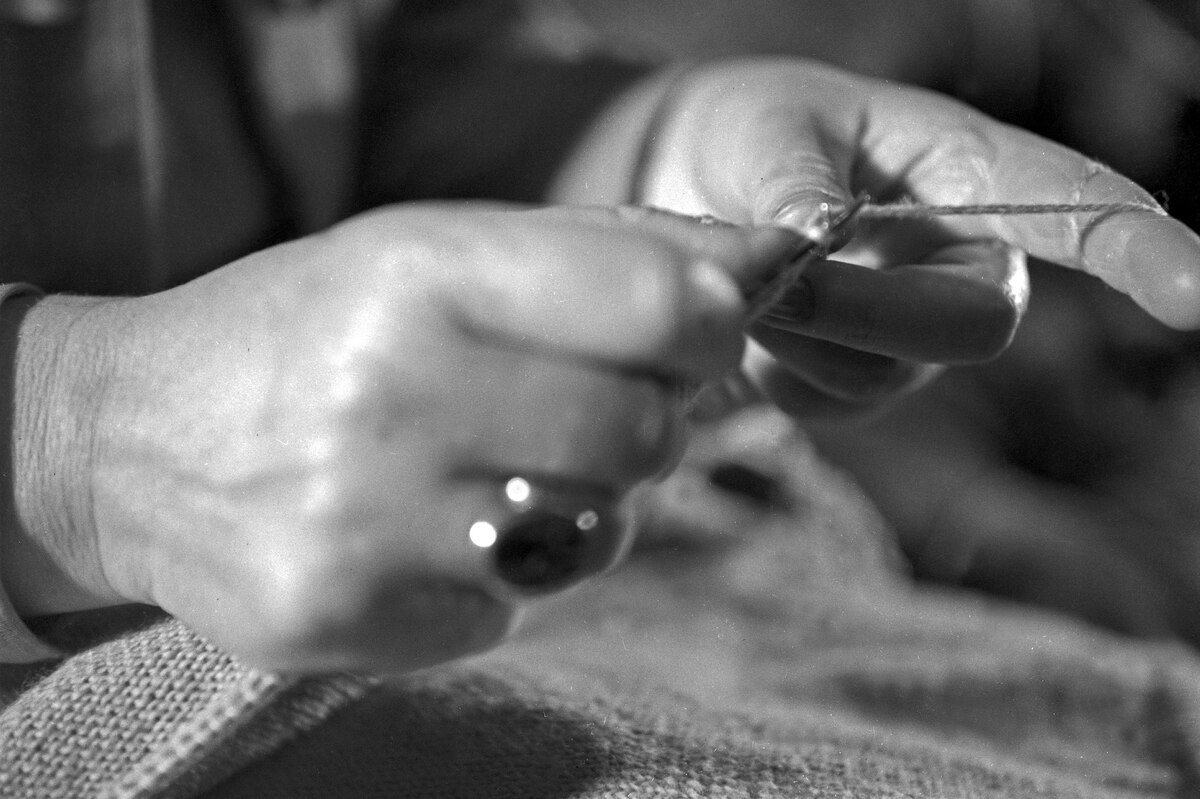
Malchow: Work with a feminine connotation has been and is constantly underestimated. Some stories are about old ladies who lived overlooking loading docks or train stations. They sat knitting at the window. Normally, a person sitting at the window all day watching the train station would be perceived as suspicious in a war situation. The person is holding knitting items in handit is perceived as harmless.

In the interview: Dr. Jacqueline Malchow
works as a historian in the museum. She studied English and history at the University of Hamburg, where she also received her doctorate. Her focus is on 18th century theater history, the history of marginalized groups and Nazi provenance research. Textile handcraft is a hobby that has accompanied her since early childhood.
taz: To what extent were these old ladies “dangerous”?
Malchow: For example, they communicated with certain pre-agreed codes on troop strengths. Then purl three times to create a raised strip or drop a stitch to create a hole. All of this was information. The result were somewhat wilder patterned scarves or socks that the women could pass on without arousing suspicion. Even if you suspect a code, only a few can crack it.
taz: What else did you notice when looking at the topic historically?
Malchow: In historical research – especially Western research – writing is primarily recognized as a source. This is incredibly snobby. Writing was a privilege. I work in historical museum areas in which stories are told and documented based on objects. Looking at the material level is important, especially if you want to tell marginalized stories. Textile objects tell the story of people who had no access to writing. There are many ways to share information without text. Even today there are enough areas in which this would be worthwhile.
taz: Which areas do you mean?
Malchow: People all over the world are currently having to find ways out of countries or systems. Information about this should ideally not be monitorable so that fascist authorities cannot see, change or trace it. The Underground Railroad already hid its clues in fabric. From the 1780s until the mid-19th century, this network helped people in what is now the United States when escaping from slavery. The paths are said to have been supported, among other things, by coded patterns in quilts. In addition, the escape routes were often braided into hairstyles. There is a story that the hair of enslaved people was braided by other people to show the way where to turn right and where to turn left. This was even brought up in the BBC series “Doctor Who” in a 2025 episode.
taz: Should private individuals in Germany also think about encoding information?
Malchow: If you look at where we are currently moving politically and how Chat control and new police laws are being discussed, then yes. Data protection and privacy are increasingly being addressed. All people should have the right to store and document information about themselves in a way that is not freely accessible. Anyone who is interested in coding or hiding information must not immediately be placed under general suspicion.
taz: Handwork is also good for your health.
Malchow: It has been medically proven that knitting and embroidery reduce cortisol levels and heart rate. Handwork has a similar effect to meditation and helps you process information. That’s why it’s so important for people who want to improve something in society: If they destroy themselves, then no one will be helped. Sit in the corner here for an hour and do whatever makes you happy, whether it’s gardening or textiles. If people who want to improve the world stay healthy and practice self-care, then that’s political.
taz: So handwork is also a remedy against sensory overload?
This is exactly why handcraft is becoming more popular again. We want to do things with our hands that are tangible and ultimately provide visible, wearable evidence of self-efficacy. When I sit in front of a screen, there is an output, but it cannot be touched. My most active crafting time was during my doctorate, when I wrote on the computer for twelve hours a day and didn’t feel like I had done anything afterwards. Afterwards, knitting and finishing something felt good.
taz: Many of those who had knitting with them at 39C3 took it out during your talk. How was that for you?
Malchow: So beautiful! I like to knit in public myself. Two of my research areas overlap: On the one hand, the feminine connotation of domesticity is an invention of the 18th century. This didn’t exist in this way before. I refuse to leave things that are connoted as feminine and domestic in this domesticity. I see it as a positive thing to see people doing handicrafts in public. I also sit in meetings with superiors and knit. If it bothers someone, they should say something. But so far I haven’t received any negative feedback. Instead, colleagues are now joining in. And other people say: I would like to try that.
taz: So it’s a unifying element even at work?
Malchow: Not just there. As soon as someone has a craft in their hand – and it doesn’t matter which one – and I sit down next to it with mine, we have a connection point. We can talk, but we don’t have to. We are visible anchors of calm for each other who, through our activities alone, give each other the feeling: Okay, we belong together, we are a community at that moment.