

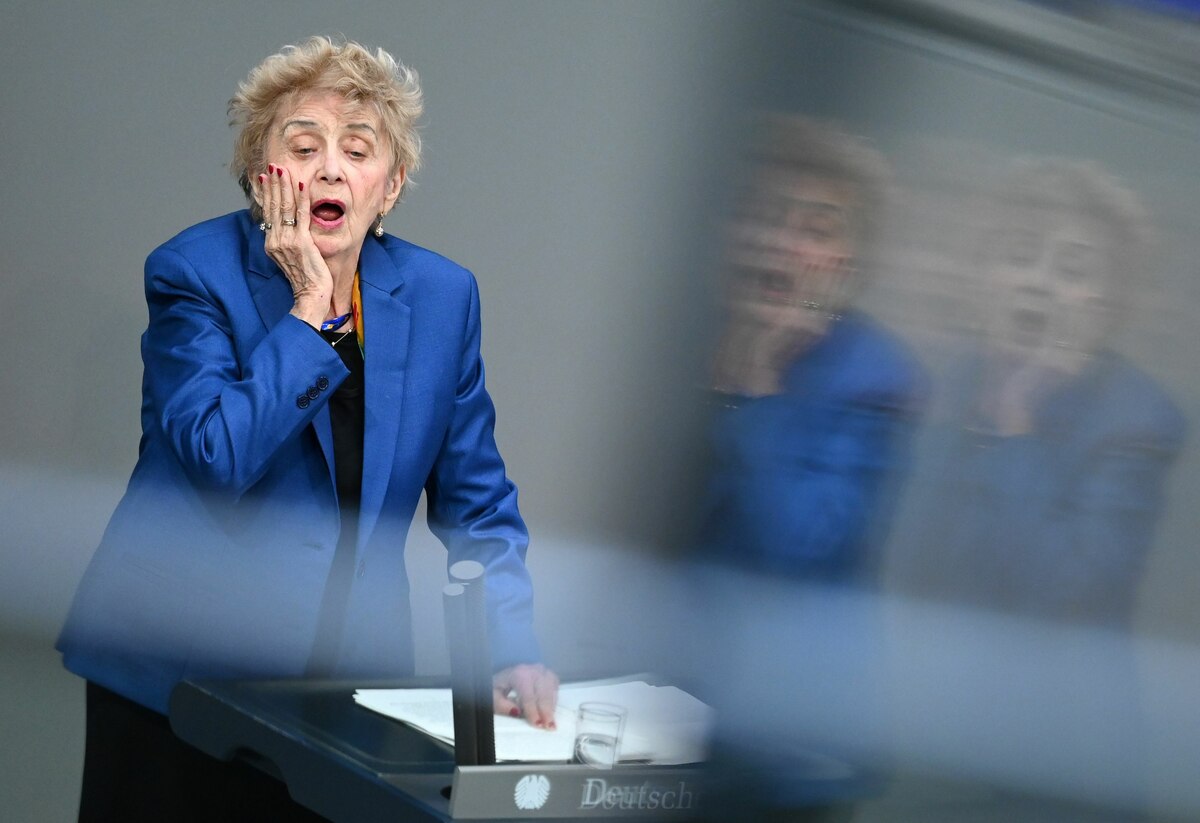
epd/kna | Holocaust survivor Tova Friedman has called for people to listen to contemporary witnesses of National Socialism while it is still possible. Friedman said on Wednesday in the Bundestag at the memorial hour for the victims of National Socialism that she was one of the dwindling number of survivors who could bear witness. The 87-year-old said she doesn’t do this to open wounds, but rather to prevent a loss of memory.
She was the child “that Hitler was afraid of,” she said. His motto was not to have any witnesses to the crimes. “I am your witness,” Friedman said in front of the heads of the constitutional bodies, MPs and many visitors in the parliamentary gallery. She wants to share a truth “that is painful but essential.” She urgently warned against current anti-Semitism. All previous efforts to combat it have not been enough, she said.
Friedman survived the Nazi concentration camp Auschwitzwhere she was deported as a five-year-old. The gas chamber was probably broken on the day she was to be murdered. She emigrated to the USA at the age of 12. Since 2021, Friedman and her 20-year-old grandson have been running a TikTok channel on which she explains the persecution of Jews by the Nazis and today’s anti-Semitism.
We would like to show you external content here. You decide whether you also want to see this element:

The day of remembrance for the victims of National Socialism was proclaimed in 1996 by then Federal President Roman Herzog and set for January 27th. It is the anniversary of the liberation of the Auschwitz extermination camp in 1945. 1.1 million people were murdered there alone.
Klöckner appeals in Migrant:inenn
At the start of the memorial hour, Bundestag President Julia Klöckner called for better protection of Jewish life in Germany. Any form of exclusion of Jewish life contradicts the essence of Germany. “Anyone who talks about reasons of state in this country must start at this point. It will not only be defended outside our borders,” said Klöckner.
To applause from the plenary session, Klöckner said: “Our reason of state begins on Berlin’s Sonnenallee, in front of the main synagogue in Munich, in the schoolyards, in the lecture halls, at X and at Tiktok.” It is evident in the protection of Jewish life in this country, in empathy and in the consistent action of the judiciary against anti-Semitic crimes. Things have also become more dangerous for Jews in Germany.
“Anyone who lives in Germany lives from the freedom and protection that the Basic Law offers. Anyone who has a German passport – whether from birth or through naturalization – must respect the framework of this order. It is not a suggestion of goodness. It is a categorical imperative,” said Klöckner.
With regard to people who have no roots in Germany, Klöckner said: “If it is supposed to be your country, it is also your story.” One must deal with the future of remembrance in a world without contemporary witnesses. “We have to find new ways to keep the memory alive.”