

taz: Mr. Karim (name changed; d. R.), as a homosexual you are threatened with threats in your home country of Iraq Jail and worse. Nevertheless, you should now be deported. How can that be?
Maher Karim: The authorities don’t believe me. I provided evidence of my homosexuality: a video and the images that were circulated of me. I told the authorities in Austria and Germany my story, but they still decided against me. Since 2024, homosexuality has been prosecuted in Iraq. When I return, my life will not only be in acute danger again. I also face up to 15 years in prison. A few days ago I found out that an arrest warrant and a judgment in absentia had been issued against me in Iraq.
taz: What does it do to you to have to prove your sexual orientation?
Maher Karim: When I am asked to prove my sexual orientation, I find it very painful and hurtful. Sexual orientation is not something that can be proven with documents, photos or stereotypical behavior, but rather an internal part of one’s own identity. This demand makes me feel like I’m under suspicion and have to justify something I didn’t choose. For me this means a psychological return to the experiences from which I fled. At the time I was forced to hide out of fear. Instead of experiencing protection, in moments like this I feel forced to reveal the most intimate part of my life to strangers in order to be seen as credible.
Im Interview: Mahar Karim
Mahar Karim (last name changed by the editors), 22, fled Iraq in 2021 because he was threatened and tortured there because of his sexual orientation. He reached Germany in 2024 via Austria, where his asylum application was rejected. Here too, his asylum application was unsuccessful; he is now threatened with deportation.
taz: Were you treated differently by the authorities because of your sexual orientation?
Maher Karim: I can’t say that all the staff or judges treated me badly. I have also experienced understanding and respectful people. However, in some situations I had the impression that my sexual orientation was not considered a serious reason to flee, but rather as a personal detail. At times the focus was more on testing my credibility than on protecting and understanding my situation. This constant feeling of having to prove one’s own fear was very psychologically stressful for me, especially after everything I had experienced.
taz: What do you mean?
Maher Karim: I come from Anbar Province in Iraq. I attended school there and then began training to become a nurse. However, I had to stop because my life was in danger in Iraq since people found out that I was homosexual. My family has cut off contact with me because they believe I have violated our religion and tribal tradition. I was persecuted and tortured. In the region where I lived, two people had already been killed and I was afraid of being the third. With the help of friends, I fled because I wanted to free myself from fear and go to a place where I could lead a normal life. I looked for this place first in Austria and then in Germany.
taz: And the accommodation in Eisenhüttenstadt where you currently live is not such a place?
Maher Karim: The accommodation feels like a prison. I am not allowed to leave the home for more than 24 hours. If I do so, I risk losing my room and having problems with my papers. In general, we constantly suffer from this pressure and uncertainty about our status. People regularly disappear because they leave the country voluntarily, flee, are deported or moved to other accommodation. Some people are only here for a few weeks, others for many months. We don’t know what the selection criteria look like and what the reasons are for the length of stay. This psychological warfare is making us sick.
taz: What do you mean?
Maher Karim: I suffer from depression, suicidal thoughts and PTSD. I have no appetite, can hardly sleep, have panic attacks and am constantly afraid. When I’m away from the home I feel a little better, but as soon as I come back everything is back. I feel like I’m completely isolated here. The camp doctor recommended that I get psychological care, but the process is very complicated. I wanted an appointment with the doctor at the camp to change medications and it took 4 months to get that appointment. In Berlin I found a psychologist who wanted to treat me, but the immigration authorities refused to cover the costs for a long time. It was only in court that my lawyer was able to get me paid for the treatment.
taz: Were there times or moments in Germany that gave you strength?
Maher Karim: Yes, there were. These are the moments where I am taken seriously and people try to really understand my story. I was in church asylum for a few months in the middle of this year. That was the best time in Germany. For me, the church was a place of security where I was not afraid of deportation and rejection. I will never forget how they told me: No matter where you come from, we will help you and be on your side.
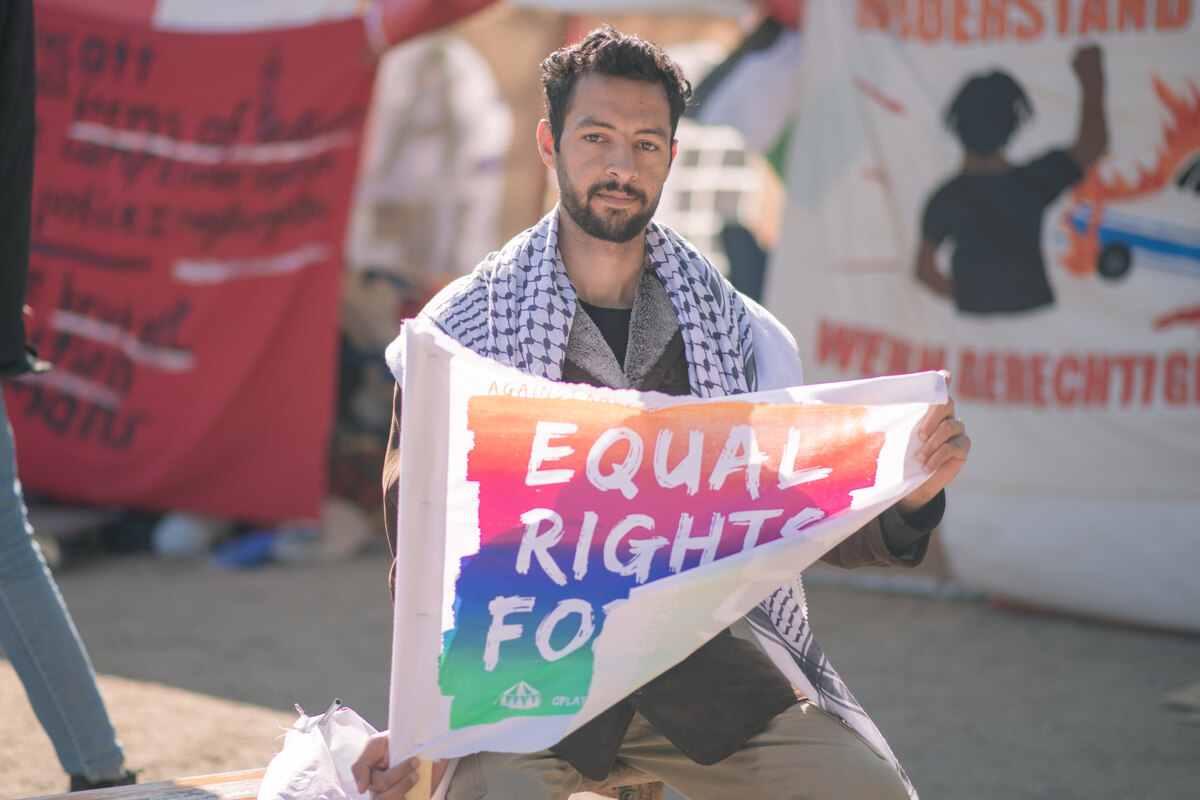
I also took part in the Caravan for Freedom of Movement organized by the We’llcome United initiative. There we were given the microphone at rallies in Berlin and Eisenhüttenstadt, for example, to tell our story and talk about our rights. This way we can show people what the word “refugee” means. It made me proud to speak there and I was happy that people care about our problems.
taz: How has your perception of Germany changed since you’ve been here?
Maher Karim: I didn’t expect it to be so difficult here. I thought they would treat my case humanely, but I’m being treated like a number in a file. I hoped that I could free myself from fear, but I have been living in fear for four years. My mental health has actually gotten worse. I ask for help and that my case be taken seriously.
I didn’t come to Germany to have a better standard of living, but because my life was in danger. I still love the same and that’s why there are no prospects for me in Iraq. My wish is to live a normal life without fear and without having to fight all the time. I want to finish my training and work as a nurse. I want to be a person who does good for the country and actively participates in society. These wishes are not exaggerated.