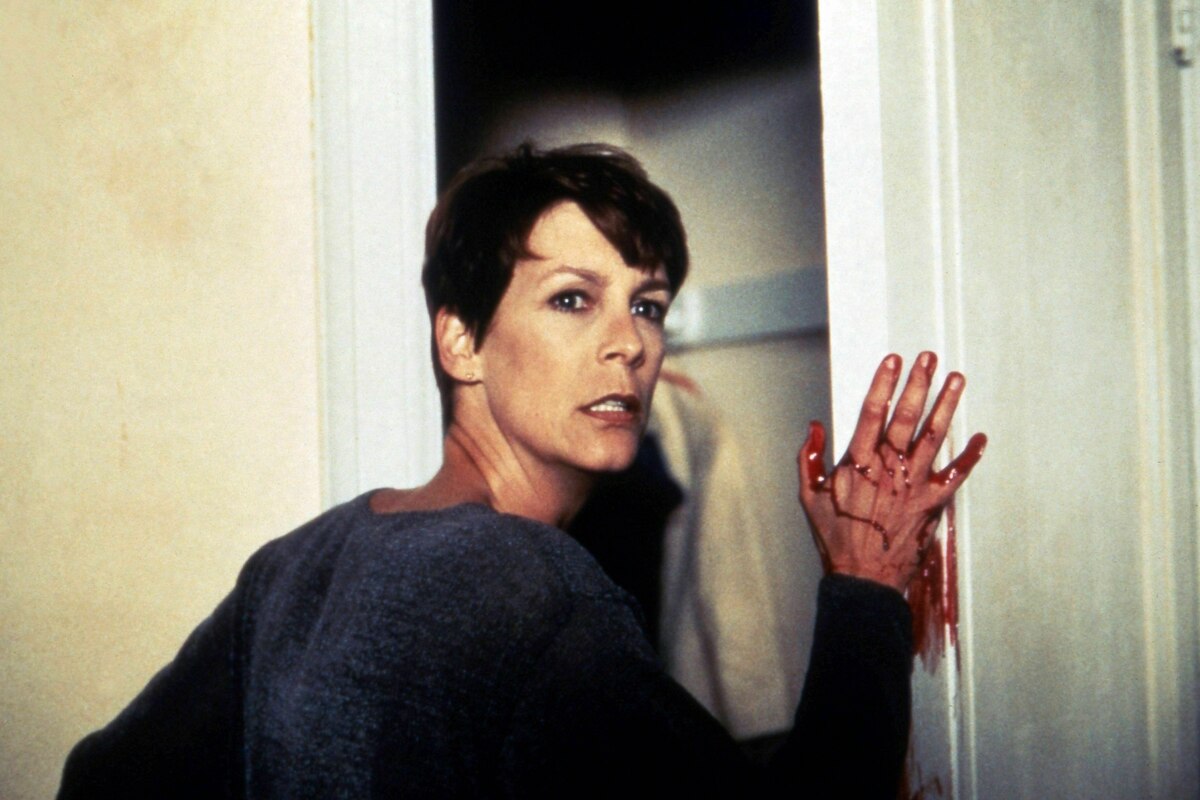
US horror cinema, which had previously been quite juicy, jumped to the meta level in the 1990s. Suddenly, slasher films that had previously been scorned or demonized by critics as moronic teen slaughterfests were feature material. The “Scream” franchise, “Halloween H20” and the more serious “In the Mouth of Madness” quoted from the history of their own genre, became self-reflexive and spoke of horror storytelling itself.
The best self-reflexive horror films did both, postmodern lightness, which addressed pop culture knowledge and connoisseurship, and popular horror film emotions, wailing and gnashing of teeth.
British horror author Josh Winning follows this tradition of self-reflexive horror in his third novel, “Burn the Negative.” The plot is as plausible as a slasher plot has to be, so not particularly.
Josh Winning: “Burn the negative.” Translated from English by Stefan Lux. Suhrkamp Verlag, Berlin 2025, 374 pages, 18 euros
Journalist Laura Warren travels to Los Angeles to report on the reboot of a 1990s horror film that is now being remade as a series. The film “The Guesthouse” has a cult following and is believed to be cursed after eight people who worked on the production died. Back then, Laura played the lead role in “The Guesthouse” as a budding child star. As soon as she arrives, a man throws himself off a highway bridge.
Clues to the perpetrator
The deaths on site increase, the director burns to death, the leading actress is murdered, and Laura is always nearby. Winning constantly gives clues that could make one character the perpetrator. Laura’s sister Amy, who is already in LA, wanted to be an actress all her life and didn’t make it. In the slasher genre, this is enough of a motive to become a serial killer.
The medium Beverly is inscrutable and once botched an exorcism with fatal results. The author who wrote the first screenplay for “The Guesthouse” and whose name is not mentioned in the credits. And of course Laura herself, who suffers from blackouts and shows clear signs of post-traumatic stress disorder.
Laura, Beverly and Amy rush from chapter to chapter and from station to station. You can read “Burn the Negative” in three ways, and if one of them doesn’t work, it’s still fun enough: first as a horror nerd who reads a text that builds a universe designated as a genre universe and which you can check for references, allusions and lines of tradition. Then as a crime thriller, as a whodunit story, with more or less convincing twists. And then as the story of a woman traumatized as a child who tries to find the origin of her suffering and thus a solution to her own drama.
The structure of the whole thing is borrowed from the films from the peak of the second wave of slashers in the 1980s. Something has always disappeared behind the spectacular death scenes, namely that many of these films – “Terror Train”, “Happy Birthday to Me”, “Sleepaway Camp” or “My Bloody Valentine” – actually had a classic, if sometimes very stupid, whodunit crime plot.
The idea of a cursed film whose monsters spill over into reality is taken from “Wes Craven’s New Nightmare” from 1994, in which the later “Scream” director Wes Craven took his own franchise to the meta level with serious irony in the seventh part. The undead serial killer who haunted and killed the children of Elm Street in their dreams in the first six parts is now on the rampage in reality and begins to terrorize the star of parts one and three, Heather Langenkamp (played by Heather Langenkamp).
There are also a lot of references to “Psycho”, to “I Know What You Did Last Summer”, to “I Still Know What You Did Last Summer” and to all slasher films that have identified trauma as the origin of violence.
Slasher motifs from film
With this joyful self-reflexivity, Josh Winning and his four novels to date are in line with authors such as Adam Cesare and Stephen Graham Jones, who transfer slasher motifs from film into their texts in a very informed, playful and at the same time serious and humorous way. A mini-trend that is also reflected in the list of awards from the most important literary prize for horror, the Bram Stoker Award. Jones received an award in 2021 for “My Heart Is a Chainsaw”, Adam Cesare in 2020 for “Clown in a Cornfield”. “Burn the Negative” was nominated in 2025.
Like any successful self-reflective Horror However, Josh Winning’s novel does not exhaust itself in self-reflexivity, but rather takes its characters seriously enough to ultimately tell something that goes beyond the genre. The trauma story is psychologically coherent and very touching in its drastic resolution, which is not exactly one. With Josh Winning, meta-levels, genre knowledge and self-reflexivity are not just games, but opportunities to take the horror genre seriously as a medium for a dark perception of the world.