

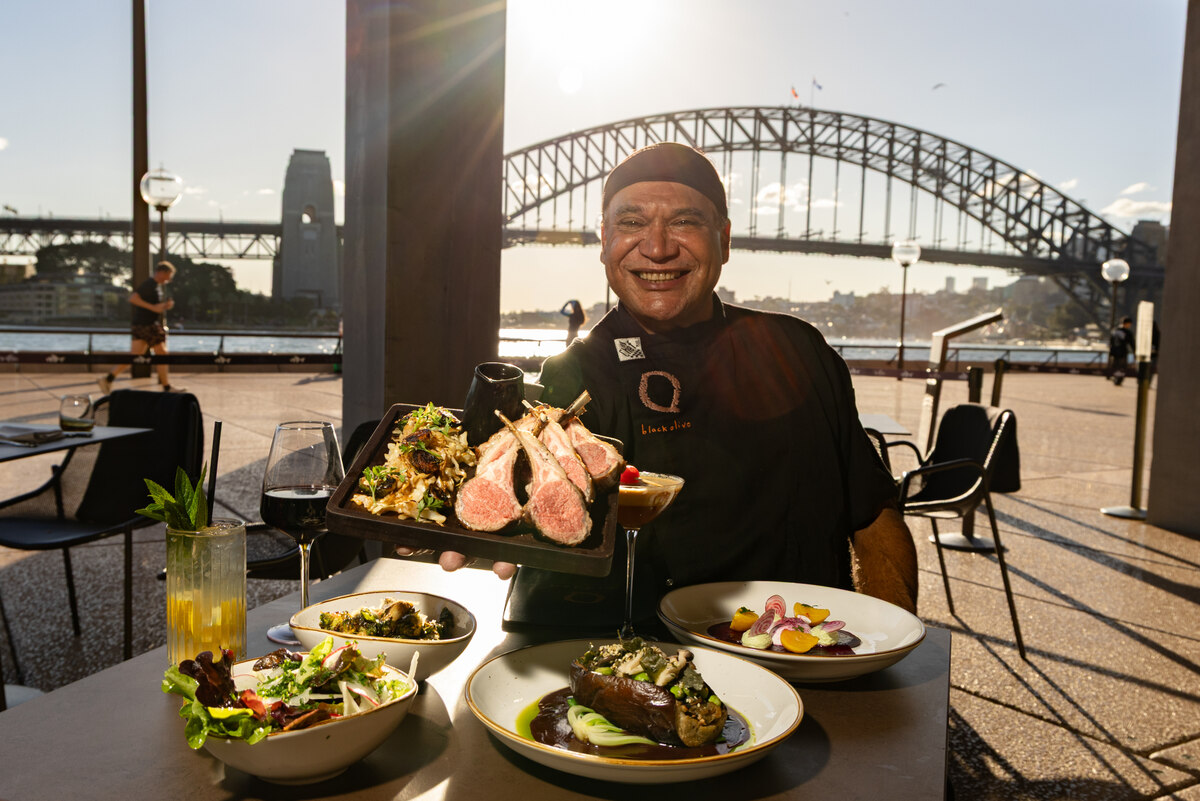
Orchestra rehearsal in the Sydney Opera House, the finale of Wagner’s “Twilight of the Gods” can be heard in the concert hall. At the same time, in the same building, a cook puts a rack of lamb into a hot pan. He is standing in the Midden restaurant and something special is happening at his stove.
For the high-quality cut of meat, which in Australia is usually covered in a sticky, slightly sweet peppermint sauce in the British tradition, the chef uses a native variety of mint known as river mint. “It’s an herb that we indigenous people have used for thousands of years,” says Mark Olive. He is the owner of the restaurant and Australia’s best-known Indigenous chef.
The Midden is the spearhead of a culinary revolution. And Mark Olive is largely responsible for the fact that Australian restaurants are increasingly using so-called “bush foods” in their menus – desert fruits, plants and animals, who have been Aboriginal for 65,000 years have fed.
With a starched shirt
Mark Olive has been interested in cooking since he was a child. He watched his mother and aunt baking and frying, he says: “I was completely fascinated by how dough could become a hot, steaming cake.” Olive later turned his passion into a career. “I had a classical education, in the French and German traditions, complete with starched shirt and tie and 16-hour days in the kitchen.”
This path was not easy for him as an Aboriginal. “Yes, racism was of course also a topic in my training,” says Olive. However, he was “lucky to have been raised by strong women.” These taught him “to ignore racists and to turn his back on them.”
From the veranda of his restaurant on the west side of the opera house with its spectacular white sail roofs, Mark Olive looks towards the harbor bridge. There was already a port here at the time of Great Britain’s invasion of the Australian continent in 1788. It was a real manger, says Olive.
The British convicts and their guards were impressed by what the country had to offer the indigenous people. “Whether fruits, seeds, seafood or other protein-rich foods” – everything was available back then, where the city center with its skyscrapers is today. And the peninsula on which the opera house stands was a place for gathering, for exchange and, above all, for eating, says Olive.
Science confirms this. During excavations for the opera house’s foundation, archaeologists discovered ten-meter-deep layers of shells, discarded over 10,000 years ago by the harbor’s indigenous inhabitants. In Australia, such a prehistoric rubbish dump is called “Midden”.
The name for Mark Olive’s restaurant was thus given. Today, the top chef serves people from all over the world at this location, “what makes Australia so unique in terms of cuisine”. Dishes in which he uses spices and other ingredients that have been used since time immemorial. Like macadamia nuts – buttery and versatile, in salads, in desserts or embedded in the crust for the local barramundi fish. Or lemon myrtle with its intense citrus aroma in marinades or jams. Then of course Wattleseed, the seeds of two types of acacia tree, which with their nutty-chocolaty taste are ideal for making bread and ice cream.
Kangaroo in the cooking pot
Another wild herb is saltbush, perfect as an accompaniment to meat or fish, as is the pepperberry. And finally kangaroo, Emu and crocodile. “These are lean, healthy proteins. They have been part of the indigenous diet for thousands of years. We should be eating a lot more of them,” says Mark Olive. He dreams of a future in which… The kangaroo fillet has replaced the beef steak as the favorite in the kitchen.
It’s been a long battle to make bush foods palatable to Australians, says Olive. For much of Australia’s modern history they were invisible in the kitchen; the colonial economy relied on wheat, sheep and cattle. But in recent years the focus has shifted. Today, bush food delights the palates of many adventurous eaters and is growing rapidly. According to an industry report from 2022, sales were the equivalent of over 44 million euros per year. Forecasts assume that the market could reach around 350 million euros by the mid-2030s.
Exports of the Kakadu plum alone are growing strongly, driven by global interest in natural health products. Distilleries are experimenting with finger lime and pepperberry, breweries are experimenting with Wattleseed beers, snack manufacturers are developing macadamia saltbush chips. Supermarkets are also following suit: kangaroo sausages, Davidson plum jam and lemon myrtle tea make the flavors of the bush available to everyone on the shelves of major retailers. Even Aldi Australia has such products on offer.
But bush food is more than just a culinary trend. It reflects a desire to connect with one’s land, celebrate Indigenous knowledge and develop cuisine that is unmistakably Australian.
In addition to Mark Olive, there are other chefs who have enthusiastically dedicated themselves to indigenous cuisine. Jock Zonfrillo, who died in 2023, developed entire menus in his restaurant Orana in Adelaide around indigenous products that were sourced directly from Aborigines.
Six seasons
In Melbourne, Ben Shewry serves dishes such as emule liver parfait with wild herbs at Attica; in Perth, the Wildflower restaurant celebrates the six seasons of the Western Australian Noongar Aboriginals with menus that are based on the ecological knowledge of the indigenous people. And Kylie Kwong used Davidson plums and Warrigal greens (“New Zealand spinach”) in Asian-Australian dishes at her now-closed restaurant.
At the heart of this movement is the recognition that indigenous peoples have preserved knowledge of food – in the case of Australia, for tens of thousands of years. Many plants require careful harvesting and processing; some are poisonous when raw. In addition, stories and cultural meanings are closely linked to the food. Organizations such as the First Nations Bushfood & Botanical Alliance Australia provide guidelines for fair trade and protection of cultural rights.
In recent years, numerous collaborations have also emerged between chefs, indigenous collectors and companies. The Kakadu plum harvest in the Northern Territory generates income while supporting the biodiversity of the landscape. Such partnerships ensure that growing demand also benefits indigenous communities.

This text comes from the weekday. Our weekly newspaper from the left! Every week, wochentaz is about the world as it is – and as it could be. A left-wing weekly newspaper with a voice, attitude and the special taz view of the world. New every Saturday at the kiosk and of course by subscription.
And native plants have another crucial advantage over introduced species in Australia: they are perfectly adapted to an often harsh climate. Many vegetables and fruits are drought-resistant, require less fertilizer and even fight pests themselves. Warrigal greens, for example, thrive on nutrient-poor sandy soils that can hardly be used for agriculture, while saltbush grows on salty subsoil. Given the escalating consequences of climate change in Australia Such characteristics are likely to play a key role in the development of more sustainable agriculture in the near future.
The fact that the menus of the future will include pizza with bush tomatoes, wattleseed lattes, pavlovas with finger lime pearls or lamb with pepperberry is very positive, says Mark Olive. Because every bite connects guests with the oldest living culture in the world. The chef calls on his professional colleagues, who still think traditionally, to use indigenous products wherever possible and warns against too much restraint at the stove. “A rack of lamb with native river mint only becomes a quintessentially Australian experience if the chef doesn’t skimp on the spice.”