

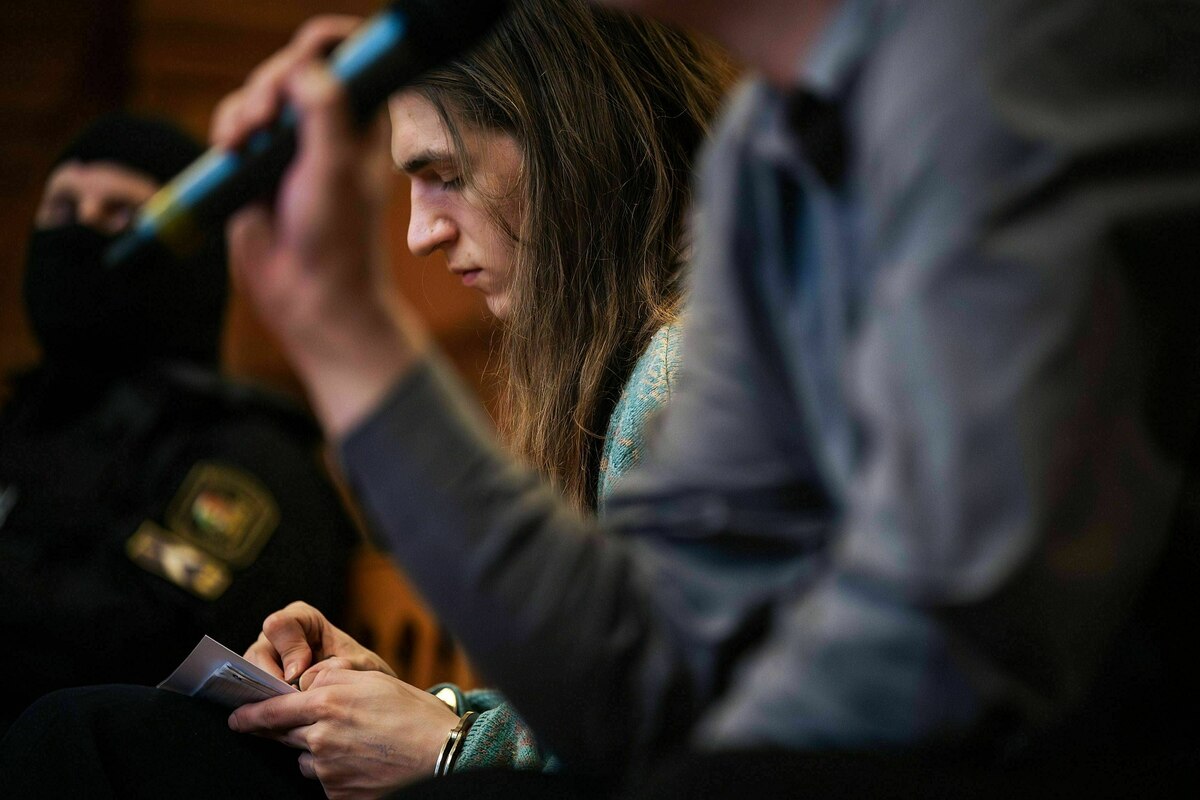
On Thursday, Maja T. was led in handcuffs and on a leash by masked security forces into the expansive Hall 36 of the Budapest Regional Court, which was hung with chandeliers. Just like on the 15 days of the trial before. The non-binary anti-fascist, 25 years old, wears her hair down and wears a knitted sweater, looks exhausted – but smiles at the parents, siblings and friends sitting on the audience benches. And they smile and wave back.
It is one of Maja T.’s last appearances in this process, which has been running in Budapest for a year and attracted international attention. Up to 24 years in prison are possible. The verdict is expected to be handed down on February 4th, and pleadings began this week.
The prosecution accuses Maja T. of being involved in two of five attacks on participants in the “Day of Honor” in Budapest in February 2023 – an annual neo-Nazi folklore event with participants from all over Europe. The attacks were always carried out by a group, masked, with batons and sometimes rubber hammers. Some of those attacked were seriously injured, suffering lacerations and broken bones.
But was Maja T. really there? The public prosecutor is convinced of this. In her plea on Monday she spoke of an “unprecedented series of attacks”. It was only by chance that no more serious injuries occurred. She calls for a high sentence as a deterrent and points to a possible 24 years in prison. At the beginning of the trial, Maja T. rejected an offer: 14 years in prison in return for a confession.
The Thuringian has so far remained silent about whether Maja T. was actually involved in the attacks in Budapest – including on Thursday. The trial failed to resolve the issue. The public prosecutor’s office points to video images and rented accommodation that prove that Maja T. was in the city with other German leftists at the time of the crime. According to the prosecution, this group belonged to “Antifa Ost”, an organization around the Leipziger Johann G.who carried out similar attacks. G. is also said to have been in Budapest. In addition, Maja T. and the others moved around the city “conspiratorially,” masked and equipped with disposable cell phones.
But neither the attacked right-wing extremists nor video images could identify the attackers. However, the public prosecutor’s office explained that even as an accomplice, Maja T. was part of the group of attackers, which ruled out a reduction in the sentence.
Maja T’s defense attorney, Tamás Bajáky, called for an acquittal on Thursday. There is no evidence that Maja T. was involved in the attacks, he emphasizes. The connection to Johann G. is also not proven, nor is the reason for Maja T’s stay in Budapest. The public prosecutor’s office is making allegations that have not been proven. Maja T. is being made into a “main protagonist” from a peripheral figure in Budapest simply because she is the only person on trial for the attacks in Hungary, said Bajáky.
After the attacks in February 2023, the police in Budapest Two Berlin leftists, Tobias E. and Anna M., and an Italian woman were arrested on site. These arrests and images from surveillance cameras led to a search for Maja T. and other German leftists. In December 2023, Saxon investigators arrested Maja T. in Berlin. Six months later she was extradited to Hungary – illegally, as the Federal Constitutional Court later ruled. The prison conditions for non-binary people in Hungary have not been sufficiently examined.
In fact, Maja T. then sat in solitary confinement in Budapest, complaining about the isolation, bad food, cockroaches, lack of light, and sleep deprivation. Last summer, T. went on a hunger strike for 40 days, which brought only minimal improvements. The taz visited Maja T. in prison and reported about it.
On Thursday, defense attorney Bajáky once again criticized the illegal extradition and the miserable prison conditions. There was also no fair procedure: exculpatory points were not taken into account and only a few documents were translated into German. Even when Maja T. was on hunger strike, negotiations continued.
And Bajáky has a video of the first attack shown again in court, in which, according to the public prosecutor, Maja T. is said to be a person with a red hat. But the photos only show her at the edge, not striking. Accurate identification never took place, complains Bajáky. The second attack is even more unclear. There are no videos of this. The right-wing extremists attacked there were also unable to describe the perpetrators. Nevertheless, the prosecution attributes Maja T. to the group of attackers, criticizes Bajáky. “It’s not coherent.”
And the defense attorney for co-accused Berliner Anna M. is also demanding an acquittal for his client. The trial also received little public attention against her and the Italian Gabriele M., but against both of them in absentia because they are in Germany and Italy – which is possible under Hungarian law. Anna M. was released after her arrest in Budapest in February 2023 and then traveled to Germany. The second Berliner arrested at the time, Tobias E., was already convicted in Hungary and was imprisoned there for two years – and now stands in court in Dresden because of further allegations.
Hungary recently tightened its measures against Antifa again
He and Anna M. are not accused of attacks in Hungary, but only of membership in a criminal organization. Anna M.’s lawyer explains in his plea that this association did not even exist, so there must be an acquittal for Anna M.. The public prosecutor’s office, however, is also demanding a prison sentence of several years for her.
And the Hungarian state had recently tightened its measures against Antifa again – and classified “Antifa East” as a terrorist group. Afterwards, all left-wing rallies in front of the court that initially accompanied Maja T.’s trial days were banned – on the grounds that terrorists could also take part. On the right-wing extremist side, however, rallies continue to be approved. Neo-Nazis will also be marching on Thursday in black jackets with the group’s emblem. The police shield her from Maja T.’s relatives and supporters.
Wolfram Jarosch, Maja T.’s father, who has hardly missed a day of the trial, tried to register a rally for Thursday – this was also rejected. In the morning, Jarosch complained to the court that it was a scandal how one-sidedly freedom of expression was being restricted in Hungary. He fears “the worst” for the verdict against his child.
The last person who remained silent about all this was Johann Wadephul’s Foreign Office. The CDU man had meanwhile declared that Maja T. had to return to Germany and that better prison conditions were needed. Then it became quiet. Most recently, the Foreign Office said that a transfer back to Germany would only be possible after a verdict in Hungary – which Hungary has already agreed to.
Given the course of the trial, it is doubtful whether the words of Maja T’s defense attorney Tamas Bajáky will still reach the court. Judge József Sós repeatedly rejected Bajáky’s requests and instead followed the prosecution. He also seemed disinterested on Thursday, scrolling on his laptop while the arguments were in progress.
Maja T. follows all this wordlessly, only occasionally a smile flashes towards the audience benches. On the next day of the trial, on February 4th, the plea for Gabriele M. is to follow – and the closing statement from Maja T. herself. Judge Sós is willing to immediately follow up with the verdict.
At the end, after several hours of pleading, defense attorney Bajáky once again appeals to the court’s responsibility to decide the fate of a person. This is “a great power, one of the greatest that a person can exercise over people.” At 25, Maja T. is at an age where the future is still open. “But my mandate could face a frightening future.”