

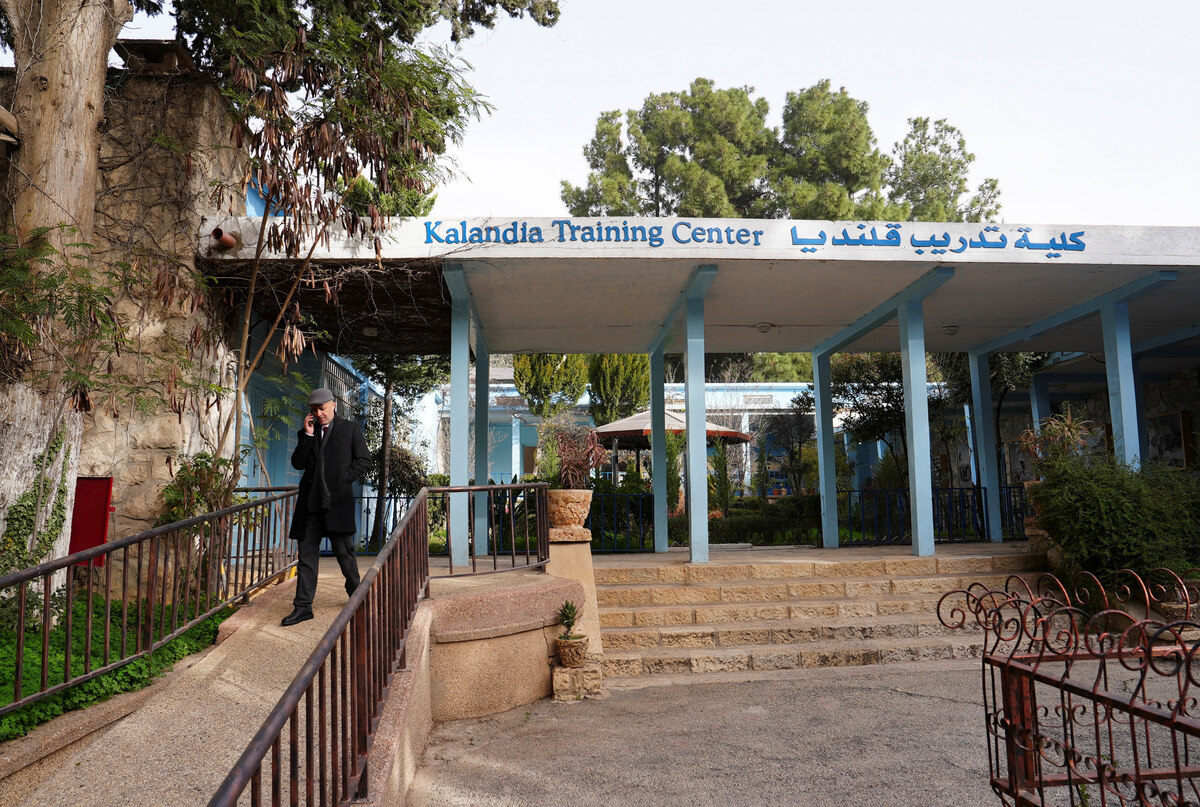
In the end, Baha Awad tears up. He has been working for 23 years at the United Nations Palestinian Relief and Works Agency (UNRWA) training center in Kalandia, located between Jerusalem and Ramallah. The 50-year-old Palestinian has been the school principal for four years. When employees of Jerusalem District Electricity turned off the power on Wednesday, Baha Awad could only watch. “They could have at least waited until the students had completed their year of training,” he says.
The carpentry and metal workshops on the extensive site near Jerusalem now lie abandoned. Awad sent the more than 325 trainees aged 15 to 19 home out of concern for their safety: the Israeli army has been operating in the neighborhood since the beginning of the week.
In the training center, a technician starts an old generator. For a moment, smelly diesel fumes waft across the area. The training center, founded more than 70 years ago, offers courses for plumbers, IT technicians and mechatronics engineers. According to Awad, the employment rate for graduates is around 80 percent – a success given the high unemployment in the Israeli-occupied West Bank.

Already in 2024, the Israeli parliament had passed two laws intended to end UNRWA’s work in areas controlled by Israel. Last October, the International Court of Justice (ICJ) found that the government in Jerusalem was obliged under international law to permit and support the work of UNRWA and other aid organizations. The report is not legally binding.
UNRWA headquarters demolished in East Jerusalem
Since January, Israel has stepped up its action against the largest aid organization in the Palestinian territories, with 17,000 employees. Excavators accompanied by police officers began demolition on January 20th the UNRWA headquarters in East Jerusalem. A new law passed in late December bans water and electricity providers from supplying UNRWA facilities. Several health centers and schools in Jerusalem’s Old City and in the Shuafat refugee camp had to close in the past few weeks.

Demolition is in full swing: the remains of the UNRWA headquarters in East Jerusalem
Photo:
Mahmoud Illean/ap
“A total of around 900,000 people from the West Bank and East Jerusalem are registered with UNRWA. 270,000 of them use medical services, as well as 48,000 students from the first to the ninth grade,” says UNRWA spokeswoman Abeer Ismail. Israel is now putting pressure on companies to stop working together. Traveling in UNRWA vehicles between the locations is already impossible due to Israeli checkpoints. The organization’s local director, Roland Friedrich, has not been allowed to enter the country for almost a year.
Israel describes the UN aid agency as being infiltrated by Hamas, but has so far provided little evidence of this. This could actually be proven for only a few employees in the Gaza Strip: after information about their involvement in the attack in Israel on October 7, 2023, UNRWA fired nine employees.
Individual employees had also violated the impartiality requirement of UN organizations with political statements on social media. An infiltration, as claimed by Israel, The ICJ judges, however, did not see this as proven. Another accusation was problematic content in school books. This was also confirmed by a commission of inquiry led by the UN Secretary General.

After the Hamas attack on October 7, 2023, the Israeli military launched an offensive in Gaza, followed in 2024 by the advance against Hezbollah in Lebanon. The conflict over the region of Palestine began at the beginning of the 20th century.
UNRWA headmaster Baha Awad wants to continue
The Israeli government is now targeting other aid organizations. Doctors Without Borders, Oxfam and 35 other international NGOs working in the Palestinian territories are to cease their work by the end of February. Many of the affected organizations had refused to share employee lists of employees in the Gaza Strip with the Israeli authorities. Within two and a half years there were attacks by the Israeli army more than 500 humanitarian workers killed become.
Headmaster Awad at the Kalandia training center wants to continue as long as he can. With a generator, the school can be supplied for around six hours per day. Awad doesn’t know what will happen if Israel turns off the water as announced.