

The finance ministers of the federal states would be happy about such large amounts. Many schools could be built, daycare centers renovated and tram lines expanded. The new wealth tax that the Left Party wants to implement would generate up to 147 billion euros in additional revenue per year.
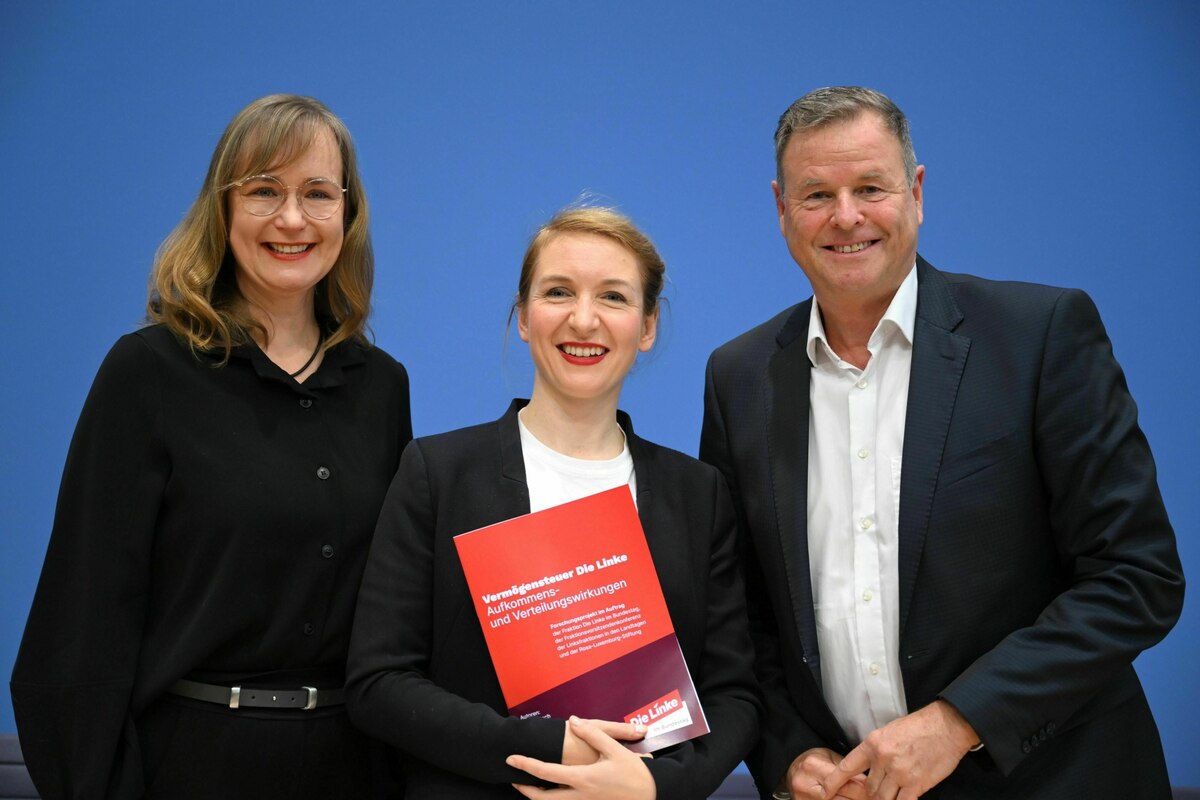
“A wealth tax makes economic sense,” said Left Party leader Ines Schwerdtner on Friday in Berlin. But it is “above all important for democracy”. People have “a right to this redistribution”. The rich must “finally give back what they got from the hard work of the people in this country”. That’s why the left is calling for the wealth tax to be reactivated.
This idea is already in its election program for the 2025 federal election. But now the party has had the concept calculated by the German Institute for Economic Research (DIW). In their report presented on Friday, DIW economist Stefan Bach and his colleagues do not skimp on critical comments.
Wealth tax has no longer been levied in this country since 1996. Recently, however, the debate about higher taxes on capital has started again because the assets of the very rich are growing blatantly. For example, the SPD recently launched a Inheritance tax concept presented with which, among other things, she wants to make greater use of large company inheritances. However, there is no concrete initiative from her to implement it.
12 percent wealth tax from capital of one billion
While the Social Democrats at least in their federal election program Although they have also spoken out in favor of wanting to “revitalize” the suspended wealth tax for very high assets, the leadership of the Union definitely does not want it. Therefore, the chance of its reintroduction in this legislative period is extremely slim. For the Left, it is about fueling public debate and positioning itself as a party of justice.
This is also why your party is entering the political debate with a very concrete proposal because people always act as if “none of this is possible and not unrealistic,” said Schwerdtner. But that is wrong. The wealth tax is in the Basic Law and could be reactivated with a simple majority. “It’s not magic, it can be implemented easily,” says Schwerdtner.
In his report, DIW researcher Bach now examines various variants of the left-wing idea for their effects. The key points of the concept look like this: The left wants to impose an annual tax on high personal net assets. This should cover all real estate, corporate and financial assets as well as luxury goods. The allowances could be one million euros for private capital and five million euros for company capital. The basic tax rate would be one percent and would rise to five percent at 50 million euros. From one billion euros the burden should be 12 percent.
Bach has calculated that the potential income reached up to 147 billion euros per year. These would benefit the federal states and municipalities because the wealth tax is traditionally a state tax. This would be paid primarily by the one percent of the population with the highest reserves – multimillionaires and billionaires. If the tax rate were to remain at one percent above the tax allowances, the state would still generate additional annual revenue of 42 billion euros.
“Urgently needed for society as a whole”
According to Bach’s assessment, these are only theoretical values. Because the capital owners would react. “If possible adjustment reactions such as tax planning and investment reluctance are taken into account, including the relocation of assets or migration abroad, the potential wealth tax revenue can be significantly reduced,” writes the DIW economist. He expects a loss of around a third, leaving around 100 billion euros left. If the reactions are stronger, up to 80 percent could be lost.
According to Bach, the losses could be limited through a more effective policy against tax planning. Nevertheless, he writes: “In the short and medium term, such a high wealth tax threatens to place considerable burdens on the attractiveness of the location, investments and innovative strength of the economy, especially against the background of the current overall economic stagnation and the crisis of the German industrial export model.”
In other words: If the rich make significantly less profit, they invest less money in research and new products, which can also have a negative impact on employment. “Therefore, a wealth tax should only be introduced gradually and, if possible, in an internationally coordinated manner,” said Bach.
This is another critical point. Most countries comparable to Germany no longer levy wealth taxes. Great Britain, France and Canada, for example, generate high revenues through property taxes on real estate.
These counterarguments do not initially bother the left. “The reintroduction of the wealth tax would not be an unfair additional burden, but rather the fair contribution of those who particularly benefit from this society,” write Heidi Reichinnek and Sören Pellmann, the leader of the Left party group, in the foreword to the study. “It is therefore urgently necessary for society as a whole to both reduce wealth differences and to enable a significant increase in education spending in order to improve the chances of children from poorer households.”