

You can complain endlessly about parent taxisabout parents who drive their children to the school gate, thereby creating confusing traffic situations and endangering other children. Or you can look for solutions – and implement them.
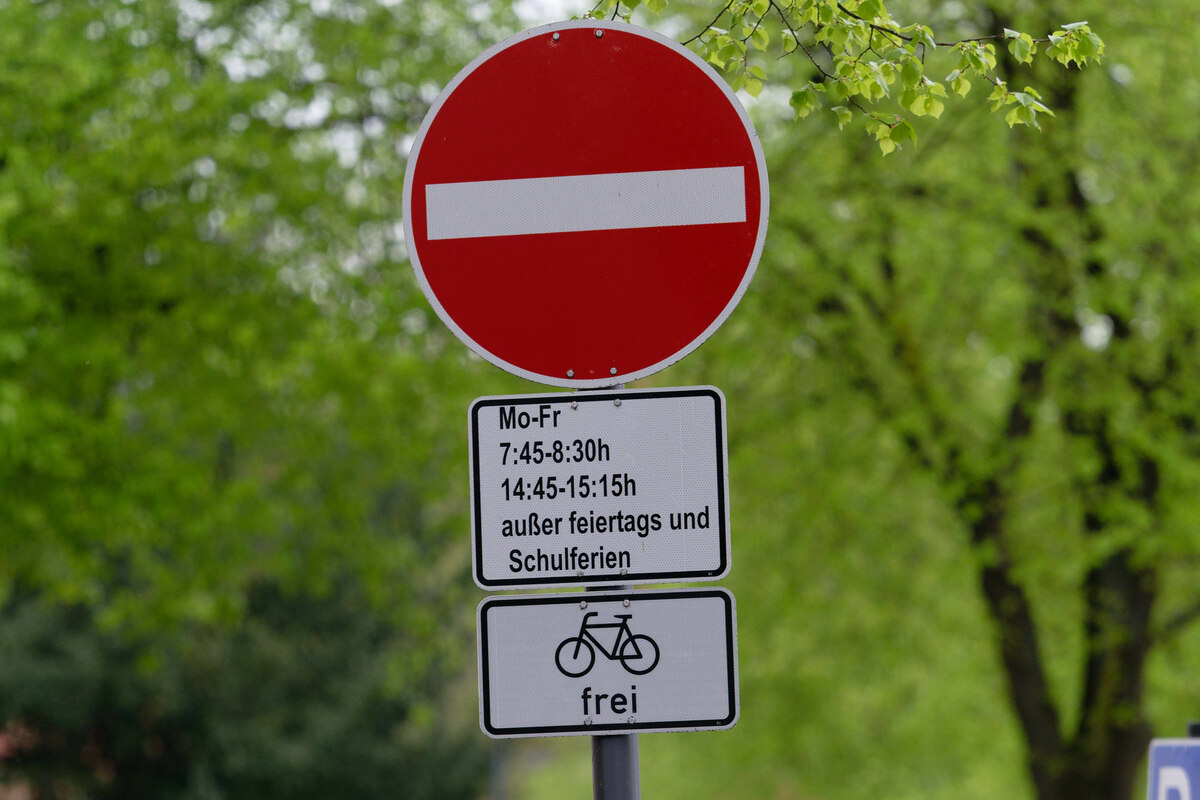
One possibility is so-called temporary school streets, in which the areas in front of the schools are closed to car traffic for half an hour to an hour at the start and end of school, with the exception of residents. The city of Cologne started this in 2023 with four model projects.
After the good experiences there, other cities and communities in North Rhine-Westphalia followed suit. The Ministry of Transport knows of 67 school streets, mostly at primary schools. “There are probably many more,” writes a spokeswoman for the ministry to the taz.
School streets have also been set up in other federal states since 2024. But Bremen and Hamburg, of all places, are extremely hesitant, and things aren’t looking any better in the third city state of Berlin. This is all the more surprising since the Greens are in government in these countries – the party that is suspected of making life difficult for drivers out of principle.
Model projects in Hamburg
Hamburg is a lot further than Bremen. In September 2024, Parliament asked the state government to select and set up locations for school streets. Early 2025 The Hamburg Senate made it clear that it at least saw no legal difficulties. A year later, the spokesman for the Hamburg Transport Senator wrote to the taz that the procedure was still being coordinated. The first school streets will be set up this year – as model projects.
He doesn’t say where they are, but confirms one when asked Article of Hamburger Morgenpost. Five schools are named there. Two of them are in the Eimsbüttel district, one in Eppendorf, one in Altona, one in Hamburg-Nord. They were not selected based on particular urgency, but rather based on whether there was the will to implement it, both on the part of the authorities and on the parents’ side.
The spokesman did not answer the question of why the locations had not yet been communicated. Nor why pilot projects are needed if the effectiveness of the measure documented in North Rhine-Westphalia could be.
At all four model locations, traffic fell dramatically in the morning and afternoon, at three locations by up to 77 percent, with the decrease being lowest in winter. At one location it was found that the decline in the second year was greater than in the first, and at a fourth location the traffic volume was reduced by a maximum of 32 percent.
However, parents apparently no longer let their children get off directly in front of the school, but instead in side streets. A survey of 110 parents showed that only seven percent of them now transport their children to school differently.
At all four model locations, traffic in the morning and afternoon was reduced drastically, at three locations by up to 77 percent.
As a rule, in Germany only signs indicate the driving ban – parents rarely volunteer to set up mobile barriers. “There are always people who don’t stick to it,” says Simone Kraus from Cologne. “But compared to before it’s a difference like night and day.”
Kraus is one of the initiators of the Kidical Massa nationwide initiative that works to ensure that children can move safely on the roads alone. She also helped initiate the Cologne school streets and is convinced of the measure. “Of course, a lot more needs to be done to reduce the risk of accidents for children,” she says. “But at least the situation at the school, where everything is concentrated, has been defused.”
Bremen has been discussing school streets for six years
But in Bremen you see things differently. Here it was the CDU that asked whether there would be school streets in Bremen almost two years ago. This has been discussed in the city for six years.
At the beginning of 2024 there was one Representative of the Senate said in parliament that unfortunately the Bremen State Roads Act does not allow for the so-called partial confiscation, which forms the legal basis for school roads in North Rhine-Westphalia. A change in federal legislation is therefore needed. The SPD was and is apparently not interested in changing the Bremen state law.
A week and a half ago, the Bremen Senate answered, this time in response to a request from the FDP, that there would not be any regular school streets in Bremen and that there was no legal basis. In addition, “at least two employees from the Bremen police or the public order office” are needed per school location to enforce the ban. The Senate forgets to mention that accidents also result in police operations and that checks are only necessary initially, if at all.
The Bremen Senate also expects “effects on the surrounding flow of traffic” and the problem of parent taxis will shift. Where? And why should the effects be more serious than in other major German cities? That’s not in the answer. And even if parents let their children drop off on the side streets, the situation is more relaxed there because not all children take the same route to school.