

Five years after the coup in Myanmar, the ex-military-led Union Solidarity and Development Party (USDP) the election farce there as expected, clearly won. According to the official results announced on Friday, the USDP won 232 of the 263 seats in the lower house and 109 of 157 in the upper house. The turnout in the election, the took place in three phases between December 28th and January 25thwas reportedly 54.1 percent, around 20 percentage points less than in the last free election in 2020.
This was declared fake by the military due to the USDP’s poor performance, which served as a pretext for the coup on February 1, 2021. The National League for Democracy (NLD) of the ousted head of government and Nobel Peace Prize winner Aung San Suu Kyi, winner in 2020, had now been dissolved by the junta.
Now on the 5th anniversary, the regime staged a large reception full of nationalistic symbolism at Yangon’s airport for a government delegation returning from the International Court of Justice in The Hague. There, the military had defended itself against accusations of genocide during the expulsion of the Rohingya minority in 2017.
With the sham elections, the junta tried to simulate a return to normality, which was already problematic before the coup. According to the constitution, apart from elected representatives, 25 percent of parliamentary seats go to active military personnel. The army chief appoints them. Now the vast majority of deputies are officers with and without uniform.
China praises “proper election”
China’s government already had right after the last election day congratulated on the “proper election”.. In contrast, the foreign minister of the Philippines, which currently heads the Southeast Asian Asean states, said: that Asean does not recognize the elections. Election observers only came from authoritarian states such as Russia, Belarus, China, Cambodia and Nicaragua.
Sea UN Human Rights Commissioner Volker Türk The army killed 170 civilians in 408 air strikes in the weeks of the election. In any case, for security reasons, voting was only possible officially in 261 of 330 electoral districts. It was enough for the regime if there was one polling station in a military post for each district. Anyone who criticized the election faced heavy penalties. According to Türk, this led to 404 convictions. “The military is trying to consolidate its rule through violence after forcing people to go to the polls,” Turk said.
Parliament is scheduled to meet for the first time in March and the new government will be formed in April. It is unclear whether coup leader and junta leader Min Aung Hlaing will then become president. Will the 69-year-old retain control of the military or share power with another general? According to the exile portal Irrawaddy USDP leader Khin Yi could also become president. He is a confidant of Min Aung Hlaing, who could thus retain control of the military.
With the electoral farce, the junta has seized the political initiative and distracted from Myanmar’s desolate situation. According to the UN emergency relief organization Okha, 3.6 million people are on the run within the country and hundreds of thousands have fled abroad. 16.2 million of the 55 million inhabitants need humanitarian assistance. It is estimated that 92,000 people have died in the civil war so far.
“Myanmar in the grip of a polycrisis”
Die Exiled human rights organization AAPPBwhose figures are also used by the UN, counted 30,357 political prisoners from the coup to the end of January. Of these, 22,767 are still in custody. 7,738 people were killed for political reasons.
Myanmar’s economy is in shambles, inflation has increased tenfold and foreign investment has fallen by three quarters. Due to the collapse of statehood, Myanmar became a world’s largest opium producer and to one Center for international cybercrime. The Myanmar Strategy and Policy Institute (SPS-Myanmar) sees the country “in the grip of a polycrisis with the risk of a failed state”.
The resistance is broad, but so far hardly coordinated. Since independence in 1948, there have been repeated armed conflicts with ethnic groups. They are fighting for autonomy and against the Burmese-dominated military’s claim to power. After the 2021 coup, ethnic rebel armies provided military training to young activists whose peaceful protest had previously been shot down. But the underground counter-government remained weak and it has not yet been possible to establish effective leadership over the up to 2,000 armed resistance groups. The ethnic rebel armies are not under any central command.
From October 2023 to mid-2024, the armed resistance was able to wrest more and more regions and cities from the military’s control. But since then the tide has changed and the military controls around half of the country again. In the spring of 2024, the army began the forced recruitment of young men and was able to increase its numbers by 90,000 soldiers, even if they are poorly trained. The military also received more weapons China, which trusts the junta to secure its economic and strategic interests more than the rebels.
The junta also benefited from Russian military advisers and from supplies of jet fuel by Iran’s shadow fleet, as a recent Reuters investigation revealed. In 2017, Tehran protested against the expulsion of Muslim Rohingya by Myanmar’s military, but the two pariah regimes have come to an agreement by 2024 at the latest. This allowed Myanmar’s air force to double its attacks. There are also goals Hospitalsschools and temples.
Rebels without foreign support
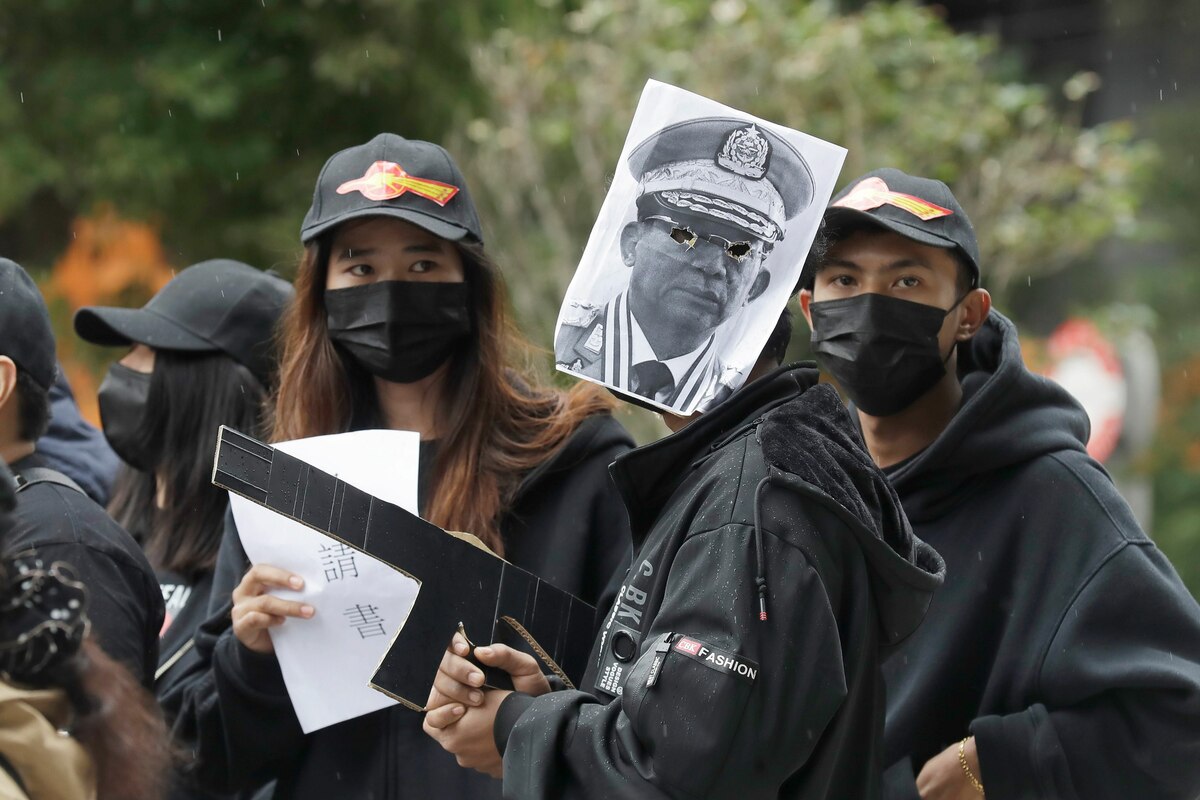
The resistance, however, receives no support from abroad, with the exception of the diaspora, which once again demonstrated in front of Myanmar’s representatives in many countries on this anniversary. According to that Military analyst and security advisor Anthony Davis There is a stalemate between the army and the resistance.
Davis believes that an alliance of 19 resistance groups formed in December to form the “Alliance of the Spring Revolution” is promising. But time could work in the military’s favor if it succeeds in driving a wedge between the increasingly exhausted rural population and the rebels, who rely on local support for the population. The armed resistance is also threatened with creeping marginalization due to the risk of individual groups being co-opted and the emergence of warlords.
The one living in Northern Thailand Myanmar-Expert Bertil Lintner puts it this way: “The unavoidable reality is that unless something truly unexpected happens, the military will remain in power for the foreseeable future.”