

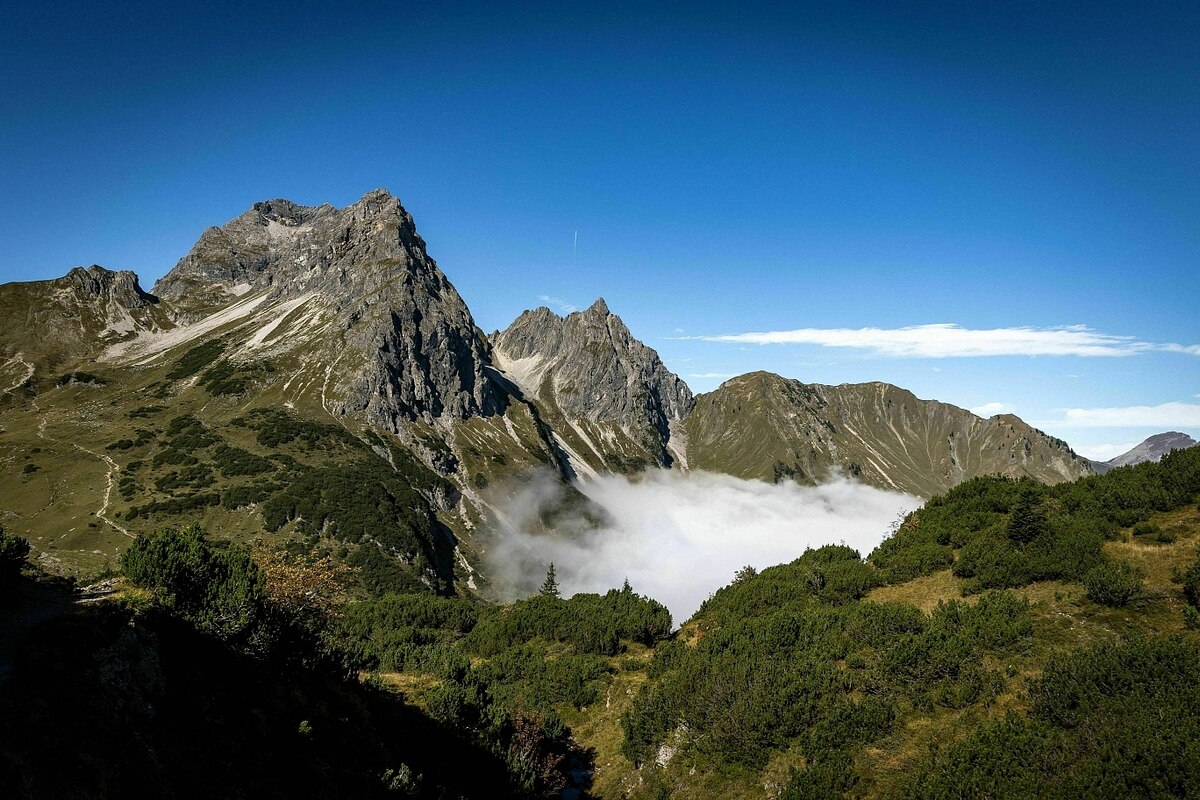
We start in Kleinwalsertal. The wide high valley at an altitude of 1,000 meters is overlooked by 36 peaks. With over 130 kilometers of slopes, modern lifts and varied runs for all levels of difficulty, the valley is a winter skiing Eldorado. But in spring, when the sun is not yet shining at over 1,000 meters above sea level, it is a good starting point for crossing the Alps.
We cross the mountains towards Lech via the Koblat Pass. In the Hintere Gemstelhütte, the cheerful innkeeper greets everyone without looking at them as boy or girl. The buttermilk from our own production tastes excellent, as does the blueberry quark. The Kleinwalsertal is an Austrian enclave that can only be accessed via Germany, which is difficult for Austrians by car. Or over the mountains like with our hiking guide Georg Pawlata on his newly designed four-country Alpine crossing: It leads from Oberstdorf in Germany via Vorarlberg in Austria and the Engadine in the Swiss canton of Graubünden to Vinschgau in Italy.
The well-trained 51-year-old from Innsbruck, studied geography, mountain expert, hiking guide, and is also a truffle pig. His latest connection is this Four-country Alpine crossing. The trails are easy to moderately difficult. “As a geographer, I know a lot about cartography and can plan such routes,” says Pawlata. A hiking connection that includes four countries appealed to him. “I started designing long-distance hiking trails for tourism associations and Tirol Advertising 20 years ago and then had the idea of designing a route myself 15 years ago. And that was the Alpine crossing from Tegernsee to Vipiteno, which 10,000 people now go every year. However, as a result, the quality of life and hiking has suffered,” says Pawlata.
In addition, tourism on Tegernsee or in the Zillertal has “increased incredibly sharply since Corona”. “Some of the paths were widened so that many cyclists came along. Everything is overcrowded, not to say mass tourism. And then it was clear to me that I didn’t want to have that anymore.”
13 kilometers daily
His new tour covers 96 kilometers as the crow flies and four countries. “I’ll run it with the group in six days. Every day, like 13 kilometers,” says Pawlata. “In between, there are routes that you can’t walk because they’re not that attractive. You take the bus or train.” There is always luggage transport. “On the first day, for example, the luggage transport takes two hours to get from Oberstdorf to Lech in Vorarlberg. As the crow flies, you actually only go ten kilometers over the mountains. By car, however, it’s 150 kilometers.”
Pawlata wants to illustrate what a rugged border the mountains are and that you can often hike over the mountains much faster, but above all closer, than driving around them by car. This experience applies to the entire route, says Pawlata. “That’s also the case on the last stage into Vinschgau. You have to drive around the outside of the pass by car. Our tour is just 15 kilometers long.”
The diversity of the Alpine regions is evident along the approximately 70 kilometer long route, which we hike in some sections. Our hike on the first day starts in the Kleinwalsertal and leads through the Gemsteltal past farmed alpine pastures to the Koblatpass (2,054 m) to the Austrian-German border and from here into the Lechtal on the Tyrolean side of the Bavaria-Tyrol-Vorarlberg border triangle.
We first cross a karst landscape that is initially green and varied, which reduces to knotweed or silver thistles higher up and becomes barren and more difficult to walk at an altitude of 2,000 meters. The final stop is Lech, where the winter tourist boom has not yet begun and the restaurants are yawningly empty.
Our second stage leads through a high valley along the Lech towards Switzerland and further over the Stierlochjoch, just over 2,000 meters above sea level, into the Klostertal. From there, the third stage goes through a landscape shaped by the last ice age with small lakes and glacial formations over to the Montafon and over the Schlappiner Joch at 2,201 meters from the Austrian state of Vorarlberg to the Swiss canton of Graubünden. It is the fourth day of our hike. The group has become accustomed to walking at a steady pace, it is becoming easier, and varied mountain panoramas compensate for muscle cramps.
Aren’t there already enough paths across the Alps?
The Rhaeto-Roman mountaineering villages on the fifth stage such as Ardez or Guarda with their old, artistically decorated houses and traditional health resorts such as Scuol, with their lush, flower-filled alpine pastures on sunny mountain ridges, are an idyllic route.
Our sixth and final stage leads to Italy in the Vinschgau. From S-charl, a small Swiss mountain village at 1,800 meters above sea level, the route continues via the Münstertal to Taufers in Italy. About two thirds of the U-shaped valley are in Switzerland, the rest in South Tyrol. It is a varied, unusual tour that Pawlata has designed. But aren’t there already enough paths across the Alps? Should everything now be marketed?
“Of course I contribute to the development of tourism offerings. But I don’t want mass tourism. Between ten and 30 people go here every day. And they don’t really stand out at all.” With the new tour, he offers an alternative to certain routes, such as the European long-distance hiking trail E5, which leads from Oberstdorf to Merano across the Alps. “There’s been a lot going on in the Alps since Corona. The mountain huts along the way are sometimes overcrowded,” he confirms. “I still love the mountains. My parents took me on ski tours when I was six and we grew up in the mountains.” He wants to offer a sophisticated, sustainable product, including when it comes to accommodation. This also includes daily luggage transport. And hiking tourism is something very sustainable. “It would be best, of course, to travel by train,” says Pawlata.
Hiking has shed the grandfather image. It’s also hip for 25-year-olds to put on their hiking boots and go to the mountains. “That wasn’t the case 15 years ago! That has really changed in a relatively short period of time.” Fashion also shows that, he thinks. “Even in the big city, people walk around in Patagonia clothes and North Face or whatever they’re called.”