

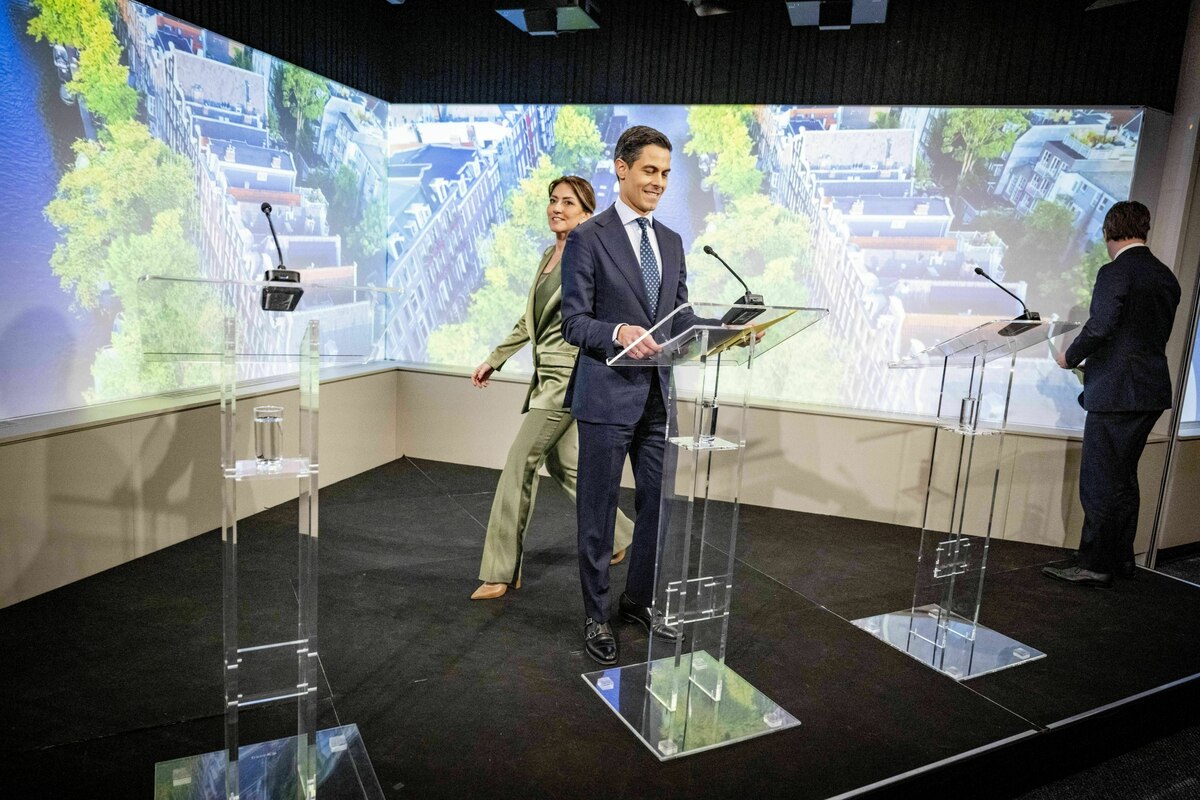
Three months after the parliamentary elections, the future Dutch coalition presented its government program in The Hague. Under the motto “Aan de slag” – “Get to work” – the progressive-liberal Democrats 66 (D66), the liberal-right Volkspartij voor Vrijheid en Democratie (VVD) and the Christian-Democratisch Appèl (CDA) want to “build a better Netherlands”.
The program was presented by party leaders Rob Jetten (D66), Dilan Yeşilgöz (VVD) and Henri Bontenbal (CDA). Jetten will be the future prime minister. The rest of his cabinet, which is due to be sworn in on February 23, is expected to be negotiated in the coming weeks.
It was already clear in advance that the coalition agreement revolved around the question of how the additional defense spending would be financed in order to achieve the increased NATO standard of 3.5 percent. These cost an additional 19 billion euros annually.
As expected, the government will make major cuts in the areas of social security and health: the personal contribution to health insurance will increase significantly, the receipt of unemployment benefits will be reduced from two to one year, and the basic pension age, which is linked to the average life expectancy, will increase more quickly. A “liberty levy”, which is to be collected via income tax, also serves to counter-finance expenditure on defense and secret services.
Departure and big decisions
Jetten, whose D66, often described as left-liberal, won the parliamentary elections in October just ahead of the right-wing populist Freedom Party (PVV).said immediately after the presentation that “a number of big decisions” had been made. From 2029 onwards, one billion euros will be invested in the construction of affordable housing every year.
D66, VVD and CDA also want to finally solve a second long-standing problem, the nitrogen crisis: farmers are to be bought out with investments worth billions and thus reduce the number of livestock. Both are signature projects of the new coalition, which propagate a new departure against the background of deep social polarization. “We believe that society again wants to see a policy that shows that working together brings more benefits than opposing each other,” it says in the coalition agreement.
Collaboration with other parties
Both Jetten, Yeşilgöz and Bontenbal have been emphasizing their desire for broad cooperation with other parties for weeks. Given that the new coalition lacks 10 seats for a parliamentary majority and 16 for a Senate majority, this is a strategic necessity.
In the future, the minority government will be dependent on support from the opposition for every new project. Although this has to be negotiated on a selective basis, Jesse Klaver, head of the future red-green merger party, has already announced that an agreement on this will be concluded “before the summer”. The new coalition is therefore permanently in negotiation mode.
Tough course in asylum policy
The coalition, called “Jetten 1” according to Dutch custom, is largely retained the tough course that her short-lived right-wing predecessor took on the issue of asylum and migration. The aim is to implement the agreed “emergency measures”, limit the length of stay and abolish unlimited status and reduce the number of migrant workers. This is counteracted by an increased budget for asylum procedures and accommodation. However, the law on the equal distribution of asylum seekers in the country, a constant hot topic of the last government led by right-wing populists, is to be retained.