

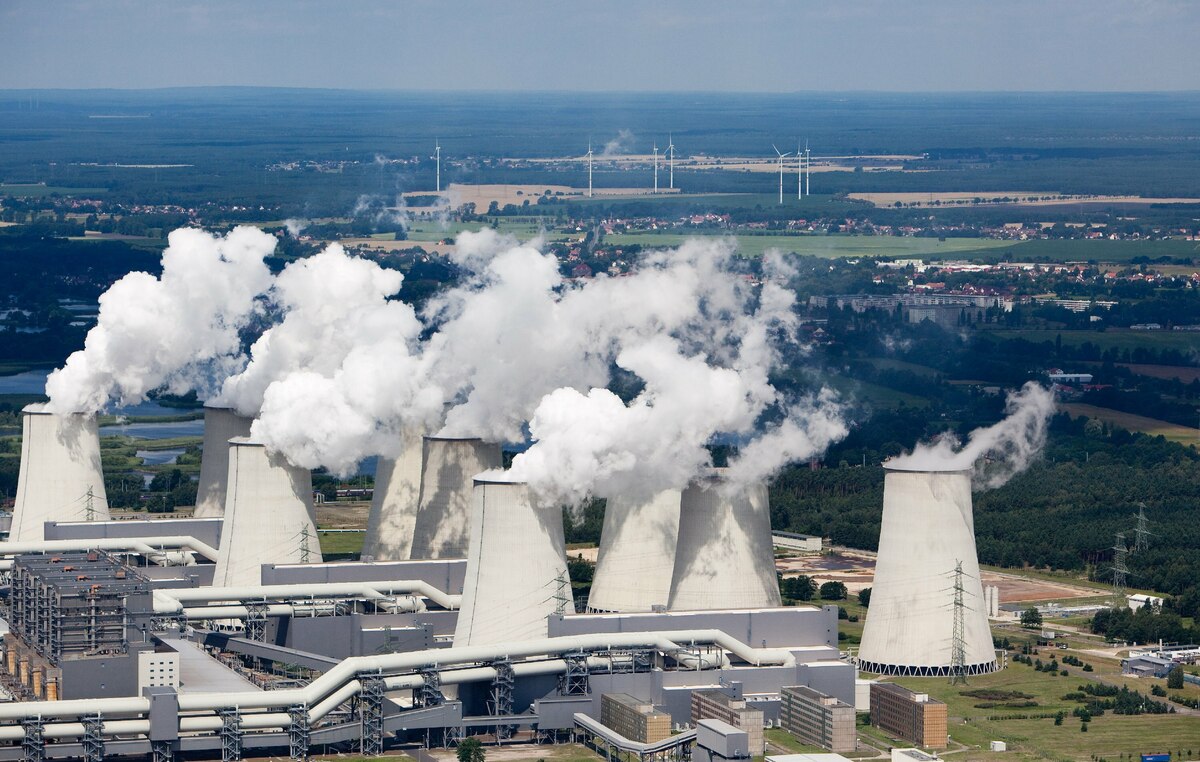
The federal government has agreed with the EU Commission on the basic principles of its power plant strategy to secure the energy transition. The Federal Ministry of Economics, led by Katherina Reiche (CDU), announced this on Thursday evening.
The agreement provides for tenders for electricity generation with a capacity of 12 gigawatts, predominantly for gas-fired power plants. The German Environmental Aid (DUH) criticizes the fact that the focus is on fossil power generation and that climate-friendly alternatives are given too little weight.
In order to secure the coal phase-out and create energy security, new capacities must be created for the rapid availability of electricity. In the future, electricity will be generated from renewable energies.
In order to ensure that electricity is available even in times when there is no wind and little sunlight, so-called base-load capacities must be available that can quickly cover demand during periods of darkness. That is undisputed.
The coal phase-out creates time pressure
However, it is controversial how many gas power plants are required for this. Because there are climate-friendly alternatives. Base load capacities can be created, for example, through the use of electricity storage.
Because the coal phase-out in the Rhenish mining area is scheduled to take place as early as 2030, there is time pressure. Tendering for the new power plants is scheduled to begin in the summer. The Federal Ministry of Economics assumes that the capacities will not be available until 2031 at the earliest. This means that coal-fired power plants are likely to remain online or in reserve longer than previously planned.
This could have been avoided. The former Green Economics Minister Robert Habeck had already agreed with the EU on a power plant strategy that was on a similar scale to the current agreement.
Because the capacities are not needed consistently, but only selectively, they are supported by the state. The EU must therefore give its consent to the plans. Federal Economics Minister Reiche reopened negotiations with the EU. She originally wanted gas-fired power plants with a capacity of 20 gigawatts. She couldn’t get her way with that.
Green hydrogen not mandatory
The EU has still not reached an agreement on all the details; for example, it is unclear how large new power plants must at least be. However, the basic principles have been agreed so that preparations for the tenders can begin.
Of the 12 gigawatts of power plant output, two should be technology-open, meaning they can also be alternatives to gas-fired power plants. This is clear from the tender criteria. The condition for 10 gigawatts is that they generate electricity over a longer period of time, which excludes storage.
“All power plants built as part of the power plant strategy will be hydrogen-capable and will be fully decarbonized by 2045 at the latest,” said the Ministry of Economic Affairs. In 2040, 2 gigawatts of power plant output and 2 more in 2043 are to be converted to operation with hydrogen.
If gas power plants are operated with so-called green hydrogen, which is produced from renewable energies, they are climate neutral. However, the power plant strategy does not stipulate that the hydrogen must come from renewable sources. It can also be produced using fossil fuels, so it does not have to be climate neutral.
Deutsche Umwelthilfe believes it is wrong that the vast majority of tenders are not open to technology. “This is bad news for electricity customers and climate goals,” says Federal Managing Director Sascha Müller-Kraenner. “There is a risk of unnecessary costs and CO₂ emissions.”
He criticizes the fact that the Federal Ministry of Economics does not present a roadmap for converting gas power plants to run on green hydrogen. “The winners are clearly the large energy companies,” said Müller-Kraenner. You could celebrate that the Minister of Economic Affairs has conscientiously completed her wish list. “Electricity customers and the climate are at a disadvantage,” he emphasized.