

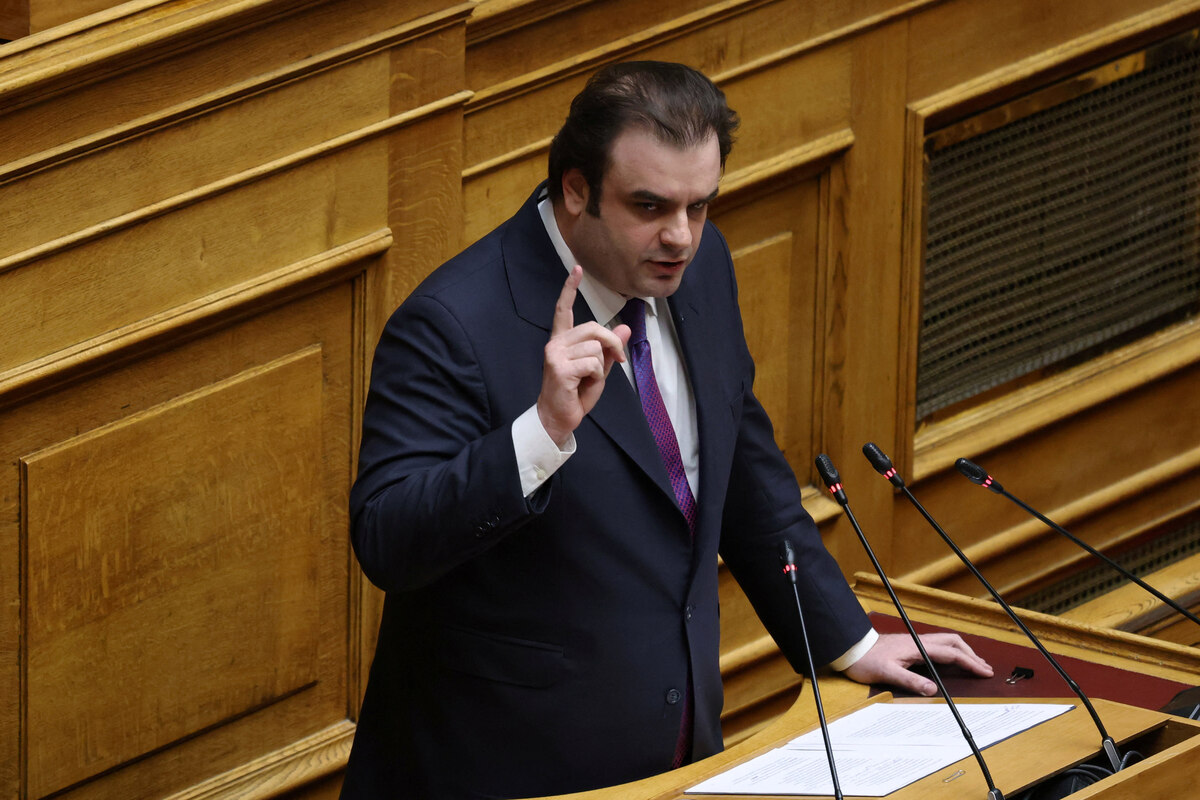
If, on January 19th, a Greek, Kyriakos Pierrakakis, is the first to chair the meeting of the Eurogroup, which coordinates the tax and economic policy of the eurozone, it will be something special. The serious Greek national debt crisis, which was the core of the euro crisis, was just ten years ago – and still has consequences today.
Pierrakakis’ election as the new head of the control center of the euro countries was celebrated in Greece in mid-December with corresponding pathetic celebrations. Conservative Prime Minister Kyriakos Mitsotakis said in his televised address: “Today is a day of pride for the country, the government and all citizens.” “We are the Euro Group!” was emblazoned in Bild-Similar to the front pages of the pro-government press in Athens – under the portrait of the Minister of Economics and Finance.
Pierrakakis, 42, a giant, jet-black hair, always freshly shaven, follows the Irishman Paschal Donohoe, who is moving to the World Bank. He easily prevailed against his only competitor, the Belgian Finance Minister Vincent Van Peteghem. A fast career, because Pierrakakis has only been at the head of the Finance Ministry in Athens since March 2025 and is not even a qualified economist.
Investments, the internal market and the digital euro
The Greek has big plans. In his application for the presidency of the Eurogroup, Pierrakakis lists four priorities: First, a savings and investment union with deeper financial integration should mobilize investment capital. The Greek also sees the completion of the internal market as Europe’s strongest growth driver.
Thirdly, he wants the digital euro megaproject advance, a key project, especially in connection with the new EU money laundering authority AMLA, based in the Frankfurt Messeturm, which began its official activities on July 1, 2025. According to observers, the digital euro and AMLA are likely to pave the way for the establishment of a Europe-wide asset register.
Ultimately, according to Pierrakakis’ agenda, the Eurogroup should from now on address structural future issues such as stability, demographics and productivity. Pierrakakis’ term as Eurogroup chief lasts until mid-2028. The ambitious Greek will lead a Eurogroup meeting for the first time on January 19, 2026.
Pierrakakis is showered with praise. An undisputed achievement is that the computer scientist, who earned a master’s degree in technology policy from the US Institute MIT, created the gov.gr platform as digital minister in Athens from March 2020. Greek citizens now have digital access to more than 2,500 government services.
However, critics complain that Pierrakakis has merely digitized the notorious Greek bureaucratic monster instead of before reduce the bureaucracy and only digitize it afterwards. Digital illiteracy, power outages, digital collapses of launched platforms during peak times: millions of Greeks prefer to hire tax consultants and accountants to have the digital stuff taken care of by the state – for a fee.
Wiretapping scandal during Pierrakakis’ term in office
That’s obviously the lesser evil. Pierrakakis’ steep political rise is also overshadowed by a gigantic wiretapping scandal during his term as digital minister. Over 100 politicians, entrepreneurs, military personnel and media professionals were spied on. A Greek businessman is involved, with whom, ironically, Pierrakakis is said to have had a “long-term and close” relationship, as a witness proved with court-approved evidence in an Athens court at the end of last year. Digital Minister Pierrakakis also waived the actually binding ministerial decision that would have allowed the independent Athens Authority to Guarantee the Confidentiality of Communications (ADAE) to carry out efficient controls in the Athens wiretapping scandal.
For self-protection? In any case, Pierrakakis’ advocates and he himself boast that Hellas completely digitalized its vaccination campaign during the corona pandemic under his aegis. Vaccination appointments were sent digitally and e-vaccination certificates were issued.
The narrative that Pierrakakis’ election in Brussels effectively seals an economic success story in Athens, which says that the former pariah Greece has become the “model student” of the Eurozone, should also be viewed with caution. The rigorous austerity course in Athens with its social upheavals has by no means clearly ended well.
The Greek economy is growing moderately again. However, this is not difficult given the low initial level of gross domestic product (GDP) of almost 249 billion euros according to the forecast for 2025 – this corresponds to the annual economic output of Berlin plus Bremen. Above all, however, Hellas would be in a pretty poor situation without the generous EU funds. EU funds of almost 60 billion euros will flow to Athens from 2021 to 2027 – an enormous sum in relation to the local GDP, namely around four percent of GDP annually.
Growth on credit
Meanwhile, Hellas’ trade balance remains strongly negative, as does its net foreign position, i.e. the balance of its claims on foreign countries and its debts to foreign countries. The debt ratio of local private households and companies also reached a dizzying 166 percent of GDP at the end of 2024. With the national debt, Greece’s total debt currently amounts to over 300 percent of GDP. The widely celebrated Greek “economic miracle” is growth on credit. A disgrace for the euro.
The widely celebrated Greek economic miracle is growth on credit
The fact that Athens is also celebrating early repayment of the loans granted by the public creditors EU, IMF and ECB after Hellas’ de facto national bankruptcy in spring 2010 with a total volume of almost 289 billion euros.
However, this is the case thanks to “bloody” budget surpluses, primarily due to excessive government revenues via indirect taxes, which primarily affect the poor and poorer people. The goal: By the end of 2026, the Hellenic debt ratio should fall from the current 145.9 to 138.2 percent. However, this is an impressive 20 percent more than at the end of 2009 before the disastrous Greek crisis broke out.
The strategy of the Kyriakos Mitsotakis government is clear: reducing debt should improve the creditworthiness of Greek government bonds. The Hellas Bond is still eight levels – and therefore miles – away from the top grade, Triple A. The junk status has now been overcome.
The total of 150 large listed companies in Athens are already benefiting from this as institutional investors from abroad are gradually joining them again, which is why the Athens stock exchange is booming. On top of that, Mitsotakis’ government is pleasing shareholders with a mini-dividend tax of five percent. The result: The rich get richer, the rest are left behind.
And how: In 2024, earnings averaged 1,342 euros gross per month, i.e. below pre-crisis levels, purchasing power has fallen to second-to-last place in the EU, only ahead of Bulgaria, and the chronically negative savings rate of private households is a special case in Europe. Greece has the undisputed highest score in the EU when it comes to “subjective poverty”, sells off state assets, serves an extensive patronage system and rampant nepotism, and corruption is flourishing.
What is left in actually existing Hellas is the top spot again in 2025 among all 20 OECD countries examined with a share of the shadow economy of 21.8 percent in relation to GDP, as well as the flourishing and vulnerable monoculture of tourism and merchant shipping, which remains tax-exempt – and thus merely makes the shipping companies richer and richer from year to year. Everything the same.