

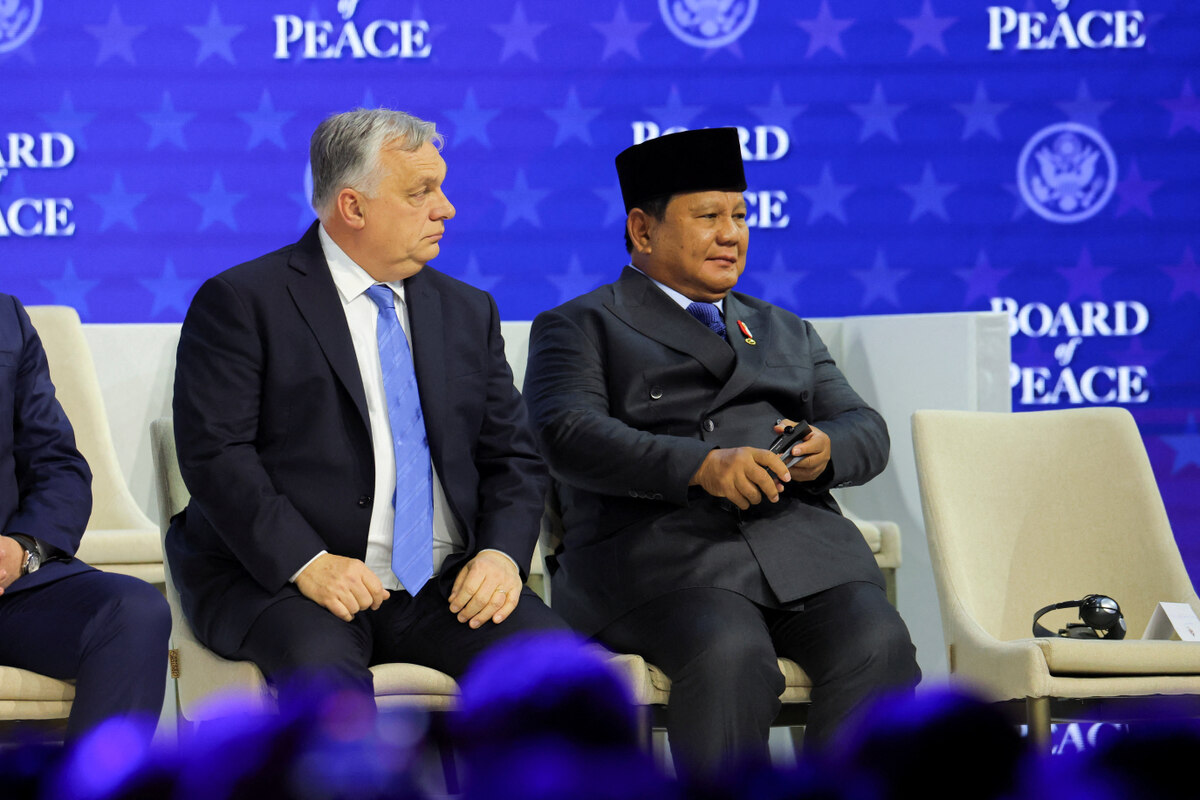
Set in oversized letters US President Donald Trump on Thursday in Davos, Switzerland, signed the so-called “Resolution 2026/1”. Peace Council. In keeping with the bureaucratic style of the United Nations, he thereby officialized the Council’s charter.
A number of heads of state and government also honored themselves, including Nikol Pashinyan from Armenia, Javier Milei from Argentina or Hungary’s Viktor Orbán. Twenty states confirmed their participation in Trump’s plan by signing the charter. In addition to Armenia, Argentina and Hungary, there are also Bahrain, Morocco, Azerbaijan, Bulgaria, Indonesia, Jordan, Kazakhstan, Kosovo, Pakistan, Paraguay, Qatar, Saudi Arabia, Turkey, United Arab Emirates, Uzbekistan and Mongolia.
Over sixty countries had been asked by the Trump administration to join the Peace Council. Originally he was supposed to direct the pacification and reconstruction of the Gaza Strip, but now – according to Trump’s vision – he should also help resolve other conflicts around the world.
But why were nineteen countries persuaded to join Trump’s council? It is rightly criticized that power is concentrated in the Chairman – Trump himself, of course – and that the Council could undermine the role of the United Nations as guardian of the international order.
Don’t piss off Trump
One reason is certainly the power of the USA, especially under Trump, who reacts violently, at least verbally, to diplomatic rejections. For example, when he threatened France with high tariffs on champagne and wine because President Emmanuel Macron expressed his opposition to his country’s participation in the Peace Council. Some people probably think that you should be on good terms with the capricious ruler.
Another reason: The so-called “liberal international world order” after the Second World War has not always delivered the stability it promised. This was particularly evident in West Asia: in Iraq, Lebanon and Yemen, for example, it was not so much the internationally recognized governments that were or are in control, but rather militant organizations supported by the Islamic Republic of Iran. This has already become a problem in the past for Riyadh and Abu Dhabi, for example.
In a more transactional order, coupled with a strong and pressured America, some of the signatories may feel they have an advantage.