

And if they didn’t die… then the vacuum cleaner is still under the clock next to the dining room table. A dinner scene, a man and woman in front of full plates at the table, is how Henrik Schrat designed the last picture of the fairy tale “The Strong Hans”.
They both look a little tired, no wonder after the previous adventures. The text was written there in white on a black background, from which a deep shaft and a cave were cut out: They led to the place deep underground where the strong Hans freed a captured king’s daughter from the power of a wild count. Several stages of the dramatic story, of liberation, betrayal and deception are crowded together here, the layout reinforces the emotions of fear and risk.
It’s done. The fifth and final volume of “Grimm’s Fairy Tales” (240 in number) was published at the end of 2025 Henrik Schratt newly illustrated. The Berlin artist has been working on the project for more than five years since it was published in 2020 one volume per year. And every time reading it was a surprise because, in addition to the collectively well-stored fairy tales, you always encountered strange, crazy, cheeky and anarchistic pieces that also belong to the Grimm world.
Like the fairy tale “The Twelve Lazy Servants”, a competition between loudmouths who, in literal speech, try to outdo each other by doing nothing, refusing to work, and letting the things entrusted to them go to waste. Schrat shows them sleeping over keyboards and on construction sites. A shot across the bow of the world of high achievers.
Without pedagogical corrections
That’s what makes this volume, as in the previous ones, part of the pleasure of reading. The revenge of the poor on the rich appears prominently in the picture, as if everything necessary for a theory of classicism had already been prepared in the fairy tales. Henrik Schrat did not tinker with the texts, which sometimes only consist of literal speech or a collection of improbable lies, nor did he make any pedagogical corrections to the fairy tales.
But it is enough that in his world of images the king’s daughters often appear as if they are prepared for hand-to-hand combat in Berlin traffic: enough thoughts shoot into the space between image and text to view outdated social patterns from a historical distance, without losing the desire for action-packed plots, the rapid transformation of locations, the tension and the comedy.
Henrik Schratt: “Grimm’s Fairy Tales, Volume 5”. Textem Verlag, Hamburg 2025. 281 pages, 350 illustrations, silver cut, 34 euros.
The graphic means, ink and brush, often develop a life of their own. The night flows black again and again across the page. The city’s towering architecture compresses the text into narrow columns. The fact that quite a bit of Berlin appears, a subway entrance here, a snack bar there, a watchtower (inhabited by Rapunzel) there, has already been mentioned in earlier volumes.

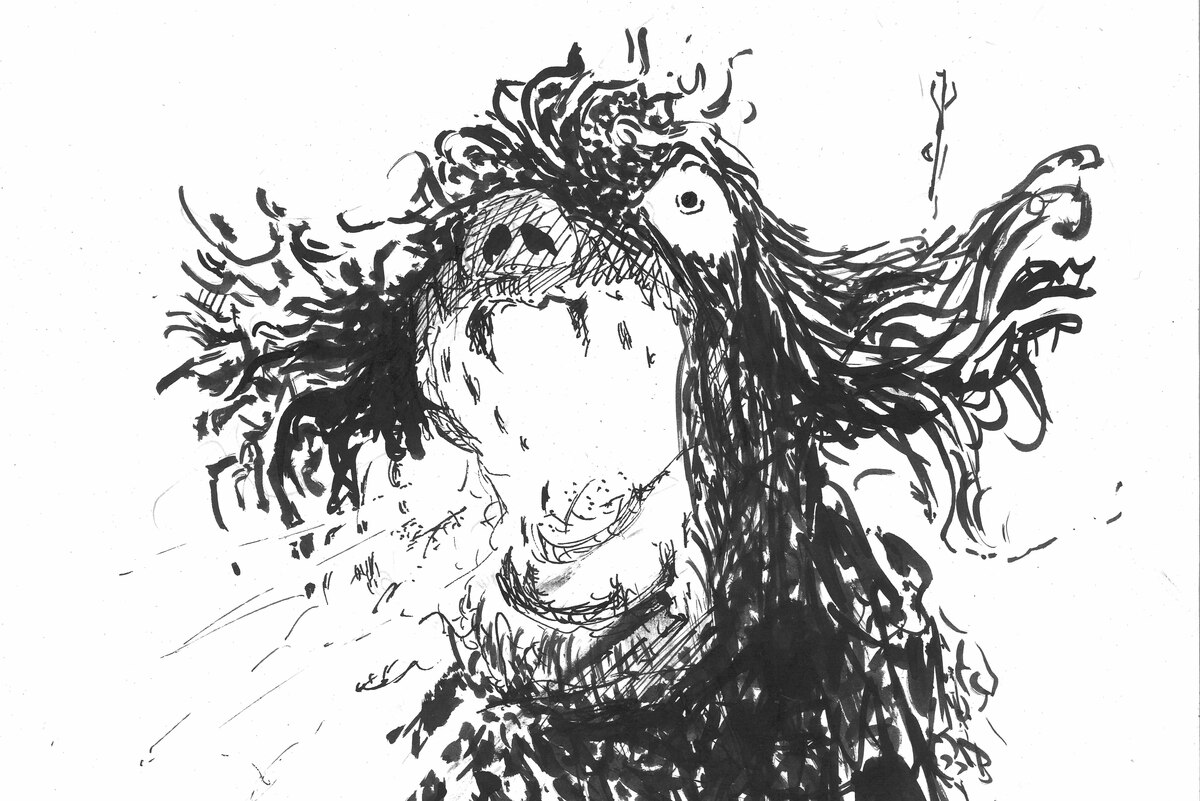
Incidentally, Henrik Schrat sent a giant, not from Grimm, but from the legends of his native region in Vogtland, into an educational campaign in 2024 before the state elections in Thuringia. The giant Dreibart should defend the values of democracy, fight against speechlessness and promote voter participation. Mobilizing the imaginative against structures of rigidity: that was Schrat’s strategy there as well as in his fairy tale pictures.
The penultimate fairy tale in the volume is that of Hansel and Gretel. At the end of the text they have happily returned to their father, who had previously left them in the forest out of hunger and need. The last picture shows the two of them on a motorcycle, their hair tousled by the wind, racing towards the viewer. Because where the fairy tale is over, life continues.