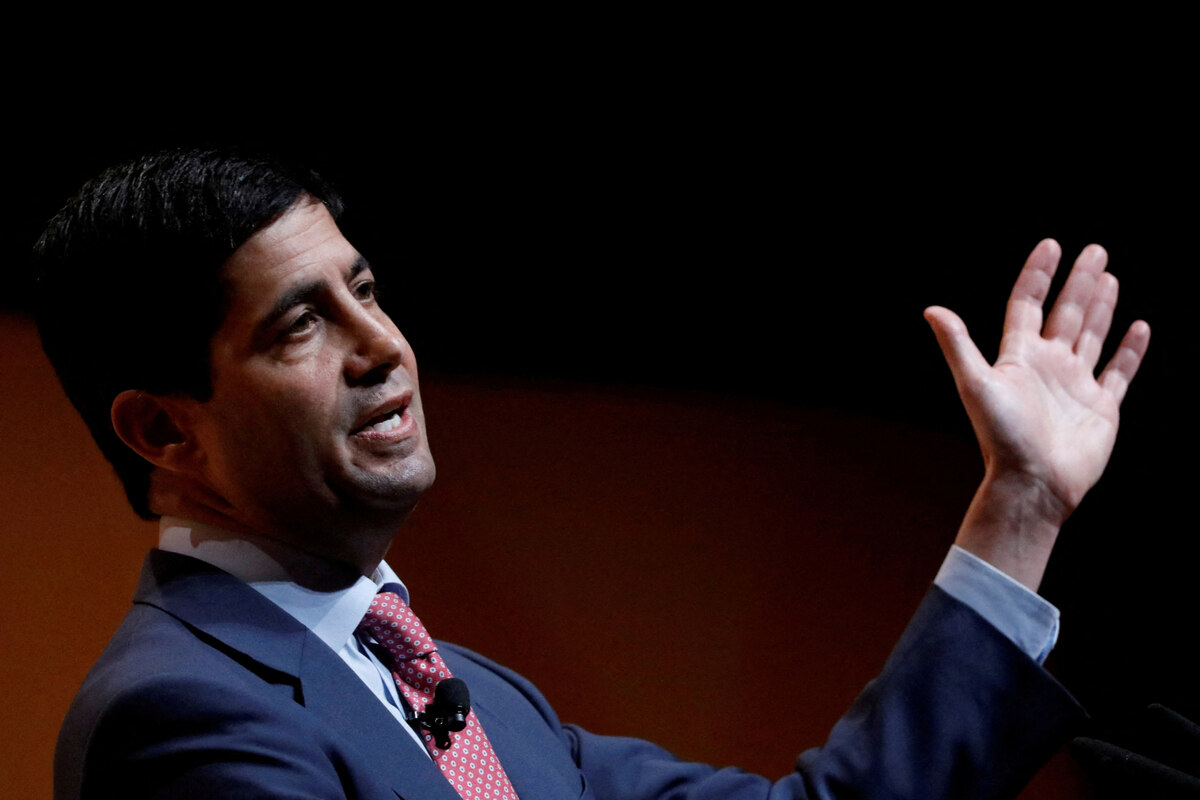
reuters | Economist and former Fed Director Kevin Warsh has entered the race to become the Fed’s future chairman US Federal Reserve enforced. This puts a proven financial expert at the head of the most influential central bank in the world, which is independent of political instructions. At the same time, US President Donald Trump emphasized before the nomination that the successor to Fed-Chef Jerome Powell will be a supporter of lower key interest rates. For Warsh, who currently works at the US elite University of Stanford, it is a return to his old place of work, as he sat on the board of the US Federal Reserve from 2006 to 2011.
The global financial crisis and the shocks it triggered, which drove up unemployment figures, occurred during this time. Unlike back then, the US economy is running smoothly. But inflation, which continues to be stubbornly high due to the consequences of Trump’s tariff policy, and a noticeably cooled labor market are presenting the Fed with new challenges, while Trump repeatedly pressures it to cut interest rates.
Fed Chairman Powell in the sights of the judiciary
Powell is even in the wake of cost overruns on a $2.5 billion renovation project at the Fed’s headquarters in Washington come into the sights of the judiciary. The Fed chief described the action as a pretext to put pressure on him over the interest rate cuts demanded by Trump. Warsh (55) made it clear in an interview with Fox News in the middle of last year that he would support an easing of monetary policy if he had a say in it.
Warsh was born in Albany, New York. He studied political science with a concentration in economics and statistics at Stanford University, where he received his bachelor’s degree with honors in 1992. He then studied at Harvard Law School at the intersection of law, economics and regulatory policy and completed his law degree in 1995.
In his professional career he has gained experience in the financial sector and politics. Warsh worked, among other things, for the major US bank Morgan Stanley and later also on President George W. Bush’s economic advisory board before moving to the Fed.
Should the Fed move closer to the Treasury?
Warsh caused a stir in mid-July 2025 with suggestions about the relationship between the Fed and the Treasury Department. In an interview with the television station CNBC, he floated the idea of weakening the agreement reached in 1951, according to which the US state’s debt management was separated from monetary policy. From Warsh’s perspective, reform could ease the Fed’s balance sheet reduction process by both institutions communicating their intentions together. However, this does not necessarily mean cooperation with the government.
The March 1951 agreement ended a period in which the central bank had committed to a low interest rate policy at the request of the Treasury Department to enable cheaper federal bonds to finance the war effort in World War II. Historians regard this agreement as a pivotal moment that established their practical independence from the government and laid the foundation for future monetary policy. With his attacks on the central bank, Trump has now sparked a debate about whether this independence is in danger. The US President has already expressed the expectation that he would like to be heard before making interest rate decisions.