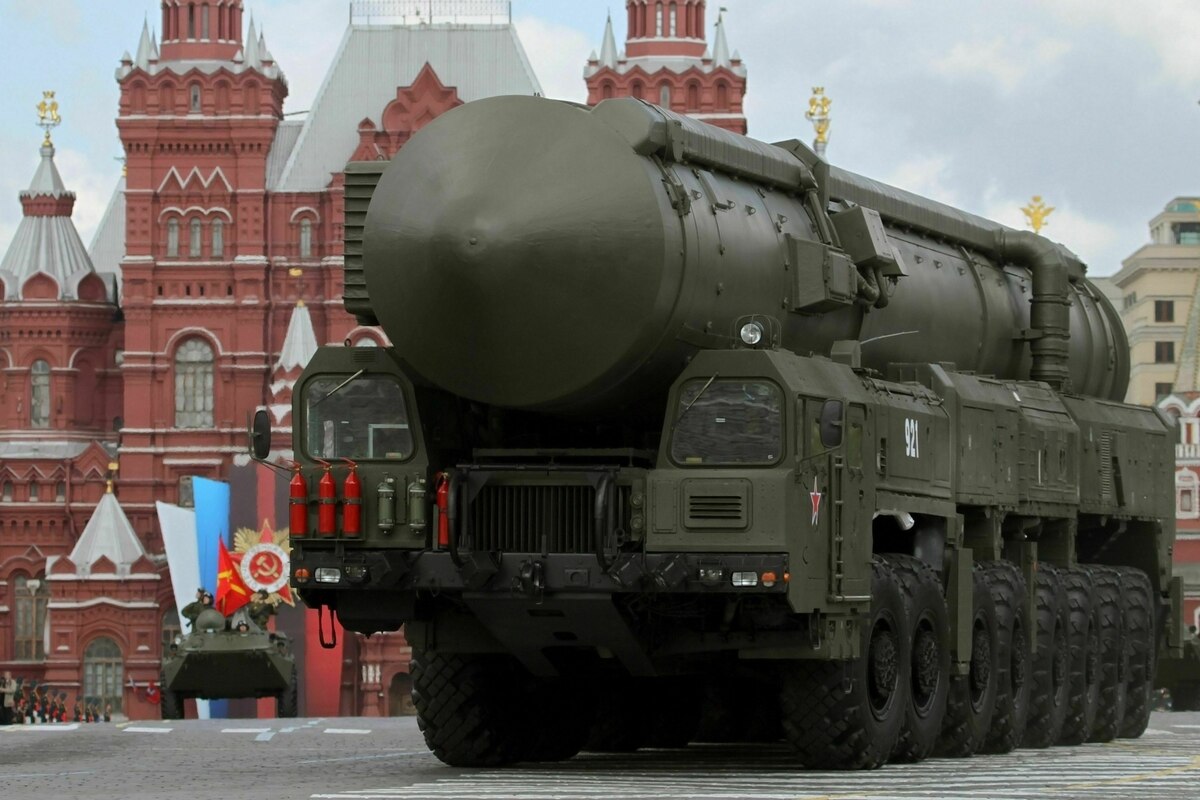
dpa | Creating peace with fewer and fewer nuclear weapons – that was the goal New Start arms control treaty of 2010. It is now the last agreement between the USA and Russia that limits the number of nuclear warheads and delivery systems – and it expires today. In official statements, Moscow complains about the end of the contract, but in Washington it is greeted with a shrug of the shoulders.
What does this mean for peace and security in the world? At the end of January, US scientists set their so-called Doomsday Clock, which warns of a catastrophic end to humanity, to 86 seconds before midnight – closer than ever before in history. Questions and answers on the topic:
Why was the New Start Treaty important?
US President Barack Obama and the then Kremlin chief Dmitry Medvedev signed New Start (from English: New Strategic Arms Reduction Treaty) in 2010. The agreement built on many predecessors. At the height of the Cold War, the superpowers maintained the balance of terror with 70,000 nuclear warheads. Then, starting in 1972, agreements such as Salt-I, ABM, Salt-II, Start 1, Start 2, Sort and INF restricted the arsenals.
New Start limited the number of strategic nuclear warheads to 1,550 for each side and the number of operational launchers to 700. In February 2021, the contract was extended for five years.
Did New Start work?
The reduction planned by 2018 has been achieved. To build trust, could Experts from the USA and Russia inspect the stand in the other country. However, these inspection trips were canceled from 2020 due to the corona epidemic. In 2022, Russian President Vladimir Putin ordered a war of aggression against Ukraine. In 2023, he suspended participation in New Start because his military would no longer be able to visit US weapons arsenals.
How do Moscow and Washington view the end of the treaty?
Officially, the Russian leadership is complaining about the expiry of New Start. “This creates a serious deficit that hardly corresponds to the interests of the peoples of our two countries and, in fact, the entire world,” said Kremlin spokesman Dmitry Peskov.
Moscow this week renewed its proposal to keep New Start limits for another year. The US did not comment. “No answer is also an answer,” stated Russian Deputy Foreign Minister Sergei Ryabkov. Without the treaty, Moscow has a free hand in the ongoing conversion and expansion of its nuclear force.
US President Donald Trump recently appeared unimpressed by the expiry of New Start. “We’ll just make a better deal,” he told the newspaper in early January New York Times. But US security experts are less calm than the man in the White House.
The CSIS think tank points to the Russian nuclear program and the arms buildup in China, which are not subject to any restrictions. “If this is an arms race, then the United States is losing it; and if it is not yet an arms race but becomes one, then the United States is starting behind,” warns CSIS expert Heather Williams.
What does the world of nuclear powers look like now?
The situation has become more confusing in recent years and decades. There are the recognized nuclear powers USA, Russia, China, France and Great Britain, all of them also on the UN Security Council. Additionally, India, Pakistan, North Korea and, unofficially, Israel have nuclear weapons.
There are more than 9,600 deployable nuclear warheads worldwide, wrote the Stockholm Institute for Peace Research (Sipri) in its report for 2025. More than four fifths belong to the arsenal of Russia and the USA. In the case of China, the researchers counted an increase to 600 warheads.
During the Ukraine war, Moscow repeatedly alluded to its nuclear potential in order to discourage Western countries from supporting the attacked country. In 2025 there was brief fighting between the nuclear powers India and Pakistan. And the covert nuclear power Israel destroyed nuclear facilities in Iran to prevent Tehran from building a bomb. The USA also intervened.
Finally, new weapons that do not fit into any previous treaty scheme are changing the situation. Russia, for example, has developed the Burevestnik nuclear-powered cruise missile and the nuclear-powered Poseidon underwater drone.
What comes next – arms race or new treaties?
“There are signs that a new arms race is emerging, one that involves many more risks and uncertainties than the last,” wrote then-Sipri director Dan Smith in 2025. The still unknown effects of artificial intelligence in defense technology also contribute to this. His successor Karim Haggag expects “a new phase of increased nuclear dangers” without New Start, as he wrote on Wednesday.
Washington has repeatedly called for China to be included in future nuclear disarmament treaties. But the leadership in Beijing has so far refused to do so. And China’s ally Russia also rejects this. The Chinese nuclear weapons potential cannot be compared with that of Russia and the USA, so it is negligible, said Kremlin spokesman Peskov. Moscow, on the other hand, is demanding that the nuclear potential of France (290 nuclear warheads according to Sipri) and Great Britain (225) be included in a new treaty.
Trump should lure Putin and China’s head of state Xi Jinping with the prospect of a three-party summit to reach agreements on nuclear arms control, suggested the US institute CSIS.
How is the situation changing for Germany and Europe?
The security situation in Europe has deteriorated significantly worsened by the war in Ukraine and Russia’s desire to become a major power. However, Russia denies aggressive intentions and accuses the EU and NATO of hostility. In addition, in Trump’s second term in office, doubts are growing about how reliable the US nuclear umbrella is for the European NATO allies. As part of the so-called nuclear sharing, US atomic bombs are stationed in Germany, and German jets could also fire them.
It is being discussed whether Germany should not build its own atomic bomb in this security situation. However, the Two Plus Four Treaty on German reunification and the Nuclear Non-Proliferation Treaty do not allow nuclear weapons. Considerations about a European nuclear umbrella with France and Great Britain are at the beginning. That is why the German government is relying on stronger conventional armament as a deterrent.