

In February 2025, the city of Oldenburg will be named after the founder Edith Ruß deleted from the House for Media Art. The removed lettering is now in the backyard the municipal gallery. The starting point for the renaming was an article in the taz drew attention to Russ’ Nazi past. Among other things, as head of the features section of the official NSDAP newspaper “Oldenburgische Staatszeitung” until 1945, she spread propaganda about “Lebensraum” and “Final Victory”. With a “historical-artistic experiment,” the house is now shedding light on the biography of its former namesake.
“We also see this exhibition as part of a reappraisal of local history and National Socialism itself. We find this very important, especially in times when right-wing populism and right-wing radicalism are on the rise all over the world,” explains Marcel Schwierin, who has been running the House for Media Art together with Edit Molnár since 2015.
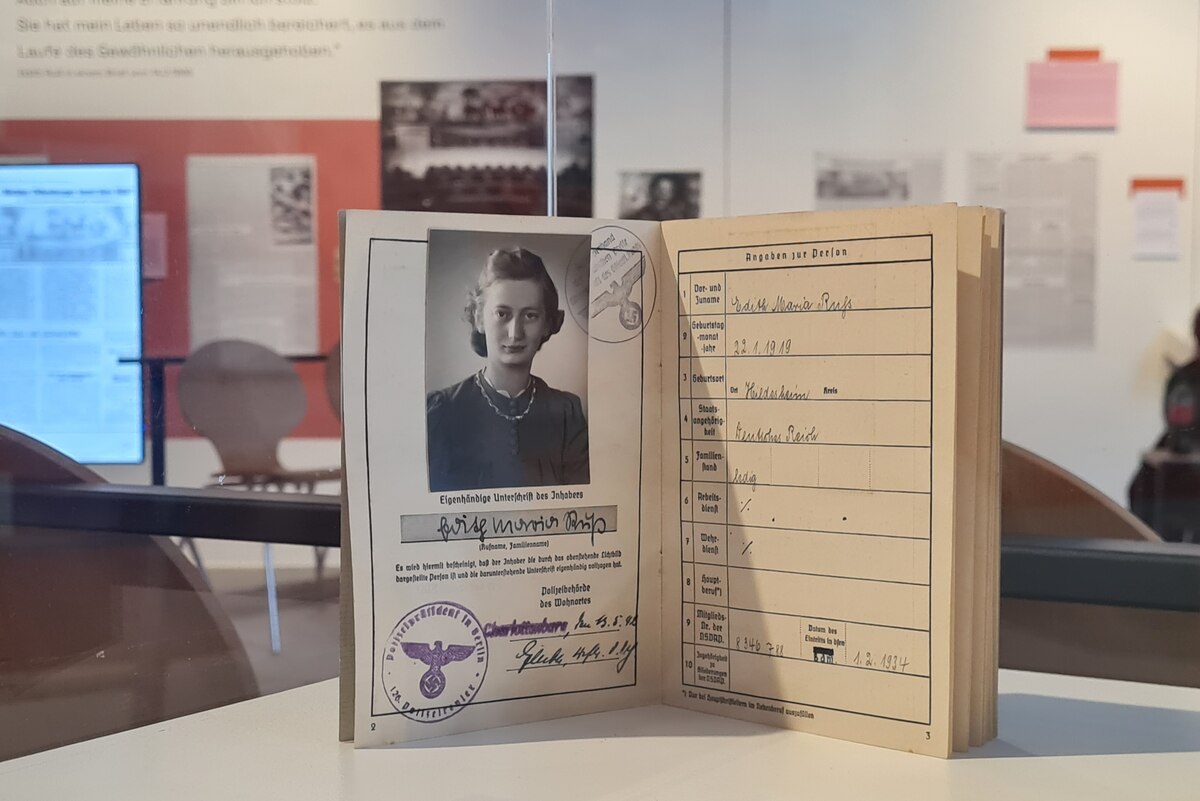
The historical part of the exhibition traces the life of Edith Ruß. Visitors can read the almost 200 original articles they have written on a screen and their ID as editor, Nazi-speak for newspaper editors loyal to the regime, is also on display. With its classification in category A, it was considered to be particularly ideological.
Her boss at the “Staatzeitung” was the ardent anti-Semite Herbert Heitz. In 1948 she issued him a clean bill of health for his denazification process and in return had him certify that he was not a member of the NSDAP. An obvious lie that no one questioned until the taz publications and was adopted in the biography published by Isensee-Verlag when the house opened. Now a new biography is in the works.
Journalistic continuities left out
Isensee was also the company that printed the “Staatzeitung” and its predecessor from 1929 onwards. There is no reference to this connection in the exhibition. There still seems to be reluctance to specifically name the actors of Oldenburg’s brown past.
In addition to various donations to the Oldenburg State Museum, Russ also initiated and co-financed the statue “The Ages of Life” in Bremen in honor of her lover Manfred Hausmann during her lifetime. The naming of the Manfred-Hausmann-Weg in Worpswede is also probably due to her.
It is still unclear where Ruß’ enormous fortune comes from. An inheritance from her uncle is possible. What is certain is that she evaded taxes on a massive scale, which is why an additional payment was due to the tax authorities when the will was executed.
Ruß’ young age was often cited as exonerating him under National Socialism. In addition to their biographies, the exhibition also sketches the lives of the “White Rose” resistance fighter Traute Lafrenz, who was the same age, and the Jewish woman Erna Gellert, who was born in Wardenburg and murdered in 1942. They are intended to show that, on the one hand, resistance was very possible and, on the other hand, those persecuted by the regime, unlike Ruß, did not have the privilege of a choice.
The CDU and FDP are of the opinion that Ruß’ later work as a special school teacher shows a turning away from National Socialism
Works on National Socialism and memory by Dani Gal, Roee Rosen, Fynn Ribbeck and others represent the artistic part of the exhibition.
It is accompanied by an open discussion room and several lectures. In this context, the historian Joachim Tautz once again presented the report commissioned by the city. After the taz pointed out several errorsit has now been at least partially revised.
In contrast to his co-author Mareike Witkowski, Tautz comes to the clear conclusion that Ruß was a “convinced National Socialist”. He also criticizes the argument of the CDU and FDP in the city council, which voted against the renaming, that Ruß’ later work as a special school teacher would have demonstrated a move away from National Socialism.
The house has finally cracked with soot. In the opening speech of the exhibition, head of the cultural department Holger Denckman also praised himself for the subsequent good handling of the “mistake” of not having adequately researched the donor’s biography. He failed to mention that not only was Ruß’ work as a Nazi propagandist already known when the house opened, but her editor’s card, including her NSDAP membership number, was also in the city’s possession.
He described the exhibition as the “conclusion” of the process. This attitude raises doubts about a fundamental realignment of Oldenburg’s culture of remembrance.
Transparency note: The author gave a lecture as part of the exhibition.