

taz: Mr. Nouripour, the protests in Iran are already easing in view of the massive brutality against the population. Has the regime won again?
Omid Nouripour: No, the regime has continued to lose ground and its foundations are crumbling more and more. Even though the protests may be decreasing, no problem has been solved. People’s desperation has grown, as has their anger.
taz: There are reports of thousands of deaths; the regime apparently shoots demonstrators indiscriminately.
Nouripour: The regime is pursuing a perverse strategy: they are shooting like there is no tomorrow. Because they know that otherwise there will be no tomorrow for the regime. And then they show the pictures of the body bags on state television, accuse the demonstrators of murder and know that no one believes them, but everyone can see that the regime is really slaughtering people. And then they execute people who are arbitrarily arrested.

This text comes from the weekday. Our weekly newspaper from the left! Every week, wochentaz is about the world as it is – and as it could be. A left-wing weekly newspaper with a voice, attitude and the special taz view of the world. New every Saturday at the kiosk and of course by subscription.
taz: You said a few days ago, The Iranian population has never been this close to freedom since the revolution. There was a lot of hope there. And now?
Nouripour: Hope is not gone. But it’s true: things aren’t looking good right now. In addition, it is still unclear whether Trump will follow up on his announcements with action.
taz: What just happened?
Nouripour: This is not the first major wave of protests, but it is the largest in five decades. Demonstrations took place in over 180 cities: trade unionists, people in poorer neighborhoods and those fighting for political freedom.
taz: Why is that?
Nouripour: The people are desperate, they are becoming impoverished. The currency collapses. There is nothing that is not at least twice as expensive as it was a year ago. I hardly know anyone who doesn’t work two or three jobs and still can’t make ends meet. There are an extremely large number of homeless children, even in the middle of winter. In Farsi they are called cardboard sleepers because they sleep on cardboard boxes. Added to this is the great lack of freedom, which affects not only, but above all, women. The courage of women is still the foundation, it is what makes the protests so strong.

Still image from social media from January 12, 2026: presumably dead people in front of a mortuary in Kahrizak near Tehran
Photo:
ap
taz: How did you spend the last few days?
Nouripour: I was busy gathering information and seeing if the people I knew were okay.
taz: You lived in Iran as a child and have family there. How are you doing?
Nouripour: I’m exhausted. But I’m not entitled to that because I’m sitting here in the dry and in a free country. I have the privilege of holding public office in a democracy. The courageous Iranians, on the other hand, are currently risking their lives and carrying on.
taz: The regime has shut down the internet and wants to prevent images from leaking out.
Nouripour: This is not new. But the complete shutdown of the Internet and, in some cases, the entire landline network means that in some cases you can no longer communicate at all. This means that neither images come out nor can people coordinate or warn where shooting is taking place.
taz: Which scenarios are now conceivable?
Nouripour: There are, roughly speaking, four: an implosion of the regime and the Revolutionary Guards taking over completely.
taz: That would be a military dictatorship.

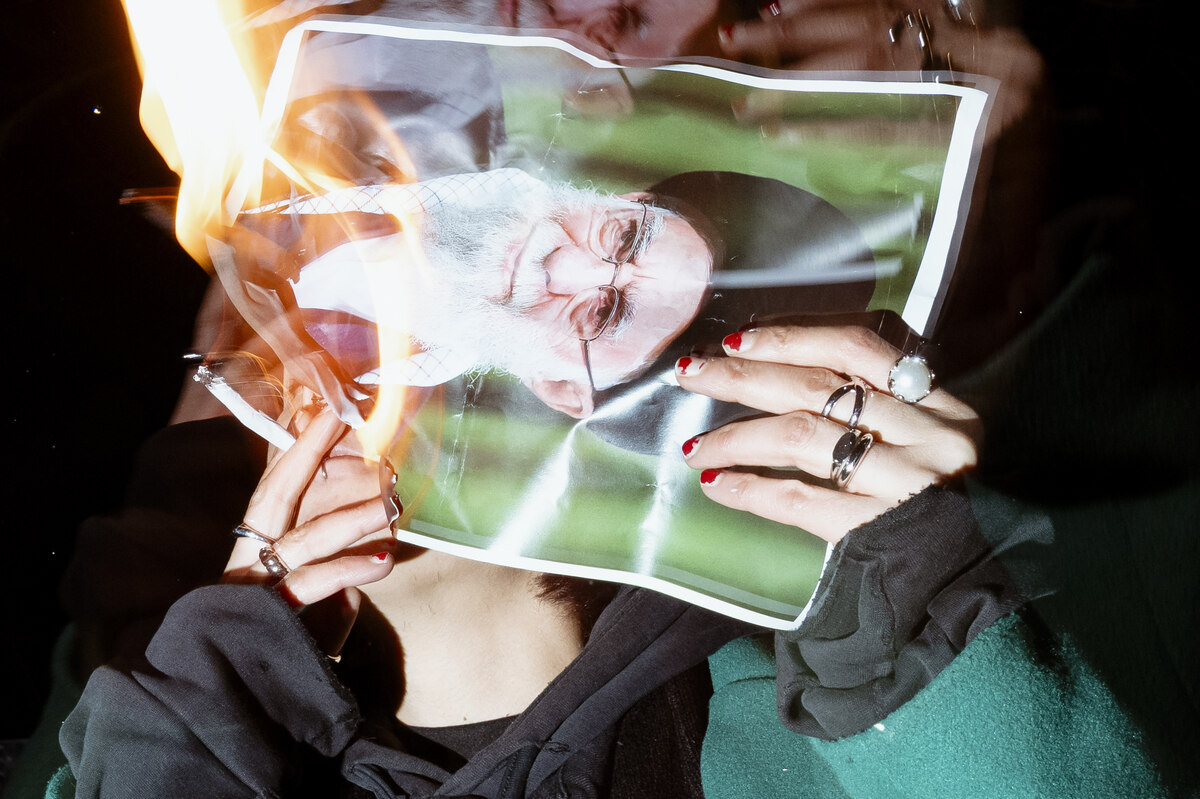
Nouripour: Exactly. Or there will be chaos and even civil war. Or the regime collapses. The fourth option is: everything is postponed. A lot depends on the USA.
taz: Donald Trump posted on Tuesday: Help is on the way. Do the Iranians have to hope that the US will intervene?
Nouripour: Iran can only be liberated from within. But of course the US can continue to shake the pillars of the regime. Trump has encouraged people to take to the streets, knowing that it is life-threatening. He has often emphasized in the past two weeks that if the regime starts murdering, that will be his red line. The killing continued all the time. At this moment, Trump is acting as if the killing has stopped – which is unfortunately wrong. Outcome uncertain.
taz: How do you assess the possibility of US intervention?
Nouripour: It is completely unclear what such an intervention would look like. You can’t just go into Iran, walk out and act like you took over the country. Financial pressure is needed, but it doesn’t take effect immediately. Internet via Starlink satellites It’s supposedly now available to everyone free of charge, but I haven’t had that confirmed yet. At least there have been no more pictures from Iran in the last few hours.
taz: The Greens have them Military intervention in Venezuela sentenced. Would an intervention in Iran be more legitimate given the thousands of deaths?
Nouripour: You can’t compare the two. Crimes against humanity are taking place in Iran. At the same time, one cannot assume that Trump would seek a UN mandate. But if I understand it correctly, you want to know whether I think it makes sense.
taz: That too.
Nouripour: If I think about it from the end, I don’t know how a military strike can permanently improve the situation of the Iranians. Especially since there are many ways to help the people of Iran.
taz: Which one?
Nouripour: If Trump followed through on his threats to impose 25 percent tariffs on every country that does business with Iran, that would be a very effective tool. This primarily affects the Gulf states, China, Russia and India. But I don’t believe in it. Donald Junior is currently doing good business with some of these countries.
taz: Whenever people protest in Iran, they demand that they… Revolutionary Guard on the EU terror list must.
Nouripour: And nothing happened. We have a federal government that can do one thing above all: analyze. This applies to the Chancellor and the Foreign Minister. How about finally getting started? In the last few weeks I’ve just noticed a new quality of spectatorship.
taz: What do you expect?
Nouripour: The listing of the Revolutionary Guards is relevant…
taz: There weren’t any under the traffic lights either, when your party friend Annalena Baerbock was Foreign Minister.
Nouripour: She tried several times. And not just after two and a half weeks like her successor.
taz: What would that bring?
Nouripour: The listing is not just pure symbolism. The Revolutionary Guard has a shadow economy that is probably larger than the country’s official economy, which is how it finances its repressive machinery. The point is that it cannot continue to do business in Europe. The question of regime henchmen’s private assets is also important; there are a lot of them in Europe.
taz: What else could the federal government do?
Nouripour: Why doesn’t the Chancellor welcome Iranian activists who stand up for their rights? Macron received them at the Élysée, and the traffic light government did the same.
taz: So create images of solidarity.
Nouripour: Yes! If this regime has lost legitimacy, as the federal government says, what is stopping them from targeting women’s rights activists? There are many well-known people from the art and culture scene and civil society here who had to flee Iran. There are directors who have won the Palme d’Or or an Oscar. What stops the federal government from showing up and asking them how they are doing? The federal government should also decide to stop deportations in this situation. There are also a number of people who entered the country with a Schengen visa and are now unable to return; their visas should be extended unbureaucratically.
taz: Many Iranians are rallying behind this Son of the Shah. How do you assess that?
Nouripour: I’m not a royalist. But I have to acknowledge that a relatively large number of people are projecting their hopes onto him. What is crucial now is that the killing stops and that at some point the people of Iran can freely decide for themselves who should be at the head of the country.
taz: In Iran there is no chance of building an opposition figure; in the diaspora the opposition is divided. Last Saturday there were three demos in Berlin alone.
Nouripour: This is all bitter. But what frustrates me more right now is that every single demonstration was organized purely by exiled Iranians. I know of other waves of solidarity from the past, including from across the democratic spectrum.
taz: You fled Iran when you were 13. When was the last time you were there?
Nouripour: I went there a few times on business and also secretly met the right people. The crucial thing was how to get out again. I’m not allowed to hand over my Iranian passport. So I always made sure that I left with a delegation. With German, partly European colleagues. And yet there were moments when three colleagues from the Bundestag courageously stood around me and had to say: We won’t leave without him. Otherwise I might not have come out.
taz: Do you also have fond memories of Iran?
Nouripour: Extremely many, I had an adventurously beautiful childhood. This also has to do with the fact that as a child I only understood the horror of war very late. When I see current pictures from Tehran, I recognize a lot of things: I got off the bus around the corner, my school was there. We played there, I went shopping there with my aunt. The basic feeling is pain. And that goes for everyone who is connected to the country.
taz: You did many years ago told about your uncle Hassan in the tazwho taught you to write in Tehran.
Nouripour: (struggles for composure) Hassan was 17 years old and had been handing out flyers. He was executed by the regime.
taz: You are now 50. Will you live to see the end of the regime?
Nouripour: Yes. And then I will finally show my son this beautiful country.