

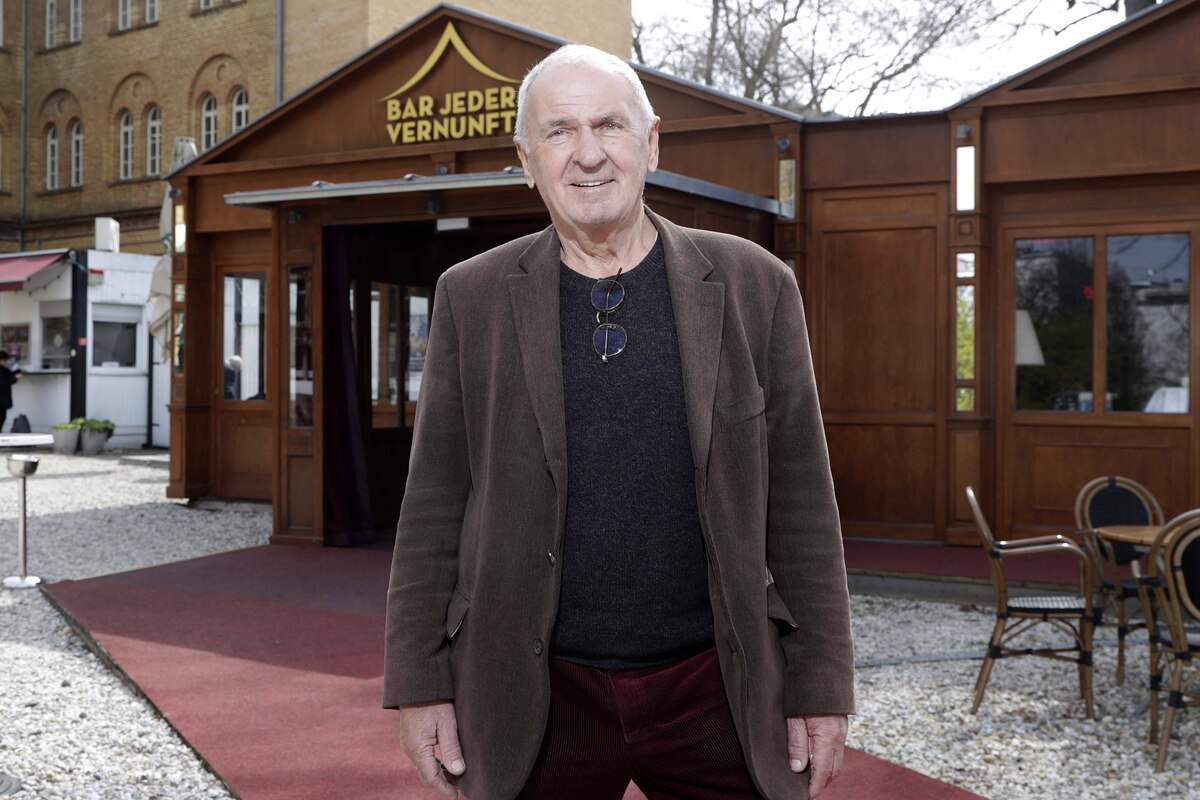
With the friendly, yet cool look of a viewer of aesthetic street furniture, one could say: Without him, Berlin – the capital of the new Federal Republic since the fall of the Wall – would be artistically poorer in every respect. About as gray and monotonous as a city of millions can be in a dirty winter with little snow.
Holger Klotzbach gave Berlin an art, with his friend and business partner Lutz Deisenbach, by founding the Bar of Every Reason – the name alone! – and years later with the Tipi branch at the Chancellery, which simply did not exist between the bourgeois operatic airs, the tired boulevard on the Kudamm and the fading underground in the respective trendy districts. Revue, Operette, Entertainment.
“The White Rößl,” for example, supposedly the dustiest culture, became a spectacular comeback in the bar of all reason in the tradition of queer cultures that last existed in Berlin during the years of the Weimar Republic.
Official bourgeois scenes had no idea how much they would be inherited by these venues
Klotzbach, who brought with him a pure left-wing radical past as a theater principal, an actor in the ’68 movement in Tübingen, so-called organizational secretary of the “Proletarian Left/Party Initiative”, one of the many political curiosities of those years of awakening the Federal Republic into a more relaxed manners. He missed out on the teaching profession that he actually wanted to take up, as determined by the state. The “Radical Decree” also applied to him, which applied to teacher candidates who wanted to ensnare the Federal Republic in a revolutionary way.
Circus-Roncalli-like placed in the Berlin air
Perhaps it was lucky for him that he didn’t have to make his living in schools, but rather in the artistic sector. This man, who was born in Duisburg, was ultimately the co-founder of the Black Café in West Berlin, Member of the cabaret “The 3 Tornados” – great intermediate stages in the alternative sceneswhich the official bourgeois scenes had no idea how much they would be inherited by venues like the Bar of Every Reason or the Tipi.
The The first theater is well attended on a former parking deck in the dignified Wilmersdorf, already tent-like, circus-Roncalli-like set in the Berlin air. The Tipi is a tent village between the government headquarters and the zoo, both “houses” are jewels, elegant and playful in one. Atmospherically the opposite of the brutalism of the late eighties.
In Holger Klotzbach’s theater landscape, he was the king, the inspirer, the idea person, the man with sensitivity for the artists who the enthusiastic audience celebrated. Without Klotzbach we would be Maren KroymannGustav Peter Wöhler, Katharine Mehrling, Georgette Dee, Gayle Tufts, Rainer Bielfeldt, Tim Fischer, Cora Frost, Meret Becker, Dominique Horwitz, Pigor & Eichhorn, Gitte Haenning, the Pfister siblings, Lisa Eckardt and Ades Zabel either remained unrecognized or never had the chance to avoid being taken to the Austragshäusl as aging diseuses.
He was looking forward to this evening so much, with high spirits and impatience as we know him
Eric Schmidt-Mohan, widower of Holger Klotzbach
Holger Klotzbach, a curator with sensitivity, has turned his venues into Berlin brands, despite all the occasional problems with capacity utilization – in the Tipi, a politician like Klaus Wowereit established his legendary reputation for having a gay evening life beyond the file studies in the Red Town Hall, for becoming a party beast. Berlin is “poor but sexy” – apparently as a marketing slogan in times of budget constraints placed in the teepee. The tipi and bar of every reason were the home, the home of a new Berlin feeling: far from the principled complaining about everything and everyone, elegant and yet tasty, cuddly in the aura and friendly (yes, Berlin has places of friendliness) to everyone.
Of course gay, lesbian and erotically ambivalent
Politically, Holger Klotzbach’s places of entertainment were gay in a confident way by himself (and his husband), without it feeling like a slogan. In the tipi and in the bar of all reason it was queer – which is not meant ideologically, but as a spatial installation in the city in which gay, lesbian and erotically ambivalent things simply seemed to be self-evident.
Holger Klotzbach died on January 23rd, shortly before his 80th birthday. And that meant for his theaters: The shows must go on. The audience cried when Klotzbach’s widower, Eric Schmidt-Mohan, died on the evening of Operetta premiere “Frau Luna” had to announce the death of his husband. He said to the audience: “And so I can invite you to fly to the moon with us and celebrate this evening, as is the custom in our house. The invitations to our premiere explicitly say Holger Klotzbach, because he was looking forward to this evening so much, with high spirits and impatience as we know it. And I now assume that his impatience was so great that he flew ahead to the stars yesterday.”
Klotzbach, the old ex-left radical magician of the really fine arts, would have liked that. May his theaters live without him as long as Berlin needs them. So forever!