

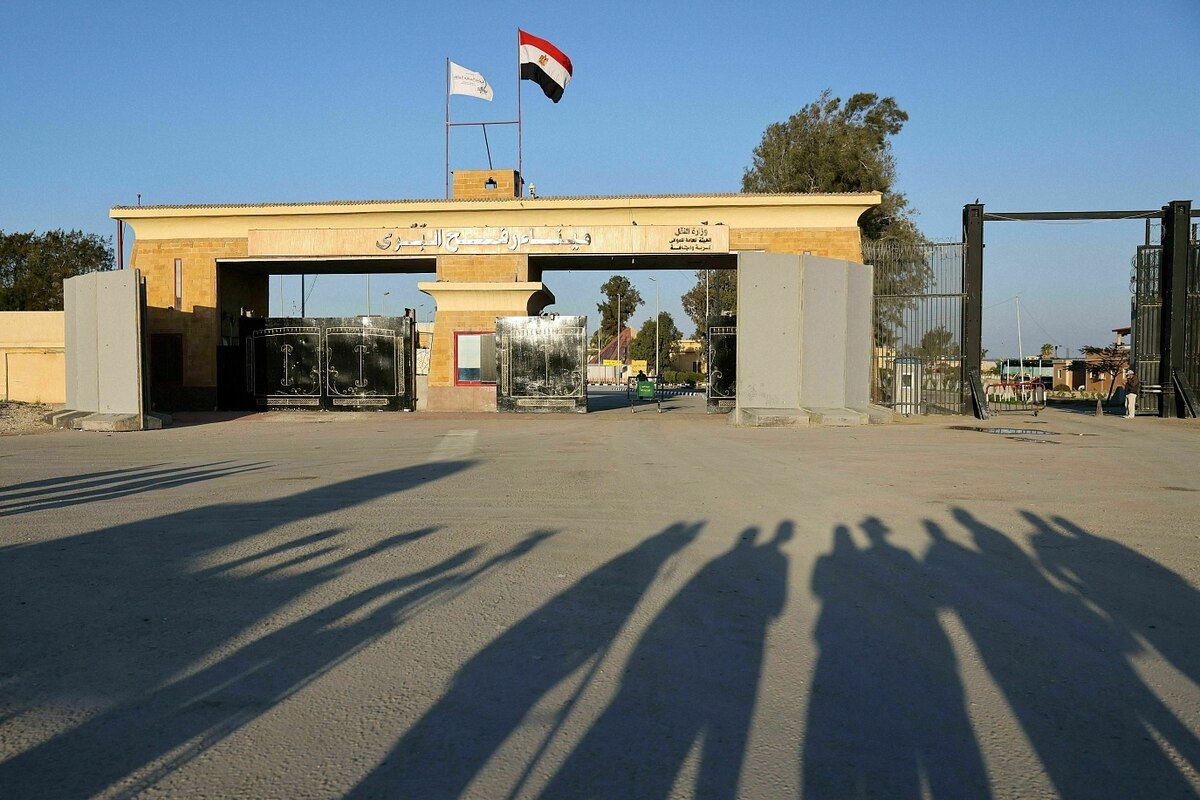
dpa | After completing a military operation to find the last hostage body in the Gaza Strip, Israel wants to reopen the Rafah border crossing between Egypt and the coastal area to limited passenger traffic. Prime Minister Benjamin Netanyahu’s office announced this last night. Upon completion of this operation and in accordance with agreements with the United States, Israel will open the crossing under full Israeli control. However, a timetable was not given.
In the statement, Israel demands that the Islamist terrorist organization Hamas make every effort to locate and hand over the hostage’s body. At the same time, it is said that Israel’s armed forces are currently conducting a targeted operation to exhaust all the information they have collected, find and bring back the body of police officer Ran Gvili. According to the armed forces, the search area extends to a cemetery in the area of the so-called Yellow Line. This divides the Gaza Strip into a part controlled by the Israeli military and a part free from the Israeli military.
Still open questions
A spokesman for the Qassam Brigades, Hamas’s military wing, had previously said that the militia was assisting the mediators in the Gaza peace process handed over all the information needed to find the body. The Times of Israel quoted a US official as saying that Israel’s operation was expected to last several more days. Accordingly, the Rafah border crossing could be reopened by the end of this week.
However, it is unclear whether this will also make it possible for refugee Palestinians stranded in Egypt to return. The Rafah border crossing, which has been closed for almost a year, is considered the Gaza Strip’s most important gateway to the world. It is the only border crossing in the Gaza Strip that does not lead directly to Israel. Israel’s military controls the Gaza side of the crossing.
USA put pressure on
As part of the first part of US President Donald Trump’s peace plan, among other things, all those kidnapped from Israel and the bodies of the hostages should be handed over. Israel had made the repatriation of the last body a condition for entering the second phase – including the reopening of the Rafah border crossing. Before Israel agreed to open it only to passenger traffic, Netanyahu met on Saturday evening with US envoy Steve Witkoff and US President Donald Trump’s son-in-law and adviser Jared Kushner. talked about the second phase.
The US wants to move on to this next phase and is urging Israel to open Rafah. In the second phase of the agreement, Hamas is to be disarmed. However, the Islamist terrorist organization has so far rejected this. According to Israeli media reports, at a security cabinet meeting on Sunday evening, right-wing extremist ministers in Netanyahu’s government sharply criticized the decision to reopen the Rafah border crossing after the search for the last Hamas hostage was completed.
Reports: Israel’s right-wing extremists against Rafah opening
Hamas has still not been completely “eliminated,” right-wing extremist Police Minister Itamar Ben-Gvir was quoted as saying. It must be smashed and disarmed. Reopening the Rafah border crossing would be “a big mistake and a very bad signal,” Ben-Gvir is reported to have said.
Ali Shaath, chairman of the new Palestinian government of experts for the war-ravaged Gaza Strip, announced on Thursday that the crossing would be opened in both directions. Although aid deliveries are processed in Rafah, they only reach the needy population through the nearby Kerem Shalom crossing.
Aid organizations have long been calling for the Rafah border crossing to be opened. For Israel, the repatriation of the last dead hostage was a central point in the negotiations. The then 24-year-old police officer Gvili was killed on October 7, 2023 in the massacre by Hamas and other extremist organizations in Israel and his body was taken to the Gaza Strip.
The massacre, in which a total of around 1,200 people were killed and more than 250 others were kidnapped in the coastal strip, was the trigger for the war. Israel responded with massive airstrikes and ground operations in Gaza. In the two years of war, more than 70,000 Palestinians were killed, according to Hamas-controlled authorities. A ceasefire has been in effect since October 10th. However, it is coming continue to cause fatal incidents.