

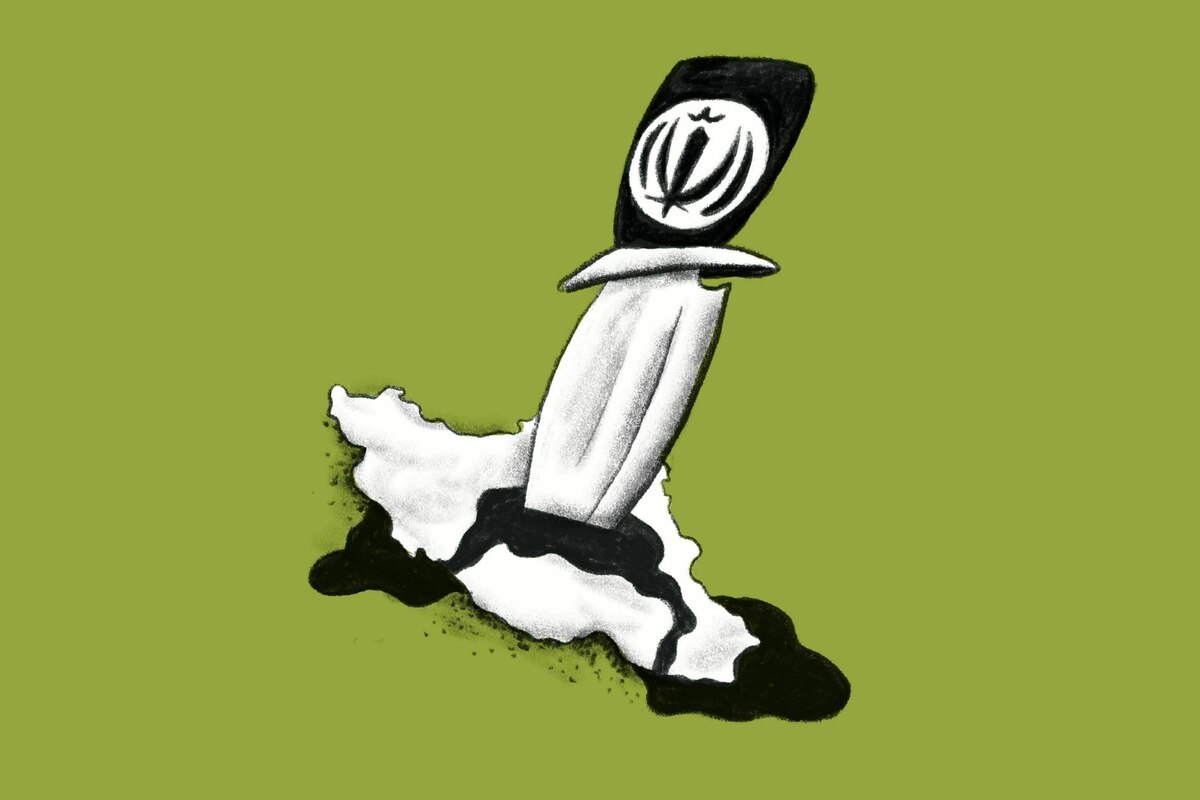
D he Iranian regime has a horrific record. It has plundered and wasted the country’s wealth, and its infrastructure and economic situation are catastrophic. It has given the Iranians nothing but empty phrases that the regime itself no longer believes in for a long time. Civil society is suppressed, women’s rights are ignored, and freedom of assembly and freedom of expression do not exist. Elections are strictly controlled, opposition candidates are not admitted, and election results – if all this is not enough – are falsified if necessary.
At the last one so far Wave of protests from December 2025 to January 2026 Many people demonstrated for an improvement in their economic situation and for their political rights. They wanted to live in dignity and overthrow the dictatorship. Many paid a high price for this: death, injuries, arrests. Although the demonstrations have subsided for the time being, the risk of torture, arrests and executions remains high.
The survival of the Iranian regime despite mass protests that have been breaking out over the years can be explained by several factors. Shortly after the Islamic Revolution of 1979, the eight-year Iran-Iraq War helped consolidate power structures. The Revolutionary Guards (IRGC) not only developed into a strong competitor to the classic military, but now also control a large part of the country’s economic resources – a power apparatus that prevents a rapid fall of the regime like in the “Arab Spring” in Tunisia or Egypt. Despite conflicts, the cohesion of the various power apparatuses (such as the clerics around the “religious leader” Khamenei) still remains without any cracks. However, less attention is paid to the fact that long-term stability relies primarily on the lack of a robust civil society, organized political opposition and credible reform processes.

The development of a vibrant civil society was initially very limited and was later systematically suppressed. This had three inevitable consequences: First, it prevented Iranian society from gaining experience in political activity and organization. Secondly, it was rarely about shaping one’s own society based on one’s own needs and ideas. And finally, political thought focused on defending against government overreach or failure. Because of the suppression of virtually all opposition or independent activity, no organized opposition could form in Iran. This further weakened the potential for change.
In many ways, 2009 was a turning point. In the presidential election campaign at the time, there was an extraordinary public mobilization for two candidates – Mir Hossein Mousavi and Mehdi Karroubi – including the “Green Movement”. After the election fraud and the violent suppression of the protests, widespread enthusiasm for the opposition candidates quickly turned into resignation, despair and hatred of the regime. Up to this point, the population had always placed hope in reforms.
Fighting dictatorship by idealizing a previous dictatorship is not a suitable path to a free and democratic future
But gradually the reformists began to resent the fact that they did not clearly and unequivocally support the victims of state violence or fundamentally question the regime. Disappointment with the reformists spread quickly and became a general phenomenon. As a result, hopes for a fundamental reform of the Islamic Republic “from within” largely vanished into thin air. This was evident in the failure of Hassan Rouhani’s presidency. With the support of two former presidents – Hommamad Khatami and Ali Akbar Hashemi Rafsanjani – he presented himself as a reform-oriented politician.
Impulses from abroad
At the end of his term in office, however, it was clear that he too could not keep his promises to the population. The targeted undermining of reform approaches by the hardliners around the “leader” Ali Khamenei prevented a gradual opening of the political system and contributed significantly to the regime being able to stabilize in its repressive form.
In recent years, a few people have appeared as spokespersons for the opposition, partly in the context of new protest movements, partly due to impulses from abroad, including Shirin Ebadi, Masih Alinejad and Hamed Esmaeilion. After the “Woman-Life-Freedom” wave of protests in autumn 2022, the right-wing conservative son of the former king, Reza Pahlavi, be counted as such. These figures have access to international media and, to varying degrees, reputation within Iran itself, even if they are mostly in exile. However, there is still no organized opposition in the country itself, and the opposition has not yet achieved unity or unification. There is therefore still no credible power alternative to the regime in Iran.
One result of the internal lack of prospects is that political hope is increasingly being shifted externally. For example, the exiled politician Reza Pahlavi became an important player not through his own strength, but through the fragmentation of the opposition, the hopelessness and lack of alternatives in the country. At the same time, a mindset has become widespread that hopes for liberation from outside dictatorship by Israel and the USA, even through further military attacks on Iran. The external powers remain primarily oriented towards their own interests. Hoping for his liberation from US President Donald Trump and Israeli Prime Minister Benjamin Netanyahu is, above all, a sign of desperation. Nobody can know whether Trump will not make a deal with parts of the regime when the opportunity arises if this would promise access to Iranian oil.
The new enthusiasm for the son of the former Shah is a mere projection of hopes for an alternative to the regime. It is done by emphasizing positive aspects of the Shah’s time, such as certain modernization measures such as cultural support programs, school nutrition programs, and reforms in family law. In retrospect, however, the dictatorial reality of the former Shah’s rule is ignored or idealized. The torture and political oppression that was widespread at the time are trivialized or denied. Pressing current questions are also swept under the carpet, including why Reza Pahlavi presents himself as conservative-democratic in public, but at the same time tolerates many right-wing radical, anti-democratic or nationalist supporters. He himself often refers to democratic principles in statements and interviews.
No change without commonality
At the same time, these confessions remain vague and general. A clear positioning against non-democratic ideas within his own circle of supporters as well as concrete ideas about democratic institutions and his own role in a possible transition process have so far been missing. This strategic vagueness contributes to ongoing skepticism about his political project.
What significance could this have for a future Iran? Fighting dictatorship by idealizing a previous dictatorship is not a suitable path to a free and democratic future. Iran has a diverse opposition potential, with personalities such as Reza Pahlavi, Narges Mohammadi and Masih Alinejad each representing symbolic weight, social trust or international visibility. However, none of them can bring about democratic change alone. It becomes problematic when hopes are projected exclusively onto individual figures, while collective initiatives and common political alternatives are omitted.
Political change should be understood as a systemic process. Concentrating power in the hands of a single person, even within the opposition, reproduces authoritarian practices and contradicts democratic principles. Rather, a democratic future for Iran requires institutional distribution of power, pluralistic structures and collective political responsibility.
The regime has been in power for around 50 years. But it can currently only survive through violence and repression. However, repression alone does not guarantee a stable future. What matters is what follows the fall of the regime. The Fight for freedom cannot consist of following self-proclaimed leaders. The Islamic Revolution has also shown how dangerous this is: millions of people followed Khomeini without knowing the long-term consequences for Iran – and thus fell from one dictatorship to the next. You now need to avoid this mistake: The fight must not be waged for a new leader, but for the values that the current regime has long trampled on: freedom and democracy.