

On August 5, 2024, a new era began in Bangladesh: After weeks of demonstrations, opposition members stormed the residence of then Prime Minister Sheikh Hasina. The “July Revolution” was a GenZ movement. It was led by students from Dhaka University who no longer wanted to put up with Hasina’s authoritarian style of government. The second term of office of the “Iron Lady of Bangladesh” began in 2009 and the country became increasingly de-democratized.
As the demonstrators climbed over the gate of the residence, Hasina fled to India in a helicopter. An interim government under Muhammad Yunus was installed. The founder of Bangladesh’s Grameen Bank and pioneer of microcredit achieved world fame in 2006 as a Nobel Peace Prize winner. It was his idea to turn the grounds of the residence into a memorial to the July Revolution. He commissioned the film director Mostafa Sarwar Farooki to develop a concept as “Chief Advisor on Cultural Affairs”. On January 20th he will inspect the July Revolution Memorial Museum, which will then open shortly afterwards.
While the political climate continues to heat up ahead of the elections on February 12th, work has been feverish in the spacious rooms recently. “We want the building to be permanently occupied by those who stormed it: a monument to the achievements of the revolution that brought down a fascist regime,” says Farooki, who is also internationally known. He hired a team of curators and architects led by Marina Tabassum and Tanzim Wahab, who were also among the revolutionaries. They developed the route and ideas for the design of the rooms.
You enter the property through the gardens, in which a roundel with symbolic grassy mound graves was created for the 4,200 victims who were killed during the revolution and under Sheikh Hasina’s administration. Their names can be read on the wall edging, with benches for lingering and mourning.
“Revolutionary heroes new owners of the palace”
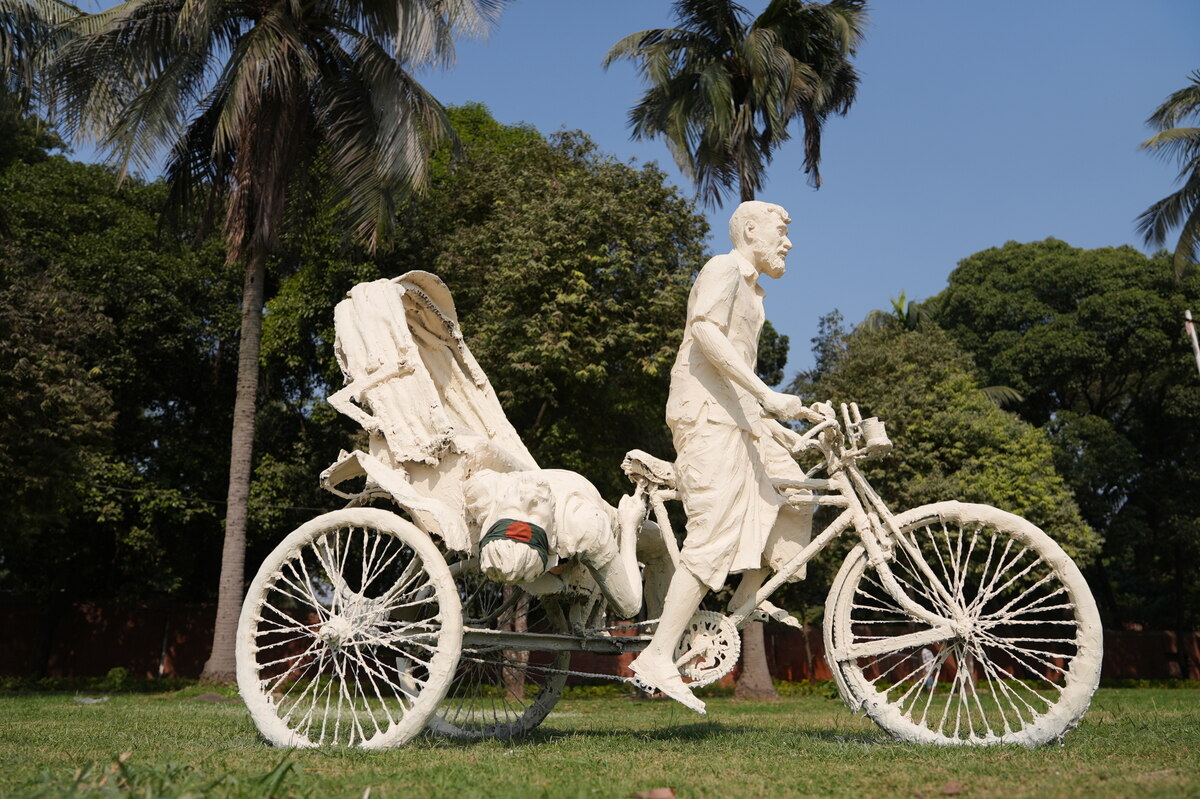
“The idea of this monument is that these people are the new owners of the palace,” says Farooki. In side beds, life-size sculptures of people who became famous during the revolution were created based on iconic photos: a schoolgirl who mingled with the protesters armed only with a cricket bat, a rickshaw driver who brought the body of a murdered man to his family…
In the entrance area you are greeted by a video sculpture that shows a montage of revolutionary scenes before you enter the representation hall. As in the entire building, the walls that were demolished at the time, including graffiti like “Dicator” or “Murderer Hasina,” were left as they were on the day of the occupation. The floor, full of smashed porcelain, with sticks, hair clips and protest banners from the occupiers, also remained as it was found. You walk across glass panels through which you can see everything.
The sofas have been rearranged and videos are projected on the walls showing what happened here on August 5, 2024. It is a strictly documentary, skilfully curated snapshot that makes the chaos as understandable as the triumph and the pent-up anger in a moving way.
Farooki and Tanzim Wahab, who is also a curator at the Berliner Spore Initiative explained: “The whole building is planned in such a way that after visiting it you not only remember this memorable day, but also understand why we have to continue fighting for a democratic Bangladesh.” An archive with contemporary witness reports and events are also planned. It is a place of mourning for the victims’ relatives, which at the same time wants to further develop the ideals of the revolution.
A showcase shows the last letter from a 16-year-old to his parents. In Hasina’s former bedroom, bloody T-shirts of the victims she ordered shot are on display.
Pluralistic representation instead of a single valid narrative
The museum impresses with its quasi-cinematic “storytelling” and an exhibition concept that gives a lot of space to the women involved in the revolution. Unlike, for example, the “Museum of the Unconditional Surrender of the Great Patriotic War” in Berlin-Karlshorst – in its original existence – this new museum does not tell a unique narrative from the perspective of the victors. Rather, it attempts to make space in the various spaces for a pluralistic representation of the country’s history that led to the 2024 revolution.
While the interim government is currently under fire for failings during its short reign, the museum looks like a convincing statement of its attempt to pave the way to a democratic Bangladesh. Perhaps not coincidentally, many influential people in the protest movement came from the university’s art departments. Those responsible are a little worried about the expected crowds at the opening, but their hope that this cultural event will have a positive impact on the elections seems justified.