

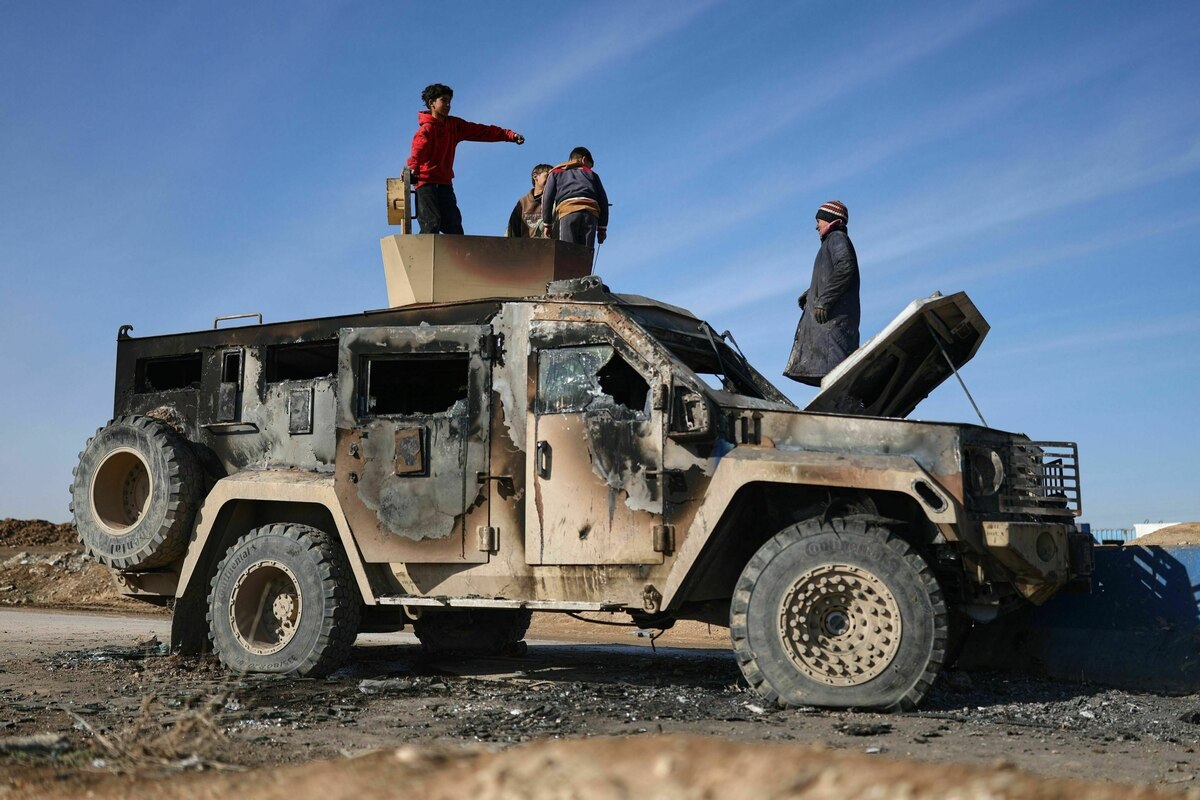
Reuters/AFP | The rapid conquest of Kurdish areas in northeastern Syria Syrian government troops were apparently preceded by secret diplomatic agreements with the USA. According to a report by the Reuters news agency on Friday, based on nine people familiar with the events, meetings in Damascus, Paris and Iraq paved the way for the offensive. Accordingly, the USA did not put any obstacles in the way of the Syrian offensive – and in doing so sacrificed its former allies, the Kurdish-led Syrian Democratic Forces (SDF).
The agreements enabled the new Syrian President Ahmed al-Sharaa to unite the entire country under his leadership: He had previously made this intention known several times. He also positioned himself as the preferred partner of the US government under President Donald Trump, these circles said. US envoy Tom Barrack later said Washington would work with the Syrian state and was no longer interested in a separate role for the SDF. The offensive means the virtual end of the autonomous zone called Rojava that Kurdish forces had established in northeastern Syria.
The course for the offensive was apparently set at the beginning of January. After talks about integrating the SDF into the Syrian army failed, a delegation from the Syrian central government traveled to Paris. There they are said to have advocated for a limited military operation during US-mediated talks with Israel. According to a Syrian source, there were said to be no objections to this. However, an Israeli diplomat, Israeli Ambassador to the US Yechiel Leiter, firmly rejected this account.
Kurds feel betrayed by the USA
Kurdish representatives now feel betrayed by the USA. On January 17, US envoy Barrack reportedly told SDF commander Mazloum Abdi in a meeting in Iraq that US preferences now rested with President al-Sharaa. The US military later warned the Syrian troops to stop their offensive. However, this fell far short of Kurdish expectations. “Are you really that ready to betray your allies?” asked Kurdish politician Hadiya Youssef.
For a moment it seemed as if Ahmed Al-Sharaa, who took power in Damascus after the overthrow of Bashar al-Assad at the end of 2024overstretch his bow. Despite a ceasefire, his troops continued to advance in northeastern Syria, angering Washington. Only when Al-Sharaa unexpectedly declared a new ceasefire on Tuesday and the SDF set a deadline for an integration plan did the situation calm down. Minutes later, Tom Barrack released a statement explaining that the US’s original reason for supporting the SDF as a fighting force against the Islamic State had largely become moot.
Iraq, meanwhile, has legal proceedings against IS fighters from Syria announced. In the wake of the transfer of imprisoned suspected members of the Islamic State (IS) jihadist militia to neighboring Iraq, the Iraqi authorities have announced the prospect of legal action against the IS prisoners. The Iraqi judiciary will “initiate the usual legal procedures against the defendants, who will be housed in the appropriate correctional facilities,” the country’s Supreme Judicial Council said on Thursday.
IS fighters on trial in Iraq?
The USA began transferring IS prisoners from Syria to Iraq on Wednesday. Initially, 150 IS fighters were transferred, said Centcom, the US central command responsible for the Middle East. In total, up to 7,000 suspected IS prisoners could be transferred. This is intended to ensure that the captured Islamists “remain in secure detention facilities”.
The background to the relocation is the withdrawal of Kurdish forces from the Kurdish autonomous region in northeast Syria as a result of the advance of Syrian government troops. Thousands of suspected jihadists are sitting in seven prisons in Syria, many of them foreigners. Al-Hol is the largest camp for families of IS fighters in the region. Around 24,000 people live there, including 15,000 Syrians and around 6,300 foreign women and children from 42 countries.
The camp was set up by Kurdish forces leading the fight against IS and supported by an international coalition. Now, however, Washington has abandoned its Kurdish allies.