

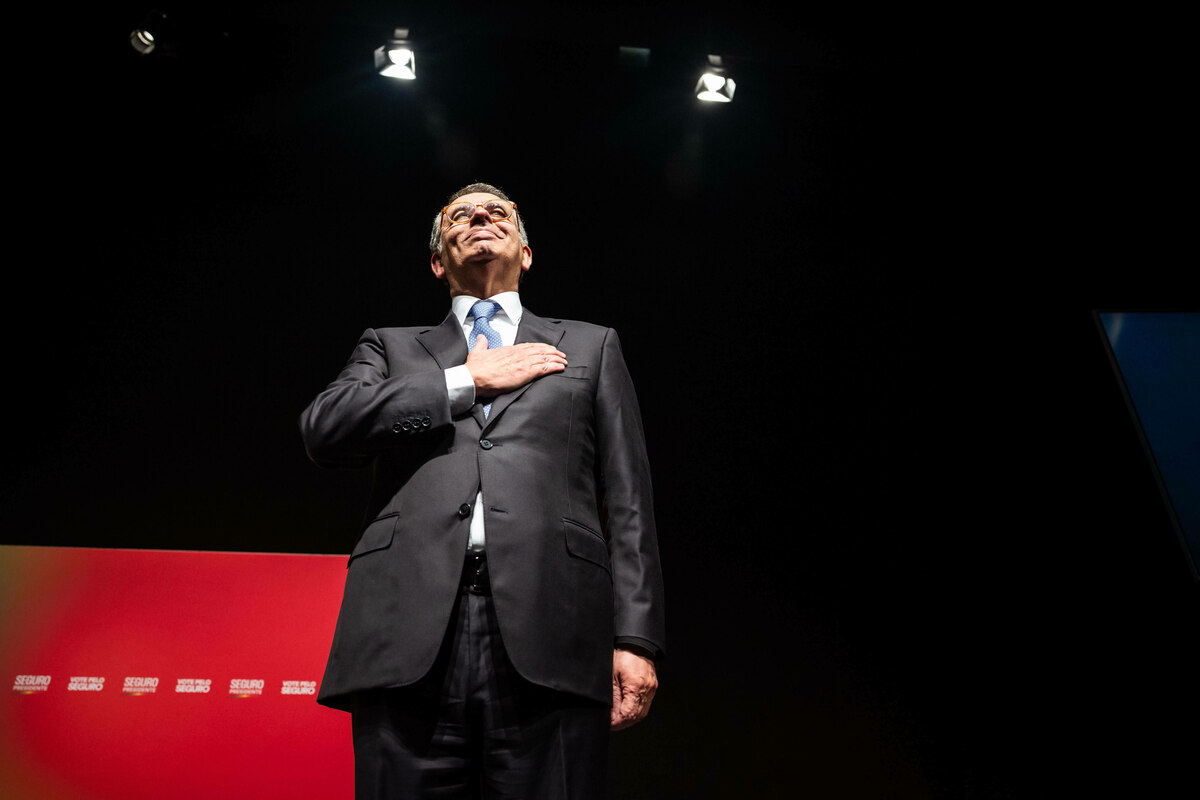
For the first time in 40 years, presidential elections are taking place in Portugal into the second round. On Sunday, the socialist António José Seguro and the head of the right-wing extremist Chega (Enough), André Ventura, will face each other. in the runoff election opposite.
Seguro received 31 percent of the vote in the first round three weeks ago, Ventura 23.5 percent. The remaining nine candidates were far behind. The winner on Sunday will succeed the conservative Marcelo Rebelo de Sousa. He was unable to run again after two terms in office.
What looked like a close race in the first round is no longer so. All surveys agree. You see ex-minister and economist Seguro with around two thirds of the votes, while former TV sports commentator Ventura with a third.
This is the result of a solidarity between all those who defend the democratic system that emerged from the Carnation Revolution in 1974 and do not, like Ventura, mourn the dictatorship that was overthrown at the time. Seguro promises to protect democracy. Ventura wants to “slam his fist on the table,” “shake the regime,” and “change it from within.”
Open letter
On the other hand, a fire wall formed after the first round. From communists to the Left Bloc and socialists to well-known conservatives. Among them are first-round candidate Luis Marques Medes and former President Aníbal Cavaco Silva. Both are calling for Seguros to be elected. Even Paulo Portas from the Partido Popular, the most right-wing Portuguese representative body had to offer until the Chega entered parliament seven years ago, is supporting the socialists.
In an open letter, 6,500 personalities from the center-right spectrum call for Seguro’s election. “Despite ideological differences, we know that António José Seguro will not attack democratic and humanist values, nor the rights, freedoms and guarantees of citizens,” it says.
And a communiqué from former head of state Cavaco Silva said: “At a time of great uncertainty and serious threats, Portugal needs a President of the Republic with common sense and credibility on the international stage who will help defend our interests.”
Only one person in the conservative Social Democratic Party (PSD) did not want to make an election recommendation: Prime Minister Luis Montenegro. “Our political camp will not be represented in the second round,” he said shortly after the first round. Montenegro runs a minority government and is supported by Ventura’s Chega. Voting in favor of the socialist would have cost him this support.
Request failed
Ventura’s attempt to become the leader of the entire right has thus failed. Given the overwhelming opposition from the moderate right, Ventura, whose Chega is the second strongest force in parliament, feels devalued.
He sees himself as a “candidate of the people against the elites”. “If everyone is against a man, it is because he is on the right path,” it says on his election posters. He ranted against immigrants and rights for minorities. He promises to be a president who will intervene heavily in everyday politics.
The Portuguese head of state has extensive powers. He is commander-in-chief of the army and can – as has happened three times in recent years – dissolve parliament and call new elections. He can also stop laws and submit them to the Constitutional Court.
The outgoing head of state Rebelo de Sousa stopped a new immigration law that Prime Minister Montenegro had drawn up with the Chega and pushed through parliament. It made it more difficult for people from former Portuguese colonies to move in and for family reunification. The law is currently being revised and will come back to parliament in the coming weeks.