

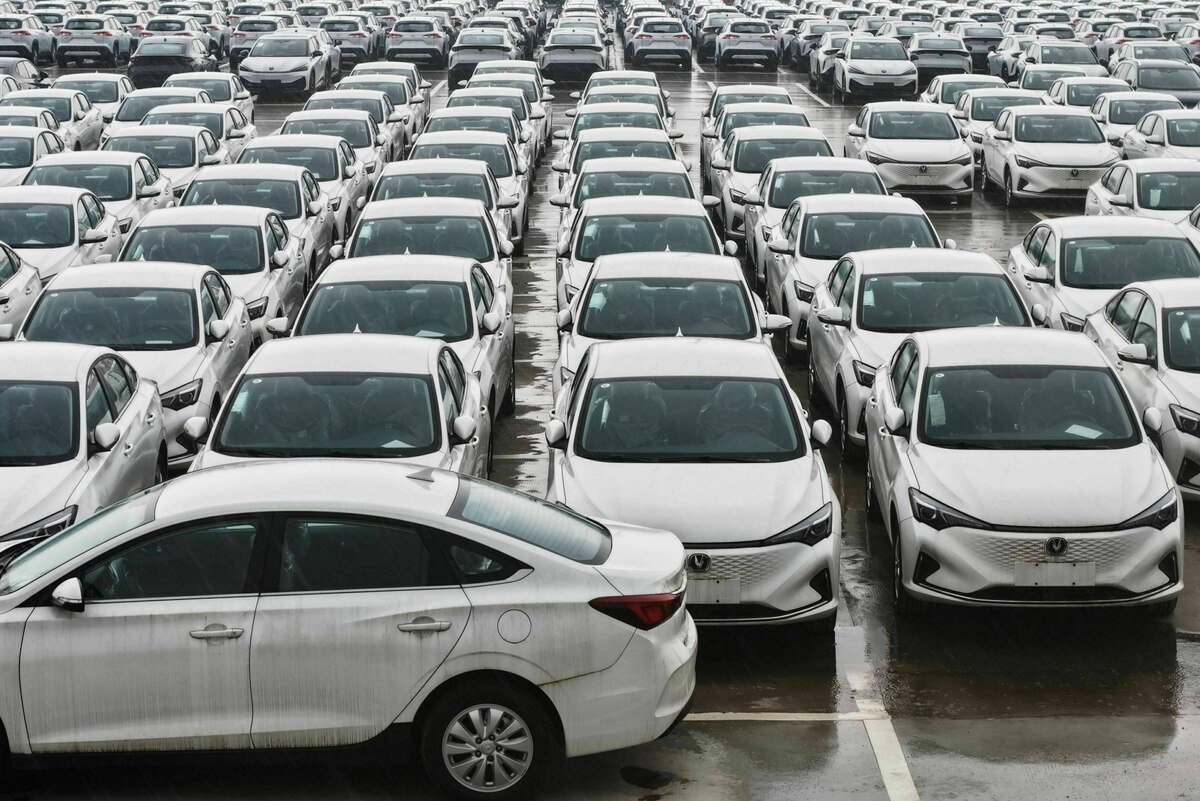
The EU Commission has presented plans for a minimum price for Chinese electric cars – and is now facing criticism for it. “A minimum import price is the worst of all solutions,” finds Julian Heinzhead of the trade policy research group at the Institute for the World Economy in Kiel. Instead of cushioning the pressure from Chinese manufacturers on European car manufacturers, “the instrument invites China’s electric car manufacturers to continue to push large quantities into the EU market”.
On Monday the Commission presented a paper in Brussels. In it she outlines what a minimum price for electric cars imported into Europe from Chinese production could look like. The minimum import prices could replace the current punitive tariffs on Chinese electric vehicles, said a Commission spokesman – but the paper is only a guide for now, further steps must follow.
Nevertheless, the Commission’s move can be interpreted as a concession towards the Chinese government, which was in dispute with Europe over the punitive tariffs that had previously been in force. The Ministry of Commerce in China then immediately spoke of an “agreement” and was pleased with the “healthy development” of economic relations between China and the EU.
After the Chinese car manufacturers became increasingly more competitive with the European manufacturers in international competition, but also on the EU market and especially in the area of battery-electric vehicles, the European Union had in autumn 2024 Up to 35 percent tariff for electric cars from the People’s Republic imposed.
“Bureaucratic monster”
The reason, according to the authorities in Brussels: The Chinese regime is pumping a lot of state money into companies there – a violation of the rules of the World Trade Organization (WTO). China’s corporations could then flood the European market with inexpensive models – and the EU car manufacturers, who do not receive such subsidies, would be left behind.
On the other hand, many European car manufacturers, especially German companies, have long underestimated the change from combustion engine technology to battery drives. And so lost ground in international competition.
Researcher Julian Hinz criticizes that a minimum import price is a “bureaucratic monster”. The Commission wants to introduce different prices depending on the model and equipment and avoid circumvention of the price obligation, for example through discounts. This is not only complicated, but it also offers a lot of attack surface for lobbyists, who can constantly demand renegotiations in many details.
In addition, the EU could create a source of income for the member states with punitive tariffs – but with a minimum import price, no money would flow into European state coffers. If Europe wants to protect its market from illegal subsidies, it should “stick with transparent, market-compliant instruments,” says Hinz. These are typically import duties.
Funding for German e-car purchases
On Wednesday, the Climate Neutrality Foundation and the Agora Verkehrswende organization discussed how the German e-car market could be stimulated in a policy paper explained. In any case, the federal government is planning three billion euros in funding for privately purchased electric cars – the associations say it should focus on people with a gross income of up to 4,000 euros and fully electric vehicles with a purchase price of up to around 60,000 euros. In addition, the funding must soon also apply to used electric cars.
It also makes sense to stagger the funding depending on the purchase price. The goal: to compensate for the fact that small and medium-sized battery vehicles in particular are expensive compared to corresponding combustion engines. For larger vehicles, the difference between the purchase prices of a combustion engine and an electric vehicle is smaller.
The paper is based on a survey of potential car buyers and a legal opinion on the regulation of the charging infrastructure. So far, the federal government has planned a new all-electric or plug-in hybrid car with 3,000 euros per vehicle – for private households with an annual gross income of less than 80,000 euros. The associations believe that this limit is set too high. For a single person, this corresponds to a gross monthly salary of almost 6,700 euros.
“For the ramp-up of electromobility in Germany, a new approach to a comprehensive overall concept is urgently needed,” says Christian Hochfeld, director of Agora Verkehrswende. The fact that the federal government has announced a funding program for private electromobility is an important step. However, the funding must be thought through consistently “if the German automotive industry is to be successful in the markets of the future in the long term”.