

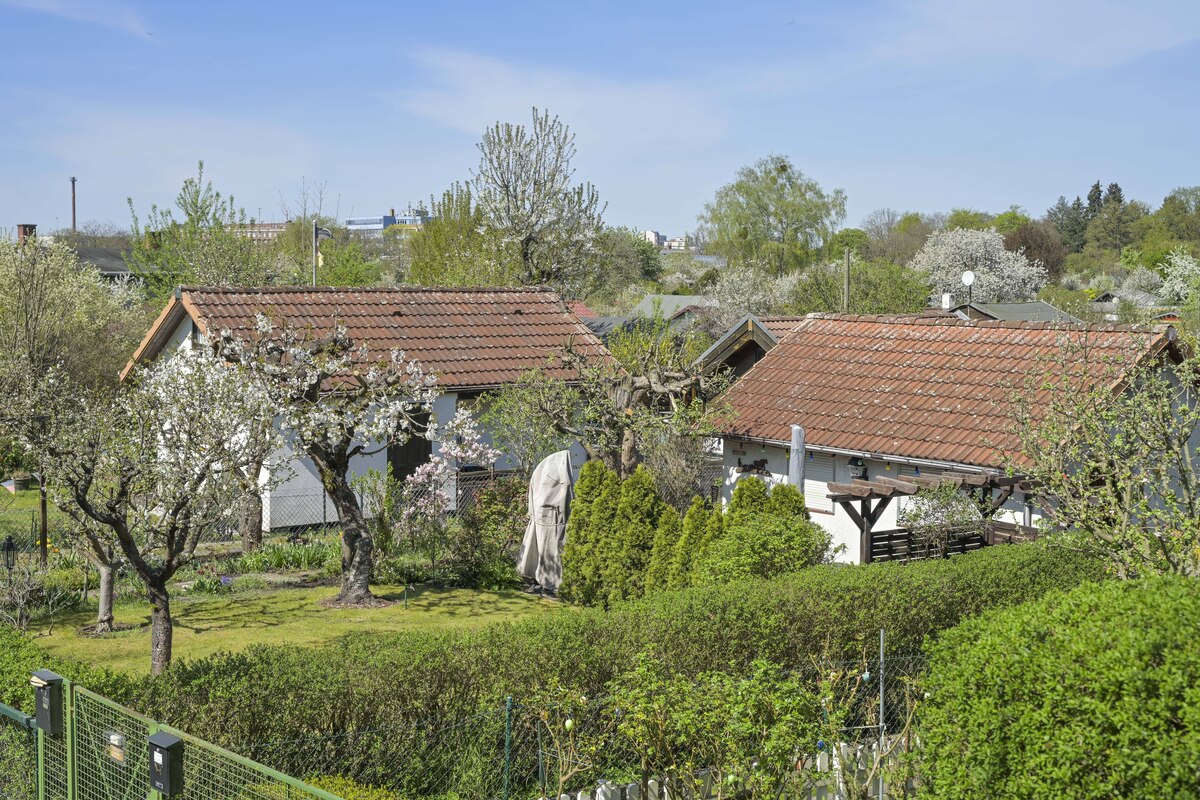
Berlin’s allotment gardeners can breathe a sigh of relief: the allotment garden area protection law is on the home stretch. According to the draft law, allotment gardens on state-owned land should be better protected from displacement in the future. The urban development committee made a recommendation for the draft at its meeting on Monday.
Specifically sees the draft lawthat equivalent replacement areas must be provided within a radius of four kilometers for allotment garden areas that are to be developed. In addition, according to the law, development is only permitted if “the public interest” outweighs that of “allotment garden use”. In any case, the House of Representatives must decide on any development of allotment areas on state-owned land.
The goal of better protecting allotment gardens from displacement is shared across all parties. Accordingly, the draft received support in the committee. The law is “a clear advance on the status quo,” said Left MP Michael Efler at the committee meeting.
The exceptions are the sticking point in the debate
Michael Efler, Linke
But Efler also criticizes that the law in its current form offers too many loopholes. “The exceptions are the crux of the debate.” Public interest was quickly identified, says the urban development politician. In the current formulation, the Senate could use it to justify almost all construction projects.
Exception for private owners
The Left also criticizes the fact that the draft excludes private owners. Admittedly, with a share of around 20 percent of the total 70,700 plots in the capital, these are only a small minority. But the loss of space is particularly great for private owners. A query from MP Turgut Altuğ (SPD, Greens until 2025) shows that between 2002 and 2022 two thirds of the allotment plots that were lost were on land owned by private owners.
Green MP Julian Schwarze also sees “great support for the law”, but has doubts about what effects the law will have in practice. Be like that in the Späthsfelde triangle in Treptow-Köpenick 300 plots of land are currently threatened because the Senate is planning a new urban district there.
Urban Development Senator Christian Gaebler (SPD) responded to Schwarze’s question: “The incentive to use as few allotment gardens as possible is even higher.” There are various variants for the Späthsfelde triangle that are currently being examined.
After the resolution is recommended, the law will be handed over to the lead environmental committee. If it is approved there too, all that remains is a vote in the plenary session.