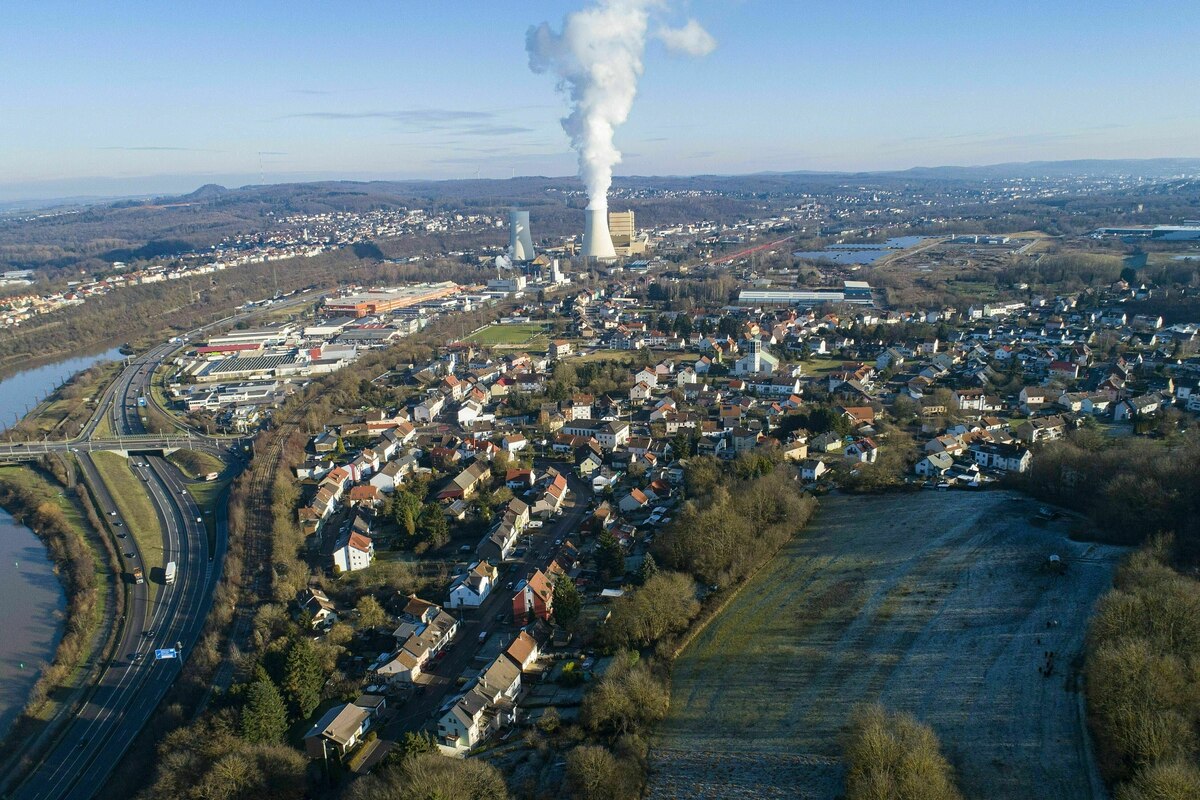
This is a setback for Germany Hydrogen economy: In Saarland, all three major hydrogen production projects have apparently failed. Despite some large amounts of promised funding, investors now all consider their planned electrolysers in Völklingen, Saarlouis and Perl to be uneconomical. This means that there will probably be no significant production of hydrogen in Saarland in the foreseeable future, as there was at first Saarbrücken newspaper reported.
According to the politicians’ plans, hydrogen should be used As a large energy storage device, it will become an important component of a climate-friendly energy industry: The gas is produced by using excess solar and wind power that would otherwise be lost. This means that renewable energies can be stored and can later replace natural gas in industry and in converted gas-fired power plants.
But in practice progress is slow. In September, Steag Iqony had already put its plans to build an electrolyser at the traditional Steag power plant location in Völklingen-Fenne – project name “HydroHub Fenne” – on hold. A company spokesman said when asked that they had made “significant advance payments” and “driven the project forward”, but implementation had proven impossible under the current conditions. Among other things, “the high electricity prices in Germany are a major hurdle,” as are “the bureaucratic requirements” that Brussels imposes.
Steag Iqony originally wanted to build a plant this year that would produce up to 8,700 tons of hydrogen per year. The Saarbahn should use the gas to operate its fuel cell trains and buses. As she emphasized, Iqony wanted to provide “important support in the gradual decarbonization of public transport in the Saarbrücken metropolitan region”. The EU Commission had even recognized the 53 megawatt project as an “Important Project of Common European Interest” (IPCEI), but in the end Iqony did not take advantage of the promised federal and state funding of 100 million euros.
In Saarlouis, the energy company RWE wanted to supply the Dillinger Hüttenwerke with up to 50,000 tons of hydrogen per year through an on-site electrolysis plant. But after the steel producer recently “communicated a significantly lower hydrogen requirement,” the project is no longer economical for RWE and will not be pursued further, said a company spokesman.
Three plants in Lorraine
The third project was to be a 70-megawatt electrolyser from the French hydrogen company Lhyfe, whose construction was scheduled to start in Perl in the first half of 2027. According to the Saarbrücken newspaper This project, which was supposed to produce 11,000 tons of hydrogen per year, will also not be realized. For this purpose, three electrolysers are being built in nearby Lorraine because the conditions there are better. In response to an inquiry from the taz, the Lhyfe company simply said that there was currently no news about the project.
The Greens in Saarland now complain in a statement that Saarland is “increasingly losing ground when it comes to a key future technology”. The party sees “central structural causes” behind the failure of the projects: the expansion of wind and solar energy is “progressing far too slowly”, which is why the amounts of electricity are “far from sufficient to economically enable relevant hydrogen production”. For an “industrial location that is facing a profound transformation,” this is “a serious locational disadvantage.”
But it’s not just an issue for Saarland: A current evaluation by the Energy Economics Institute at the University of Cologne shows that the goal of building 10 gigawatts of electrolysis capacity in Germany by 2030 will “probably not be met”. The installed electrical output of electrolyzers in Germany is currently 181 megawatts, and there is at least a final investment decision for a further 1.3 gigawatts. The reason for the slow expansion is “high investment and operating costs in conjunction with consumers’ relatively low willingness to pay”.