

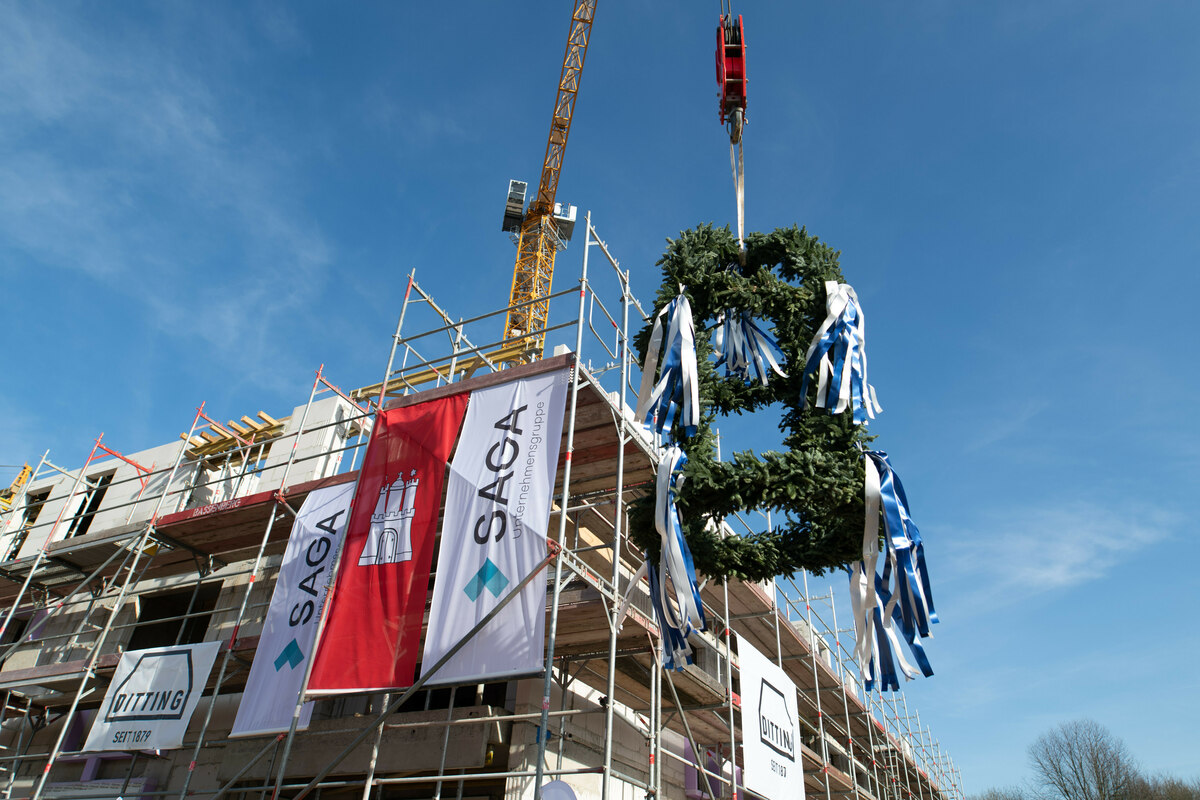
The red-green Hamburg Senate approved more social housing last year than in 25 years. As Urban Development Senator Karen Pein (SPD) said at a press conference in Hamburg City Hall, Hamburg is at the top of all federal states in terms of the number of subsidized apartments per capita. Despite these efforts, however, the number of social housing available is stagnating and can only provide for a fraction of those eligible.
“Hamburg remains a national leader in promoting new construction and modernization,” said Pein. This is a clear sign that social housing is a priority for the red-green coalition – and also a success of the cooperative housing policy in Hamburg. This consists of an alliance for housing in which the Senate and the seven districts work together with the housing industry to enable as much new construction as possible.
However, setting priorities also comes at a price: 735 million last year, 868 million this year – roughly the equivalent of an Elbphilharmonie every year. The city’s total expenditure amounts to 22 billion euros. “The Hanseatic city can (still) afford this because of its economic strength,” says Andreas Breitner, director of the Association of North German Housing Companies (VNW), in which predominantly companies oriented towards the common good are organized.
However, only 2,700 of the 6,400 additional approved social housing units (all numbers rounded) are new buildings, 400 of which are primarily for those urgently looking for housing. 1,600 apartments were given a commitment because their modernization was supported. The Senate bought an occupancy bond from the owners for 1,800 apartments.
No movement
For years, the number of social housing in Hamburg has hovered around 80,000, said Ralf Sommer, chairman of the Hamburg Investment and Development Bank (IFB), which distributes state subsidies and loans. Last year, 4,400 apartments fell from the social bond, which can last 30 years.
In fact, 2,000 social housing units were added last year through new construction and 1,500 through modernization. Around 650,000 households in Hamburg, i.e. almost two thirds of all households, are entitled to social housing.
When asked that the Senate, with 2,700 approved new social housing buildings, remained below its self-imposed target of 3,000, Pein pointed out that the proportion of subsidized housing in all new housing has risen sharply in recent years: from 26 to 28 percent since 2011 to now 42 percent. The CDU parliamentary representative Anke Frieling called this an alarming number. “Hamburg needs a lot of additional apartments in all segments,” said the MP.
At least for normal earners, the Senate has taken this into account in recent years and created three funding paths for different income groups, with rents ranging from 7.85 to 9.99 to 12.95 euros as of January 1st. This means that the Senate has “the entire city in view,” praised VNW association director Breitner.
The Left accuses the Senate of failing to build particularly affordable housing
In order to compensate for the wage and price increases from 2021 to 2023, the Senate had already announced a price jump last year, so that the rent of the cheapest apartments was increased by eight percent and that of the most expensive apartments by six percent. In the future, social rents are expected to increase by two percent annually, which corresponds to the inflation target of the European Central Bank (ECB).
Heike Sudmann, a member of the Left Party’s parliament, accused the Senate of failing to build particularly affordable apartments under the first funding route. It will remain with 1,700 instead of 2,300 apartments Senate behind its self-imposed goal. “It is precisely this living space that Hamburg needs most urgently,” commented Sudmann.
At this point, the VNW always points out that its members, especially cooperatives and municipal companies, have an average rent that is below the starting rent for social housing: currently 7.69 euros compared to 7.85 euros. However, the VNW average predominantly includes existing rents.
The IFB’s support activities should not be neglected, including in the energy transition, which, of course, is the case recently successful climate decision has once again confirmed that it should be socially just. The state bank supported the modernization of a further 6,100 apartments, almost half of which were for thermal insulation.
The Senate wants this year Promote 15,000 modernizationsbuild 3,000 rental apartments with social bonds and buy 1,100 bonds.