

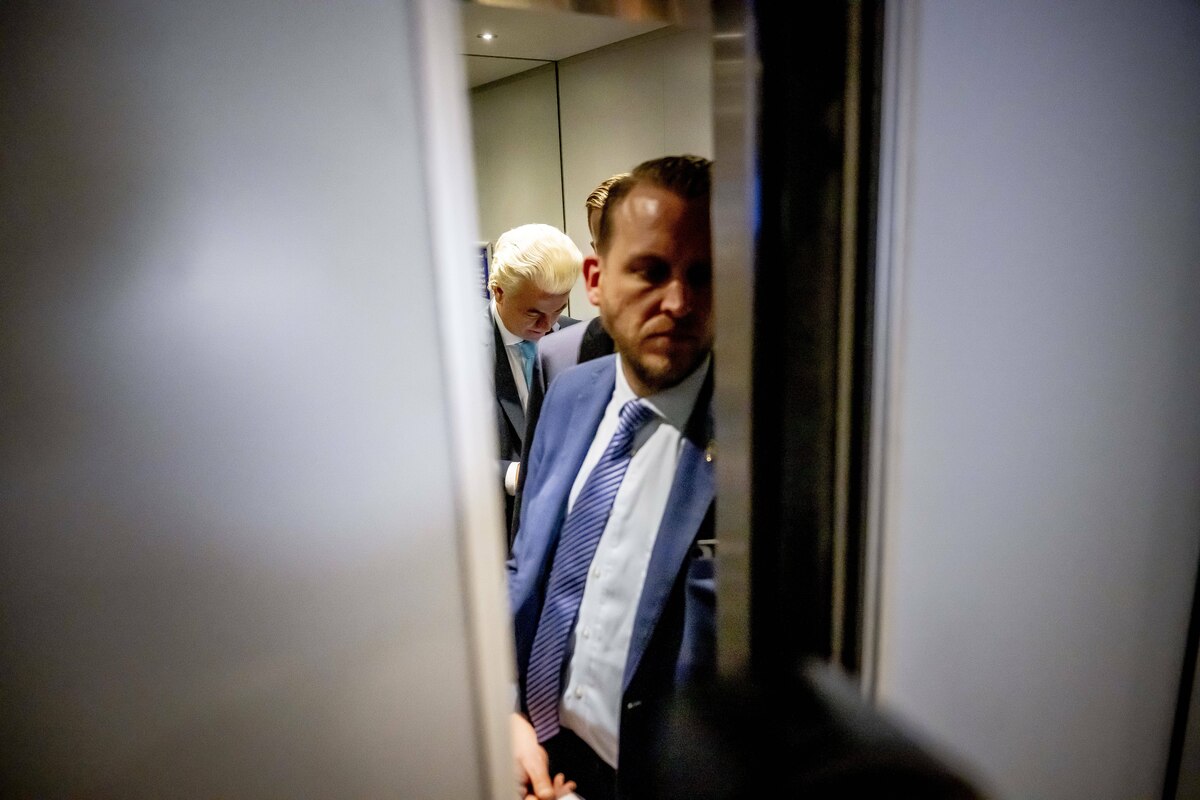
It was nothing less than a PVV earthquake that occurred on Tuesday: seven of the 26 MPs from the right-wing populist Partij voor de Vrijheid (PVV) announced their departure from the group in one fell swoop. The most prominent of them is Gidi Markuszower, under whose name the renegades want to unite to form a new faction. He is accompanied by Shanna Schilder, Annelotte Lammers and René Claassen, who came third, fourth and seventh on the list in the parliamentary elections in October. In addition, Hidde Heutink, who led the election campaign, as well as Nicole Moinat and Tamara ten Hove.
The sudden bloodletting costs the PVV its status as the largest opposition party in the Tweede Kamer. In addition to the weakening in numbers, it is losing important functionaries. For the party, which lost 11 of its previous 37 seats in October and thus the liberal election winner D66 was narrowly inferior, this is a hard blow.
In its 20 years of existence, the PVV has had no other official member apart from Geert Wilders, founder, boss and figurehead. It also does not have regular party structures. There is currently a legislative proposal from D66 that would exclude parties from elections without sufficient internal democratic practice.
The mutiny that took place during the weekly parliamentary group meeting was partly triggered by the structures in question. Because the dissidents around Markuszower demanded the transformation into a member party. In addition, there was now an evaluation of the poor election results and a change of position towards the future centre-right minority government.
Wilders didn’t see Bruch coming “at all.”
This, consisting of the election winner D66, the Christian Democratic CDA and the right-wing liberal VVD, is dependent on support from the opposition and held talks with all relevant parties in mid-January. Wilders was the only one who refused this, which Markuszower did, according to the daily newspaper Volkskrant called “very unreasonable”.
It is not the first time that dissatisfied MPs have turned their backs on the PVV. But never before has this happened in this concerted form as a jointly staged reaction to Wilders refusing to discuss the criticism raised. Loud The Telegraph, the largest newspaper in the Netherlands and closest to the PVV, the PVV boss, who spoke of a “black day” for his party, did not see the step coming “at all”.
It is obvious, however, that Wilders is in a difficult position: the frustration that he was unable to be employed as Prime Minister of the last right-wing government led by the PVV led to the realization that the toughest asylum policy in Europe that was being sought was easier to promise than to implement.
His decision to leave the then coalition backfired in the elections. Not necessarily because the voters had had enough of the PVV’s rabid anti-immigration policy, but rather because there were enough other parties to choose from that also pursued this policy.
PVV dissident leaders invited to form government
There is now apparently another party, the seven former PVV MPs. On Friday, the resigned Hidde Heutink registered an internet domain for a Dutch Freedom Alliance. As Markuszower on the BNR Nieuwsradio station When asked about it, he confirmed that this name was being considered for a new party.
“Where freedom begins, the future blooms,” is now written on the corresponding website. Under “news” it was announced on Wednesday that Markuszower was appointed chairman Discussion about the future minority government was invited.