
Since the advent of graphic novels in the book trade, comic creators have increasingly been dealing with literary models and traditions. Adaptations of great classics are booming. There’s a lot there, from conservatively implemented comic versions of the Jane Austen novels to the ambitious “Faust I” adaptation by Nele Heaslip based on Goethe by Jaja Verlag, Berlin.
Comic biographies of famous authors are also in vogue. As demonstrated by the illustrated and interpreted biographies of Franz Kafka, Virginia Woolf and Thomas Mann that have appeared in recent years. They should introduce many people to the classics Works against the background of other periods of time have appeared.
Two other current graphic novels deal with “great writers” and their works in very different ways: Paul Auster and Rainer Maria Rilke.
Paul Karasik, David Mazzucchelli, Lorenzo Mattotti: “Paul Auster – New York Trilogy”. Graphic Novel, German by Joachim A. Frank. Reprodukt Verlag, Berlin 2025, 400 pages, b/w, hardcover, 29 euros
Melanie Garanin: “My friend Rilke”. Carlsen Verlag, Hamburg 2025, 192 pages, hardcover, 26 euros
Young Ellen on the trail of the old master
The Berlin artist Melanie Garanin, born in 1972 (“Nils – Of Death and Rage. And of Courage”, Carlsen Verlag, 2020), has dedicated a pointed homage to the poet Rainer Maria Rilke, who was born 150 years ago, in her graphic novel “My Friend Rilke”. The poet, who was born in Prague, Czech Republic (then part of the dual monarchy of Austria-Hungary) in 1875 and died in Switzerland in 1926, is still considered one of the most important German-language poets of literary modernity.
Melanie Garanin’s graphic novel is about the journalist Ellen, who is commissioned to write something about the famous Rilke. Ellen travels to Worpswede rather listlessly to fulfill her duty. She attends an event organized by the Rilke Society where the young poet spent some time.
Just as she’s about to sneak away from what she sees as a dull event, she bumps into a strange man with a mustache. And as luck would have it, we unexpectedly had a lively conversation with the gentleman. Inspired by the many Rilke quotes from the man in old-fashioned clothing, the journalist develops more and more interest in the poet king. She researches Rilke’s life and travels to other important stages in Rilke’s life, to Paris and Switzerland.
The readers are a good step ahead of the somewhat dreamy, likeable and scatterbrained heroine. Because they can immediately see that the strange gentleman Ellen meets again in Paris is none other than Rilke himself. Whether it is a ghost, a revenant or a materialized dream remains an open question. But a stormy, absurd amour fou sets in motion.
Original idea
Melanie Garanin has found an original approach to bring her favorite poet Rainer Maria Rilke closer to today’s readers. The clever drawings are loosely arranged, mostly do without panel frames and rely on situational comedy.

Melanie Garanin’s graphic novel is about the journalist Ellen, who is commissioned to write something about Rilke
Photo:
By Melanie Garan/Carlsen
The artist’s gently caricaturing style and friendly watercolor colors fit well with the genre of self-deprecating romance, in which fantasy and reality repeatedly clash in the most comical ways.
With numerous references to Rilke’s biography and important works, “My Friend Rilke” is not only entertaining, but also ideal as an introduction to his world and language.
Auster’s ghost and doppelganger
A much darker mood emanates from the (around 400 pages!) adaptation of a classic of recent contemporary literature. Paul Auster’s “New York Trilogy” was taken on by three comic artists. Auster’s cycle of novels, written between 1985 and 1986, is now considered a classic of postmodernism and the American author’s main work (1947–2024).
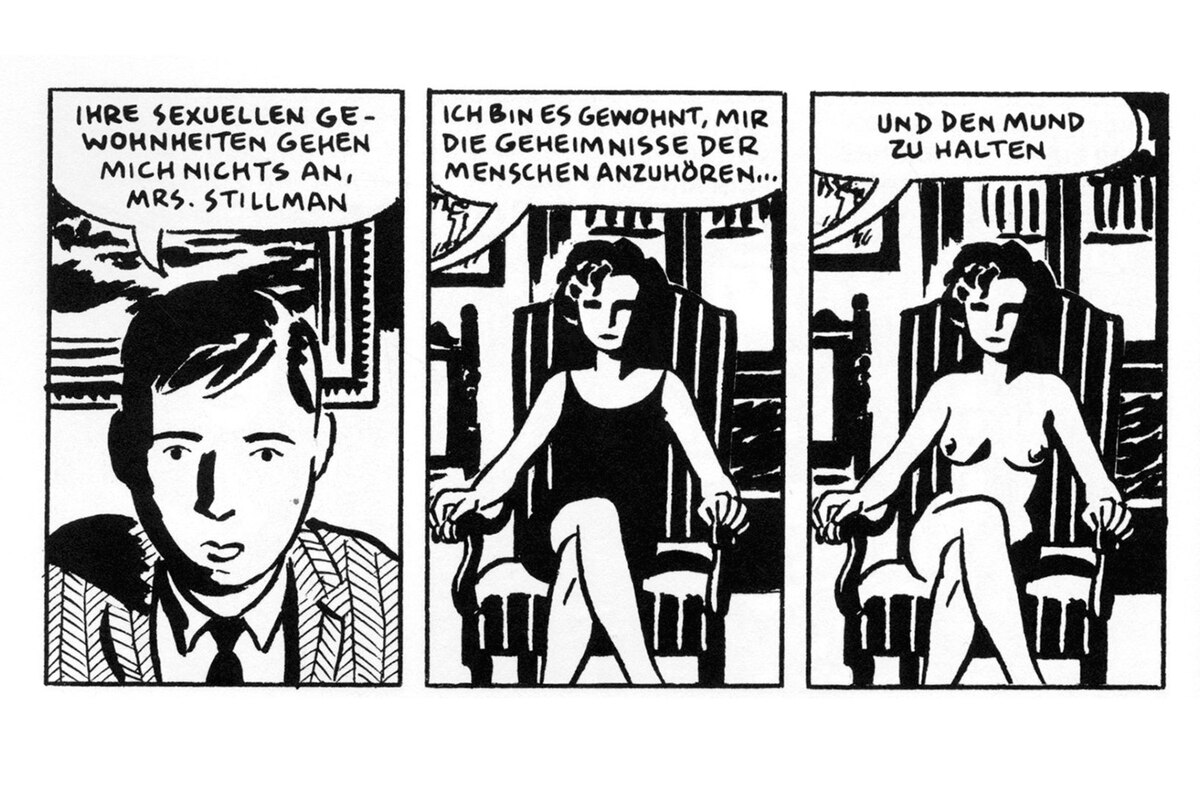
Paul Auster himself has incorporated numerous literary references into them – from Miguel de Cervantes’ “Don Quixote” to Henry David Thoreau’s “Walden” to Nathaniel Hawthorne. The trilogy is also based on the classic genre of the detective novel, but at the same time it is deconstructed. As early as 2004, the comic adaptation of the first volume of the trilogy “City of Glass” by Paul Karasik and David Mazzucchelli was published in an English-language edition, which was initiated by the American comic artist Art Spiegelman (“Maus”).
This first adaptation is still considered a successful transfer into comic form, as it does not simply illustrate Auster’s nested, ambiguous narrative structure, but rather interprets it graphically independently on each page, thus adding another layer.
“City of Glass” is about crime writer Quinn, who is mistaken for a private detective named Paul Auster. Out of curiosity, he takes on the role of a detective who is supposed to monitor an old man with supposedly evil intentions. In the process, his own identity increasingly slips away.
Dark Maelstrom and Role Playing
David Mazzucchelli’s black and white drawings are clear and atmospherically strong at the same time. Like the main character, the recipient also finds himself in a dark reading maelstrom from which he finds it difficult to escape. Paul Karasik, himself a cartoonist and comic artist (including for the “New Yorker”), knew Paul Auster personally and wrote the scenario for this first volume.
For the two additional volumes that have now been published (and combined with the first part in one book), he has now written the scenario and drawn the final part himself.
The Italian Lorenzo Mattotti took over the graphic implementation of the second part of the novel “Schlagshadow” and opted for a more classic illustration style. “Schlagshadow” is about the private detective Blue, who is commissioned by Mr. White to shadow a man named Black. The plot develops even more densely and claustrophobically than in the first volume.
Blue detaches himself from himself, slips into different roles to get to know Black and finds himself caught in a kind of conspiracy.
Surreal perspectives
Lorenzo Mattotti’s masterful black and white drawings continually add surreal perspectives to the story. It is usually limited to one image per page, the text is set separately. But the format is repeatedly broken up, divided into comic panels and sparingly provided with speech bubbles.
Overall, this is a profound, philosophical study of the existential existence of the individual, surrounded by an inhumane, hostile mass. Here too, the form of comics can add new facets to the narrative of the novel.
The third part, “Behind Closed Doors,” by Paul Karasik is basically about mirrored characters, this time there are two writers.
The common opinion that a graphic novel adaptation is simply a simplified version of an original text can be contradicted using examples like these. It has to be in no way inferior to the novel in terms of complexity, see the New York trilogy. Or she can interpret and tell classics differently biographically using imaginative and humorous approaches, see “My Friend Rilke”.