

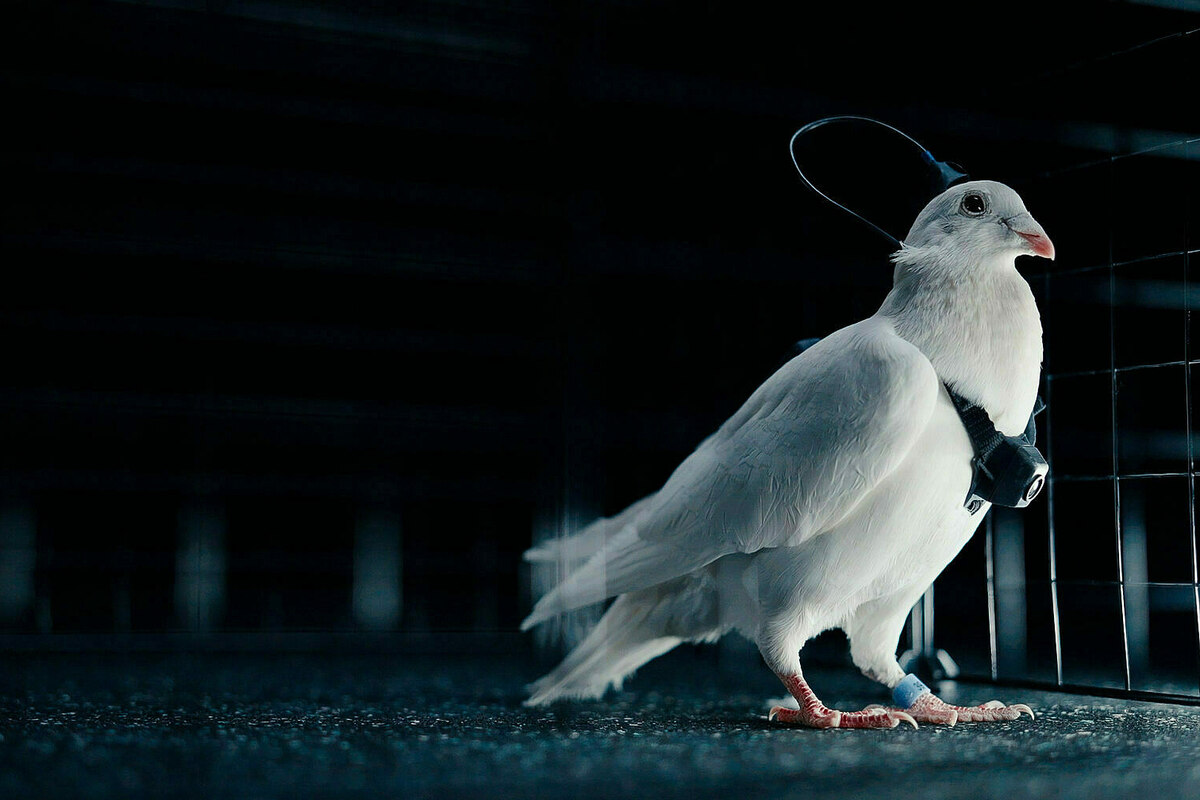
A woman stands in a room with a cage in the middle and two chairs to the right and left of it. She holds a pigeon in her hands and says in Russian “Fly to the base!” and lets her go. The pigeon flutters to the cage. She says, “To the right.” The pigeon flies to the right chair. “Left” – to the left chair. This isn’t a particularly well-behaved or well-trained animal. It is a “product” presented by the Russian company Neiry at their annual conference at the end of 2025: Pigeons, controllable via brain implant.
To do this, the Russian scientists surgically insert electrodes into the regions of the pigeons’ brains that control movement and orientation. The electrodes are stimulated via radio and the pigeon flies in the specified direction. To do this, the animal wears a solar-powered backpack with GPS and radio modules. Using the GPS, the person controlling can see where the animal is and can steer it. Neiry plans to soon expand this system to include crows or seagulls.
Tabloid media like the US one Sun now warn of “Putin’s frightening fleet”. But the phenomenon is not that new, says the scientific director of the German Spy Museum, Florian Schimikowski: “The connection between spy technology and animals goes back a long time.” Already in the First World War, pigeons spied on opponents from above with automatically triggered cameras.
The pigeon’s big advantage: its outstanding sense of orientation, although it is still not entirely clear how it works. “To navigate, they may be able to sense magnetic fields using sensitive receptors in their eyes and beaks,” says Dr. Brandon Mak, who researches pigeons at the Technical University of Munich, among other things.
Pigeons are small, quiet and inconspicuous
Since ancient times, people have used carrier pigeons to find their way home alone. During World War II, British intelligence dropped pigeons in cages and bags with small parachutes at night over territory occupied by the Wehrmacht. Agents collected them, attached messages to their legs and released them. The birds automatically flew back to Britain – without being intercepted like radio waves.
Animal cyborgs have also long been a reality. The CIA tested cats in the 1960s as live bugs, with microphones in their ears, batteries in their stomachs and an antenna in their tails. Ten years ago, Russian researchers connected microchips to the brains of rats to find explosives. Nevertheless, Schimikowski says: “If the control of the pigeons works as Neiry states, it is a new level.”
In a press release, Neiry announced that their “biodrones” can be used in agriculture or logistics, for example. Although Neiry is officially a private company, it has received financing from a government-initiated fund. The state gas company Gazprom and the city of Moscow use its products, according to Neiry’s website. The question arises: Could Moscow use the pigeons militarily, for example in its war of aggression in Ukraine?
Compared to most other drones, pigeons are very small, quiet and therefore inconspicuous, especially in urban areas where they flutter around anyway. Pigeons can fly up to 400 kilometers a day. That’s significantly further than most small reconnaissance drones – those Mikado The Bundeswehr, for example, which is used primarily in urban areas, only has a range of one kilometer. According to Zhimikovsky, the cyborg pigeons could be used for Russian warfare – for example in the war in Ukraine – still be at most a small addition. “If Moscow really had technology from which it expected an enormous advantage, it would do the devil and blow it out into the world.” The program would be kept under the highest secrecy.
And how are the animals themselves actually doing?
Espionage itself plays a major role in the war in Ukraine. Ukraine in particular is dependent on this information and relies primarily on technical espionage: satellite data from Western partners show troop movements, electromagnetic signatures reveal where radio communications are being made, and drones provide intelligence about the enemy.
In addition to the latest technology, Russia is increasingly relying on good old human agents. Russian spies already penetrated the Ukrainian security forces during the annexation of Crimea. Today, some chatbots can recruit “disposable agents” via Telegram groups, one says Report of the Office for the Protection of the Constitution from May 2025. You get paid with cryptocurrency for small orders. If they are arrested, they cannot reveal anything because they hardly know who they are working for.
All of Europe and Ukraine’s Western allies have been targeted. “Russia is spying in Europe to find out where the arms supplies come from and where the individual countries stand politically,” says Shimikowski.
And it doesn’t just stop at scouting. Russian secret services have long been actively intervening. Like in the summer of 2024, when packages containing incendiary devices appeared at several DHL locations and exploded. According to investigations The Russian military intelligence service GRU is behind it. Also Drones over Bundeswehr barracks, disinformation and cyber attacks are part of the repertoire. “The approach has become more and more aggressive in recent years,” says Schimikowski. Through these actions, Ukraine’s Western allies have long been part of this hybrid war. In the face of these threats, the cyborg pigeons seem almost harmless. But they show how analog and digital espionage are merging today.
And how are the animals themselves actually doing? On the website, Neiry emphasizes taking good care of the animals. But there are no independent assessments or long-term data on their well-being. Neiry did not respond to a query from taz. In any case, pigeon researcher Mak is shocked about the project. “Animals have no way of consenting to such a practice,” he says. If the pigeons had to regularly cover long distances of 400 kilometers, most of them would probably die from the effort. “Technology should replace the use of live animals and not the other way around.”
There are currently no clear international and ethical rules for the fusion of living beings and technology. While animal protection guidelines would apply in the EU, for example, animals in scientific research are exempt from this in Russia. At least adopted by UNESCOof which Russia is a member, will issue the first global recommendation on the ethics of neurotechnology in humans at the end of 2025. It emphasizes the protection of intellectual integrity, transparency, consent.