

Kinshasa, Nantes, London, Amsterdam, Berlin, Budapest, Moscow, Riga, Saint Petersburg. The number of locations is impressive. And it is probably the first series finale of a – also – German series since 1985, since “Beyond the Dawn”, also a six-part series that takes place in the Amur region on the Russian-Chinese border.
Ah, the blessed 1980s. At that time, the plan for a European internal market was being pushed forward under Commission President Jacques Delors – the signs were pointing to cooperation. German, French, Italian and British television companies co-produced the six-part series (plus pilot film) “Mission Eureka” (1989): a political thriller including a space program and killer computers.
That’s what “The Kollective” ultimately comes down to, after a few detours in, as I said, numerous locations. There shouldn’t be too many spoilers. In any case, this series is also a joint production by ZDF, France Télévisions and Rai. The European idea is alive!
Political thriller “The Kollective”, available in the ZDF media library
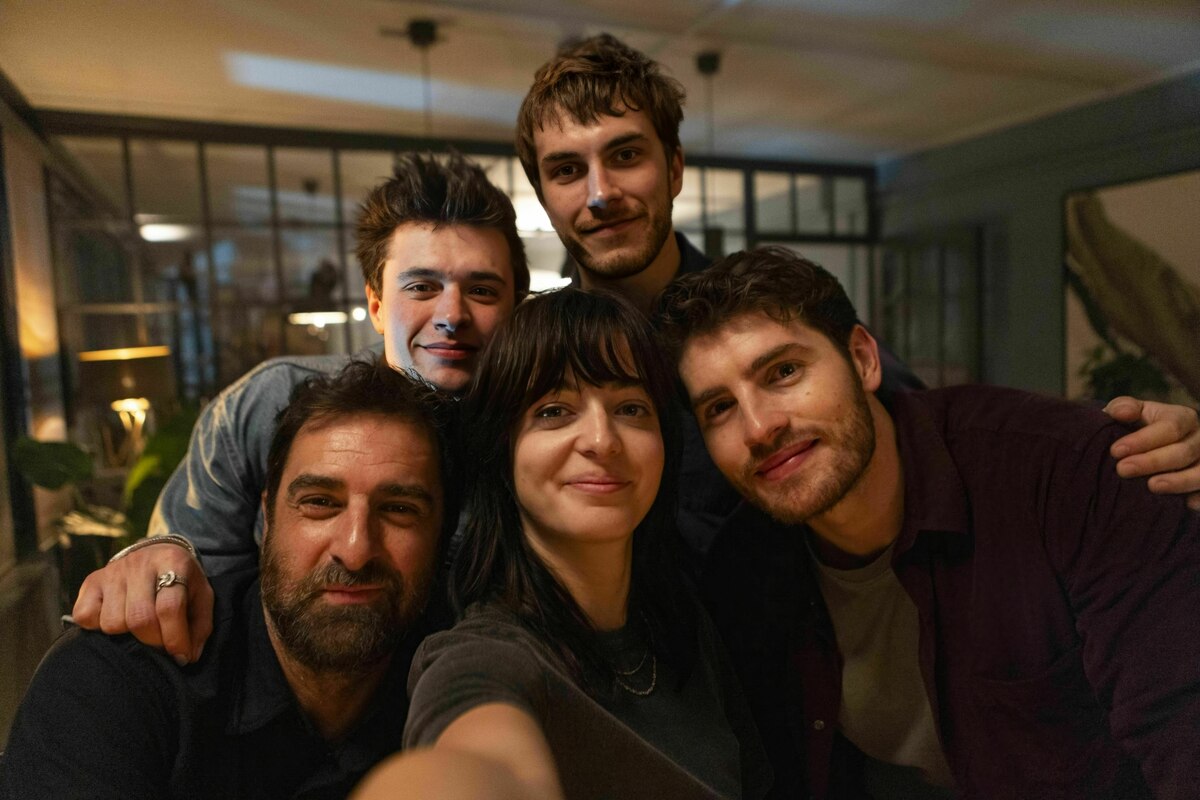
The same can soon no longer be said about the journalist who gets on a plane in Kinshasa at the beginning of the series. The plane crashes. And the members of “The Kollective”, spread across five (Western) European cities (see above), immediately realized that this couldn’t be an accident. With the exception of Etienne, played by Frenchman Grégory Montel, who was born in 1976, they are all digital natives: used to doing their (open source) research work at the keyboard. They see themselves as investigative journalistsbut make a living as waiters or sperm donors. They reject the traditional quality media; they have a code: “Our independence is our most important principle.”
Little squeamish
The principles are repeatedly discussed and questioned throughout the course of the plot. “We are investigative journalists. Not secret agents.” “But we are so close. And all the victims must have made some sense.”
There are a few victims, and in this respect the series is as little squeamish as any Bond film. And if the active coexistence of the five initially makes you think of youth series like… “Five Friends”, that’s over after the first episode at the latest: one of them doesn’t survive either.
And although this production (with stars Natasha McElhone and Moritz Bleibtreu in supporting roles) makes every effort to illustrate digital communication and research in a futuristic way, a story cannot be told that way and tension cannot be created. To do this, the young journalists have to get out the door. First of all, to Kinshasa, where the murdered journalist was on the trail of explosive connections between coltan mining in Congolese mines, the upcoming presidential elections there and unscrupulous Russian mercenaries.
The series claims to be inspired “by true events.” The obvious model for “The Kollective” is the Bellingcat research network, which has gained merit with its investigations into the shooting down of the MH-17 passenger plane over Ukraine and the poisoning of ex-agent Skripal with the nerve agent Novichok. The murder of Russian journalist Anna Politkówskaya, Alexei Navalny’s undercover phone call with one of his FSB assassins and the – presumably – Israeli computer worm Stuxnet also served as references.
The blessed 1980s
Again and again the hunters become the hunted, especially Delia and Aaron barely escaping their pursuers. They are played by Céline Buckens, who made her first appearance in Spielberg’s “War Horse”, and Felix Mayr. You can currently see it briefly in the second season of Apple, which takes place in Berlin TV-Series “Hijack” see. This is a British production – it goes without saying that the Germans in Berlin speak German to one another.
In “The Kollective” it would have to be much more multilingual – the version offered to local viewers by ZDF only has one language for conversation at all locations: German. Like in the blessed 1980s.