

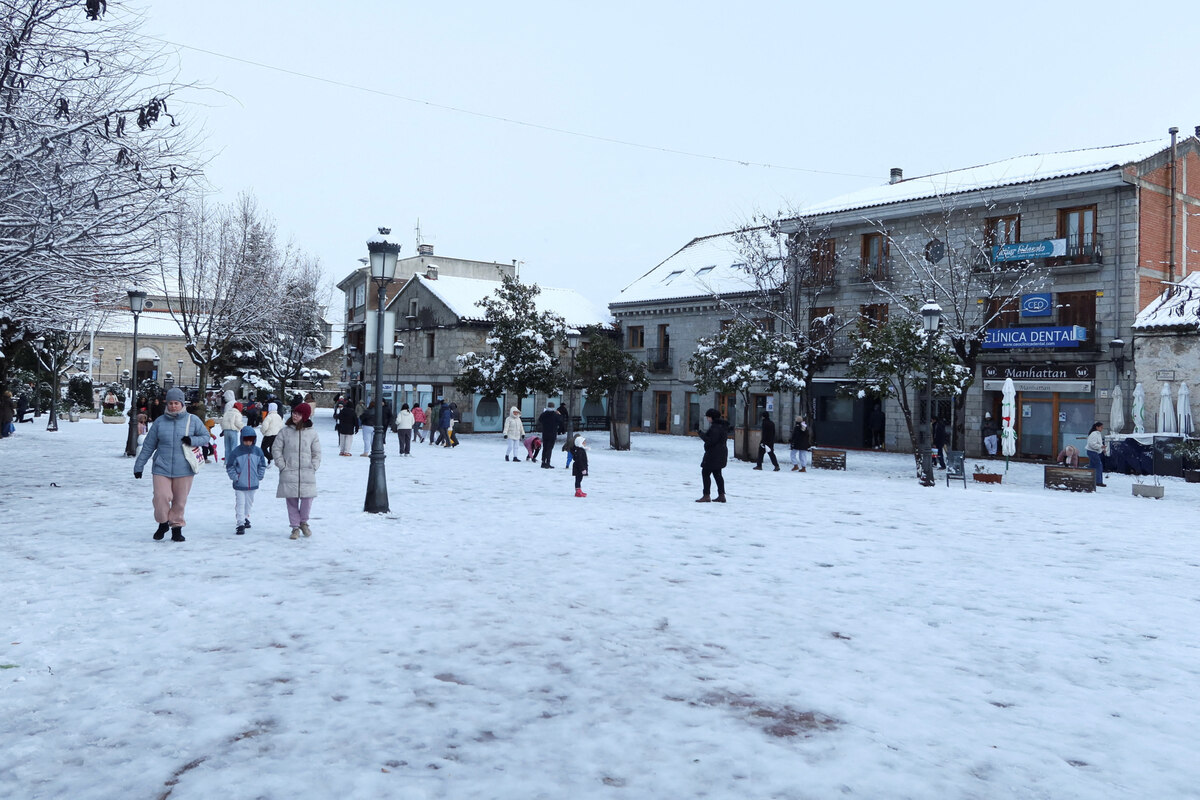
Harry, Ingrid, Joseph, Kristin – everyone in Spain knows these names. These are the storm depressions that have occurred in the last two weeks. As soon as one swept over the Iberian Peninsula, the next one came. Frost, floods, winds of over 130 kilometers per hour, snow across the country brought these low pressure systems from the Atlantic. For the political right, they are a reason to once again question climate change. Exactly what is happening now is evidence that the climate has long since gotten out of hand.
The heavy snowfalls on the Iberian Peninsula, which have brought half the country to a standstill several times, are due to the general rise in temperatures – in the air, but also in the seas. Warm air can hold more moisture. The cold low pressure areas enclose or collide with warm, moist layers. It snows or rains heavily for hours. Precipitation falls in a short period of time, the kind that normally occurs in months. The consequences: roads closed by snow or, worse, flooding where it rains.
Houses are under water in northwestern Spain and Catalonia in northeastern Spain a local train on a boulderwhich had fallen onto the tracks due to the heavy rain, another crashed into a sliding retaining wall. The train driver was killed.
Especially in the east of the country, people look to the sky with concern when heavy rain is announced more and more often. Because there, in the Valencia region, came In October 2024, 229 people died in floods. The culprit was a dana, which is what the Spanish call isolated low-pressure areas with heavy rain. A similar phenomenon to that which now led to the heavy snowfall.
Heat waves in summer, heavy snowfall in winter
The weather expert for the Spanish public television TVE, Mónica López, no longer just announces temperatures and precipitation. She tries to explain evening by eveningwhat happens.
Heat waves in summer as well as heavy rain and heavy snowfall are the two sides of the same coin, explains Mónica López
Heat waves and drought in summer as well as heavy rain and heavy snowfall like these days are “the two sides of the same coin,” she explains. With climate change, “it will rain just as much throughout the year as before, but differently,” says López. The dry periods in summer would become longer and hotter. When it rains, it is usually heavy rain or, when it is cold, heavy snow like now.
The phases between the storm lows provide proof that it is still too warm overall: 10 to 20 centimeters of snow at medium altitudes disappear within a few hours due to the warmer winds – until the next low, which brings more snow. This is precisely what shows the general rise in temperatures due to climate change. The media is calling what is currently happening in Spain a “cold wave,” but it is Actually, it’s not a cold wave. Although the cold episodes are frequent, they are far too short in themselves to be considered a cold wave.
A cold wave is when a tenth of all weather stations in the country record minimum temperatures that are five percent below the average of historical records in January and February. Records from the Spanish Meteorological Service show that cold waves have become shorter by 1.2 days per decade over the last 50 years. There hasn’t been a cold spell in the last two years and it doesn’t look like it will this year either. despite the storms.