

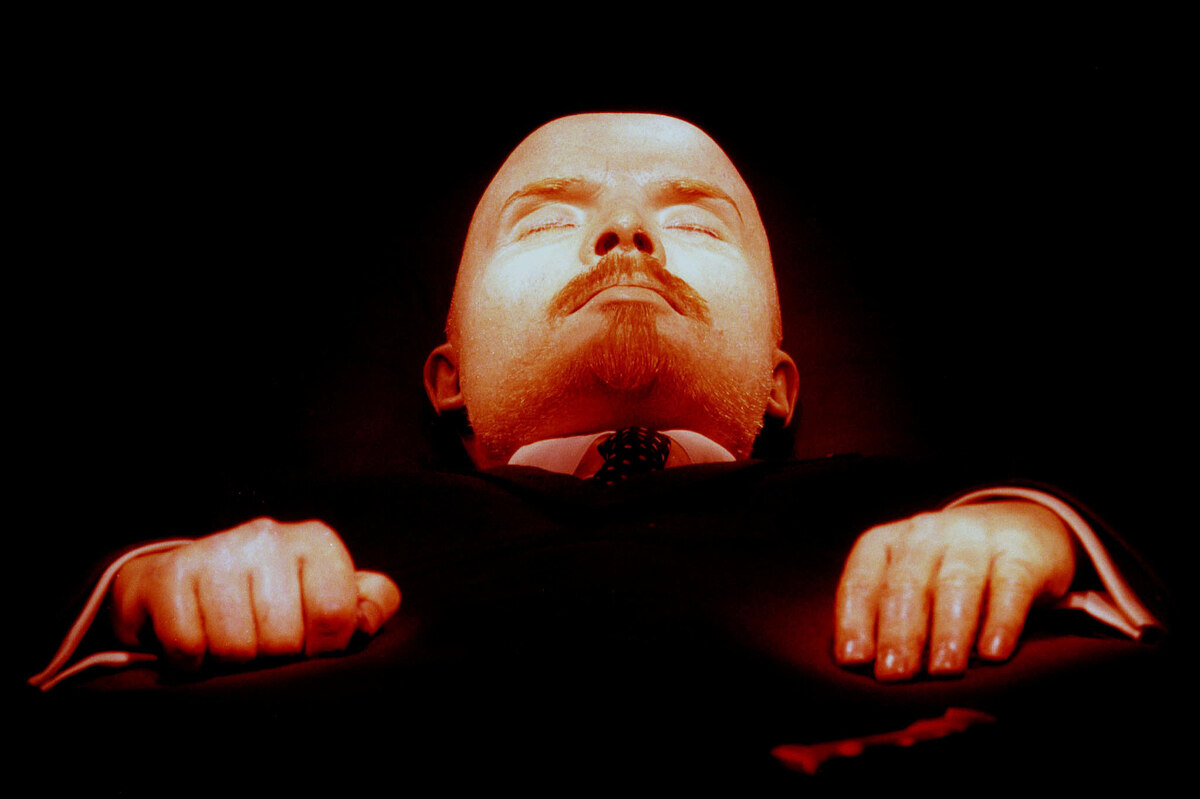
V or 102 years ago, Soviet doctors embalmed the body of the deceased leader of the world proletariat. On January 23, the coffin containing Lenin’s body was brought from the Moscow area to the capital. Within a few days, over a million people took part in the celebratory farewell. As a result, letters from “the working people” were published in the newspapers, demanding that Lenin’s body be preserved for future generations.
In fact, these letters were initiated by Stalin. He insisted that Lenin be “preserved for many years using the most modern methods” and placed in a specially constructed glass tomb.
Lenin’s companions spoke out against this – Trotsky and Bukharin called this an “insult to Lenin’s memory”. Nadezhda Krupskaya was also against it. But Stalin prevailed: the sacralization of the dead Lenin was politically useful for him and gave the slogan “Stalin is Lenin today” additional weight.
is chairwoman of the “Zukunft Memorial” organization. Her book “The Key Would Still Fit. Moscow Memories” is currently being published by Droemer.
The marble mausoleum built in place of the temporary tomb became the most important sacred place in the country. From here, Stalin and his successors greeted cheering crowds and watched military and sports parades.
For half a century, Lenin became a symbol invoked by both perpetrators and their victims. During the Great Terror, many appealed to the “good Lenin” in contrast to his supposed antipode Stalin, who had “usurped” the ideals of the revolution. This image of the kind Lenin, the protector of the people, endured for a long time. After Stalin’s death, the changes in the country – the renunciation of mass terror, the dissolution of the GULAG, the rehabilitation of victims – were described in party language as a “return to Lenin’s norms”. However, this formula served to preserve the party and state system.
The guard of honor was abolished
In the 1990s, it seemed as if society was ready for a farewell. The line in front of the first McDonald’s in Moscow was significantly longer than the one in front of the mausoleum – and that was a sign. A desacralization began: the guard of honor was abolished, Lenin’s figure was transformed into a tourist souvenir – a matryoshka from which Stalin “came out”, followed by other Soviet leaders.
With the beginning of perestroika, Lenin’s image took on new contours. Published archival documents showed the brutality with which Lenin acted from the beginning of his seizure of power – in the civil war as well as in creating the system on which Stalinism was later built. It seemed as if the real farewell had finally begun. But that didn’t happen.
Not just because of Yeltsin’s fear of communist protests. In the mid-1990s, a growing nostalgia for the Soviet era became visible – and with it the Leninist-Stalinist tradition also revived. Putin’s historical mythology is also based on this nostalgia.
Part of an imperial construct
For Putin, who presents himself as an Orthodox Christian, condemns the October 1917 coup and supports the cult of the Tsar’s family – i.e. affirms everything that Lenin fought against – removal of Lenin from the mausoleum should have been supported. But Lenin is – albeit to a lesser extent than Stalin – part of the Soviet memory that Putin is restoring today, as part of a national-imperial construct.
That’s why the mausoleum is not a museum, but remains as a symbol mythological Soviet memory the most important thing – although not the only one – Lenin monument in Russia: There are around 30,000 in total.