

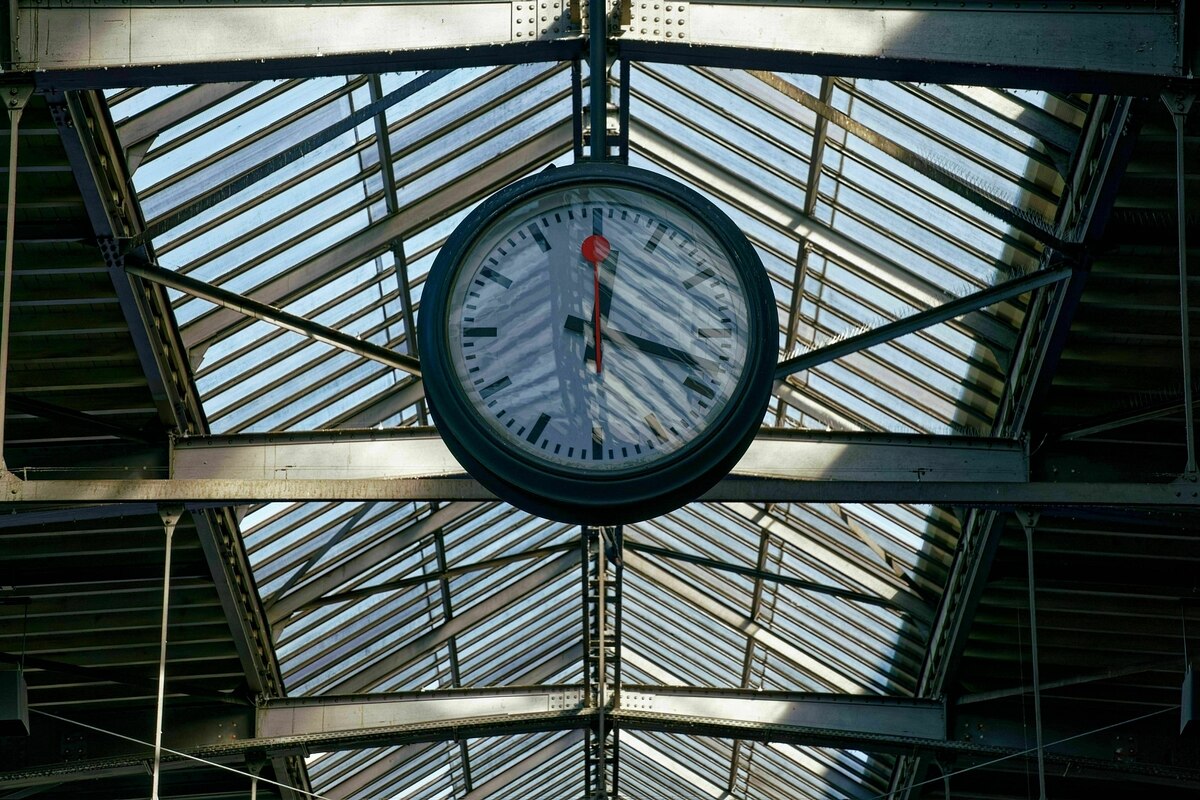
dpa | Die Swiss Railways (SBB) have set a record: Last year, 94.1 percent of passenger trains reached their destination on time, the company announced. The year before it was 93.2 percent.
This was achieved with around 1,600 special trains despite numerous construction sites and several major events such as the Eurovision Song Contest and the European Women’s Football Championship. The most punctual day in the history of the SBB was December 28th: on that Sunday, 98.6 percent of trains in Switzerland arrived on time.
In Germany: 60 percent for long-distance transport
Of such values Rail users in Germany can only dream. While in Switzerland long-distance and regional transport are practically equally punctual, there is a gap at Deutsche Bahn (DB). Only 60.1 percent of long-distance trains were on time last year, compared to 88.7 percent of regional trains. The DB calculates a punctuality rate of 88.0 percent for all passenger traffic.
Deutsche Bahn also allows itself more leeway than the Swiss when it comes to defining punctuality. In Germany, a train is considered late for six minutes or more. At SBB, trains appear in the delay list for just three minutes.
The Swiss are also annoyed about the DB situation. “Trains from Germany in particular arrive in Switzerland late, which affects punctuality in this country,” they complain. “To counteract this, SBB turns trains around at the border if necessary and uses replacement trains within Switzerland.”
DB boss wants to save 500 million euros on corporate management
In Germany wants Bahnchef’s Evelyn Palla will save 500 million euros per year in corporate management in the future. “We want to focus on the functions that actually help us improve the quality of the railway across the board,” she said at the company’s New Year’s reception in Berlin. “And we will say goodbye to the rest, to everything else, because we simply can’t afford it anymore.”
Significant savings are needed in the group management, emphasized the manager, who has been at the top of the railway since October of last year. “What are we planning to do? Actually, a cost reduction of up to 500 million per year in the corporate management alone.”
Clearcutting of the corporate management
Just a few weeks after taking office, Palla announced a comprehensive restructuring of the entire group and planned a clear-cut, particularly at management levels. Of the around 3,500 jobs in the so-called corporate management, around 30 percent are to be cut. At the level below the corporate board alone, Palla has eliminated around half of 43 management positions. Further measures are to follow.
As a further focus of the reorganization at the railway, the boss wants to shift more responsibility to the area. “This means that measures to improve quality in the stores are no longer taken by the group management, but in the stores, directly where we are close to the customer.” In the future, responsibility for stability and quality in rail operations will lie with regional management levels.
Palla also wants to measure the group’s progress on two metrics: punctuality and operating results (EBIT). At least when it comes to poor punctuality, there is currently no improvement in sight. Palla referred to a record number of construction sites on the network this year and slowing down traffic. Last year, punctuality in long-distance transport was only around 60 percent. This is also the minimum target that the railway boss has announced for 2026.