

Nina wants to become a famous actress. Irina Arkadina has long been one, her young lover, Trigorin, is a writer and also famous. Arkadina’s son Kostja is looking for art, i.e. the avant-garde. His uncle Sorin, on the other hand, drowned his former creative ambitions in alcohol. The doctor Dr. Dorn is no help when it comes to healing and is also involved in polyamorous relationships while his wife, the estate manager Polina, arranges the house plants.
There is also Masha, her middle name is probably “melancholic”: her sadness for life is omnipresent. “My life is much harder,” the uptight teacher Medvedenko once claims – whoever believes it. He will later marry the melancholic Masha. Then colorful balloons burst, a karaoke system flashes, and “Ne me quitte pas”, “Dreams are my reality” and “If you don’t know me by now” waft meaningfully through the room.
“The Seagull” is the first production by Yana Ross German theater in Hamburg. The play, premiered by Anton Chekhov in 1896, is, as always with this playwright, about people, their vain search for happiness, art and crises.
The characters are stuck tenaciously in the provinces. There, dialogues collapse long before they could arise, questions are lost without answers, vows of love fade away in the room. Sometimes seagulls are shot in flight and sometimes fishing rods are thrown into the lake. Art is tried again and again and despairs of it. Especially from Kostya.
Paul Behren plays this serious young man with intrinsic impulse. He tirelessly rehearses his choreography durational performance. The work itself, an experimental join-in-feel-your-breath audio walk, resonates with his mother (wonderfully and wonderfully technophobic: Bettina Stucky) to the deepest incomprehension. Soon afterwards, she will mercilessly dismiss the sad Masha (Henri Jörrissen) as “early aged” and try to bring the enthusiastic Nina (Josefine Israel) back to the facts of the stage.
“The Seagull”Deutsches Schauspielhaus, Hamburg. Next performances: February 7th, 19th & 24th, each at 8 p.m
However, Nina has already fallen in love with her acting idea and the supposed linguistic genius Trigorin (Daniel Hoevels). She passionately imitates every movement of this wordless writer, every breath he takes. She hangs on his every word and, like Kostja, follows Trigorin’s words and his gaze with emotion even when he “muses” about the black beams in the stage sky. Then everyone stares through a huge hole that set designer Bettina Meyer used to open the wood-paneled room into the promising nowhere.
Close to the characters
You get closer to all the characters this evening, which is certainly due to Ross’s casual version of the piece; you watch their enthusiasm with horror, worrying about the lives of those on the stage. And so does that of Nina, who would make “every, every, every sacrifice” for art and live for her fans, because “the happiness of these people only lies in admiring me, in looking up to me.”
When Josefine Israel says this with conviction, a wonderfully shimmering overlay appears for a magical moment: you happily look up at the actress, admire her acting – and yet you know that the sentences belong to the theater character Nina.
In general, this evening is a festival of actors; in addition to those already mentioned, Josef Ostendorf, Angelika Richter, Samuel Weiss and Pascal Houdus are also in top form. You want to endlessly watch your characters yearn and fail, follow them into their abysses, knowing full well that their story has an end. And that’s exactly when Behren/Kostja lets themselves fall into a large, round hole that opened up in the stage floor in the second part of the evening.
What emerges is a study of the all-too-human in general
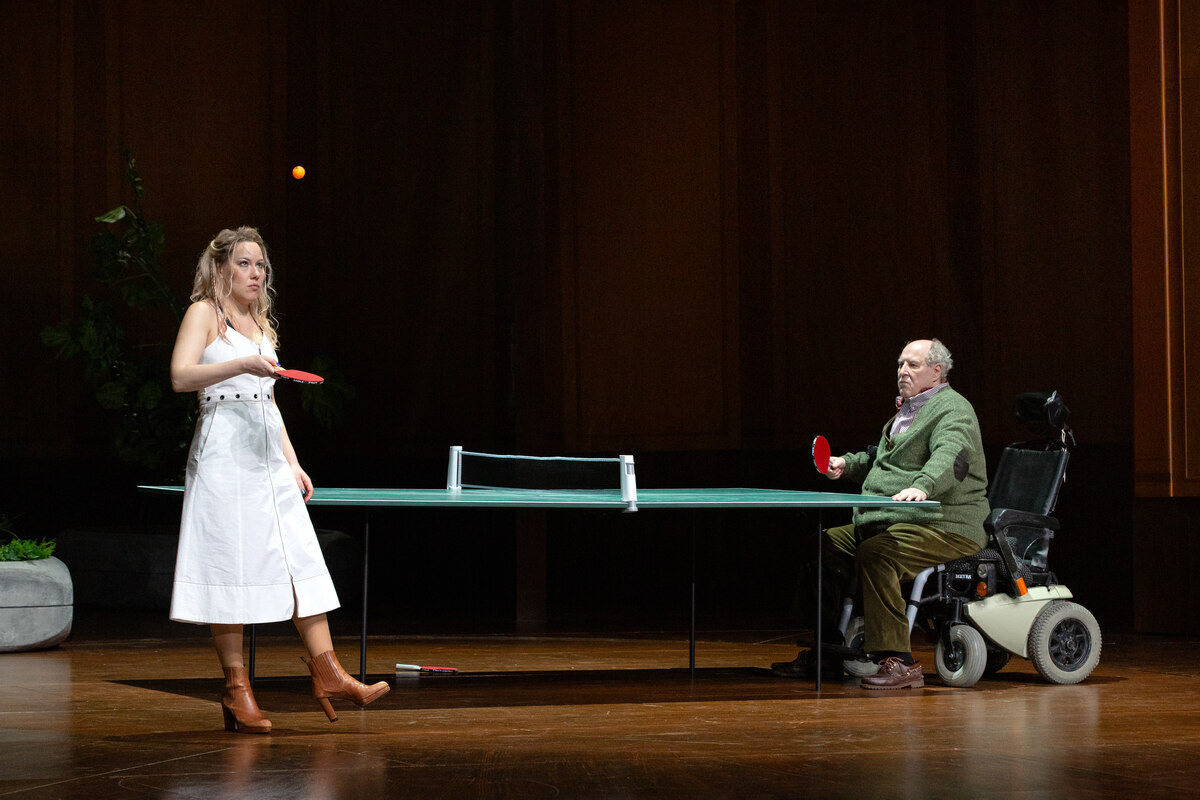
Ross’ production sparkles through the truly fantastic ensemble. But in this radiance, it’s easy to overlook the technical construction of many scenes: the run around the table tennis table, the “War is afraid of…” game, the karaoke singing and the bingo inherent in the piece at the end. Character developments are lost, as are understandable internal relationships, heights of fall or arcs of tension.
What emerges is a study of the all-too-human in general. Not always coherently staged, but absolutely worth seeing. Or, to put it in the words of Irina Arkadina: “I breathed, I enjoyed.”