

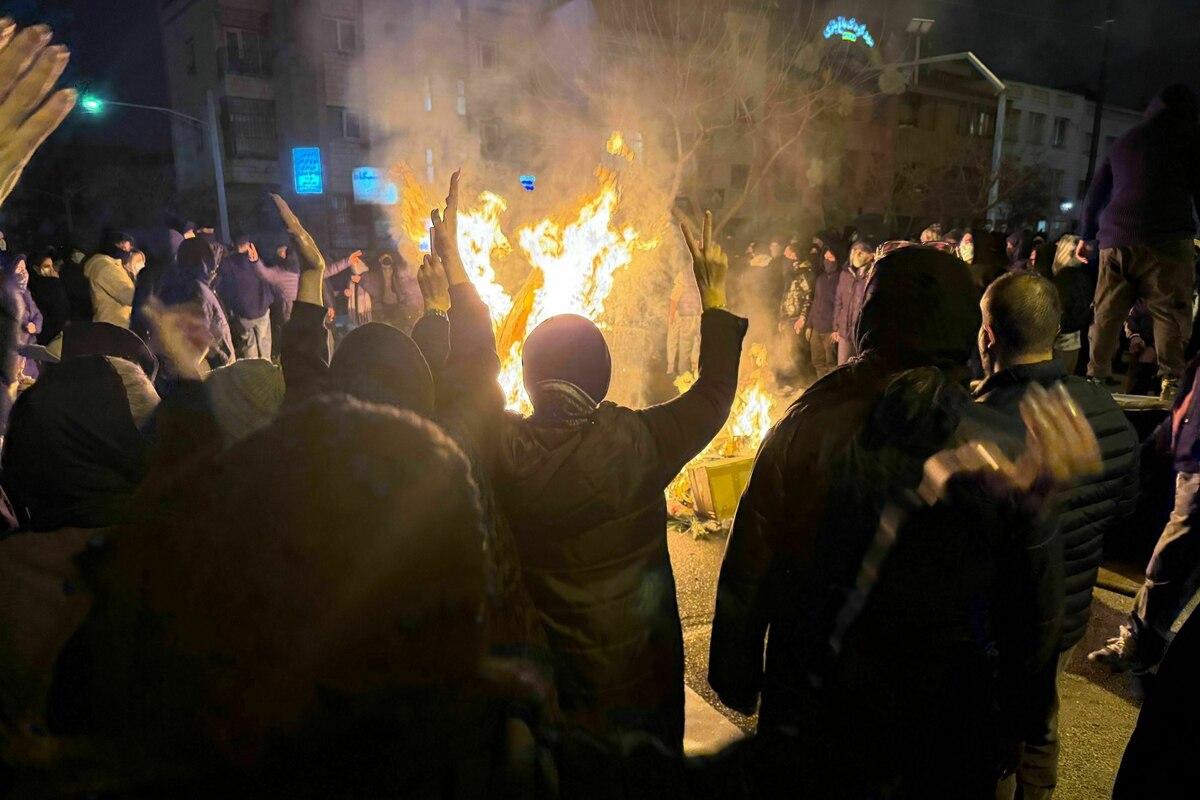
D he protests on the streets of Iran are decreasing, but the situation remains tense. US President Donald Trump continues to threaten the mullahs’ regime with consequences. Would a US military strike be right?
And.
In an optimal world there would long ago be a world police force. An intervention force that arrests despots who violate human rights and brings them before the International Court of Justice in The Hague. Secured by a vote of the United Nations, which relies on understanding and respect. In an even better world, opposition movements would be able to drive the despots who oppress them out of office through constant resistance alone. Yes, yes, something like that has already happened. In 1989, for example, in the GDR.

But the real world is not like that. Especially not in Iran. On the one hand, there is a strong opposition movement that has been able to bring the masses onto the streets again and again for decades, but has failed due to the brutal violence of those in power. On the other hand, there is Donald Trump, the US President likes to see himself as a world policeman. Why? Because he can.
Trump has Iran urged to hold on, help is on the way. Which can hardly be read as anything other than a blatant threat of further US military intervention. At least since the kidnapping of the Venezuelan president the world should know that what looks like US preparation for war is preparation for war. It makes your stomach turn. Simply because nothing good rarely comes of it when one despot fights another, and that too militarily.
Nevertheless, many people in Iran would be happy about US intervention. Because – unlike in the GDR – the demonstrators are not facing a wavering regime that shied away from taking the very last step in 1989. On the contrary, the mullahs’ regime relies on the power of guns. And the opposition has different than 2023 in Syria nor do they have their own armed troops in the rear to drive out the tyrant. Nobody can want another intervention from Donald Trump. But even more unacceptable are the thousands of demonstrators who apparently died.
Gereon Asmuth
No.
Nobody knows how many people have already been killed in the protests in Iran. Some speak of more than 2,500 dead, including 100 security forces. But there could be many more, but that cannot be verified with certainty. Images of victims and body bags in cold storage give an impression of horror. The Iranian regime has announced summary trials and the first executions. It’s unbearable.
Many have long wanted the fall of this regime and hope that a military strike by the USA could now hasten it. But that could be a fallacy. Although the regime enjoys less and less support among the population, it still bases its power on the judiciary, army, police and secret services. It has its back to the wall.
At the same time, too many of the regime’s pillars have a lot to lose. An attack from outside is likely to bring the ranks together. And after recent experiences with U.S.-induced overthrows in Afghanistan, Iraq and Libya, one can be skeptical as to whether a form of “regime change” imposed from outside is even desirable. It has led to bloody civil wars in many countries with thousands of deaths. Iran is a multi-ethnic state: 90 million inhabitants and many minorities. If it were to plunge into complete chaos, the consequences would be unforeseeable.
We must exhaust all possibilities to increase pressure on the regime to give in to the demands of the protesters. It is right for Germany to review its trade relations with Iran and it should stop deportations there. Sanctions and threatened criminal prosecution are better than military operations. It is important to protect the activists. A US military attack would be counterproductive. Freedom and democracy cannot be bombed into existence – past experiments have shown that.
Daniel Bax