

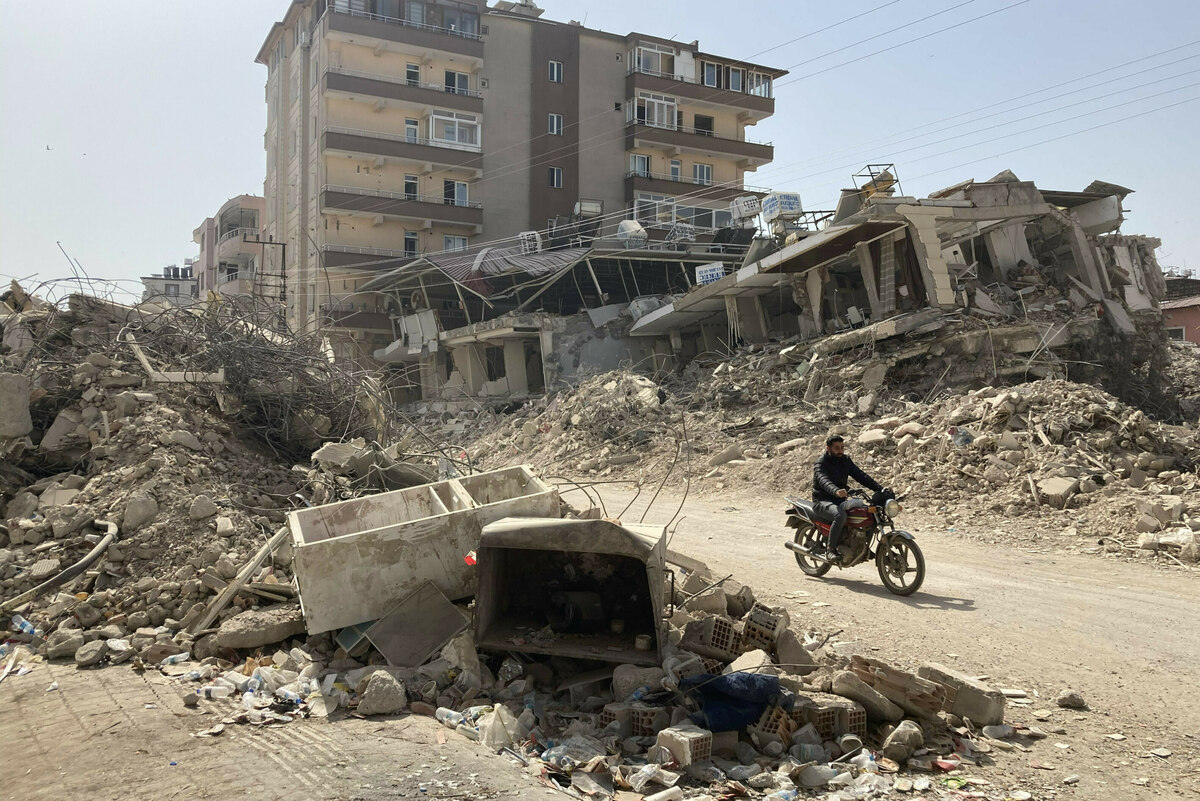
This Friday marks the third anniversary of the devastating earthquake in southeastern Turkey and Syria. It was one of the worst earthquakes in living memory. It destroyed entire cities, claimed 54,000 confirmed deaths in Turkey alone, and many people are still missing. There are still no exact figures from Syria.
There are two completely different narratives about the three years since the quake. The Turkish government is particularly proud of its reconstruction efforts. It is a “success story that is unique in the world,” says the Minister for Urban Development and Environmental Protection, Murat Kurum. The opposition is completely different. Starting with the fact that it took the government in the particularly affected region of Hatay a full three days to even show up after the earthquake, the reconstruction is also a catastrophe. Only mass is taken into account.
In fact, Kurum boasts that the state social housing agency Toki has already completed 70 percent of the 450,000 new houses planned by the end of 2025. 350,000 apartments were given to people who lost their homes in the 2023 earthquake.
These days Kurum is traveling through the former disaster area with a hand-picked group of foreign journalists. It is difficult to verify whether the official figures for newly built buildings are correct. Anyone traveling through the crisis area can immediately see that thousands of people are still living in residential containers in fenced-off areas.
Disgraceful conditions
At least 200,000 people continued to live in deplorable conditionssays CHP boss Özgür Özel, who is also visiting the earthquake area these days. Independent urban planning experts describe the reconstruction as an industrial mass production of completely soulless new development areas that no longer have anything to do with the former cities.
Demet Parlar, an Istanbul doctor who works in the earthquake areas, particularly criticizes the complete lack of any infrastructure. “There are no schools, no hospitals, and even the former community health stations are not being rebuilt. The people there lack everything, and there is no internet.” An acquaintance of hers who was assigned a new apartment couldn’t even enter the house because there were no roads between the houses and construction was still going on everywhere, she says.
For people who have remained in the region since the earthquake, the situation on site is often hell. In Antakya, historic Antioch, earthquake victims tell how they have been living in the dirt and noise of construction sites almost continuously for three years. “Since the quake there has been a cloud of dust over Antakya, making it difficult to breathe and, above all, making many children sick,” a woman told a dpa reporter.
But what’s really bad is how condescendingly the state treats the earthquake victims, reports Mevlüt Oruc. He is a journalist in Samandag, the port city of Antakya near the border with Syria. “People want to cooperate and help, but you don’t let them,” says Oruc. “The plans are made exclusively from above. Many victims cry when they see their land being expropriated in order to then build four-story apartment buildings on it. Their citrus and olive groves have also been nationalized.”
Intact houses were demolished
In fact, in order to be able to build quickly and on an industrial scale, large areas were expropriated everywhere and even intact houses were demolished. A few exceptions were made for historical buildings, particularly in Antakya. Here, the Ministry of Culture has cordoned off areas where historical buildings once stood. They should be rebuilt more carefully and more slowly.
In Antakya this is the famous Habibi Necar Mosque from the 7th century, which is already shining in new splendor. The reconstruction of churches and synagogues, however, is hardly getting off the ground because there is a lack of money.
In Antioch/Antakya, where the first Christian community outside Jerusalem was founded, Fadi Hurdigil, chairman of the Foundation of the Greek Orthodox Community in Antakya, has been fighting for the reconstruction of the church for more than two years. “Many of our people left after the earthquake, but are now coming back,” he told dpa. “You need a meeting place.” The state recently promised at least start-up financing. Many hope that Antakya will once again have a multicultural urban community in the future.