
Where there is talk of “no other choice” there is room for doubt. Because there is basically always such a different choice – those who use the phrase are usually not describing any compulsion, but rather themselves: their worldview and thus the silent ordering system that underlies their thinking, which defines the terrain of their own decision-making options and sorts them, evaluates some options for action as “reasonable” and banishes others directly from the realm of the feasible.
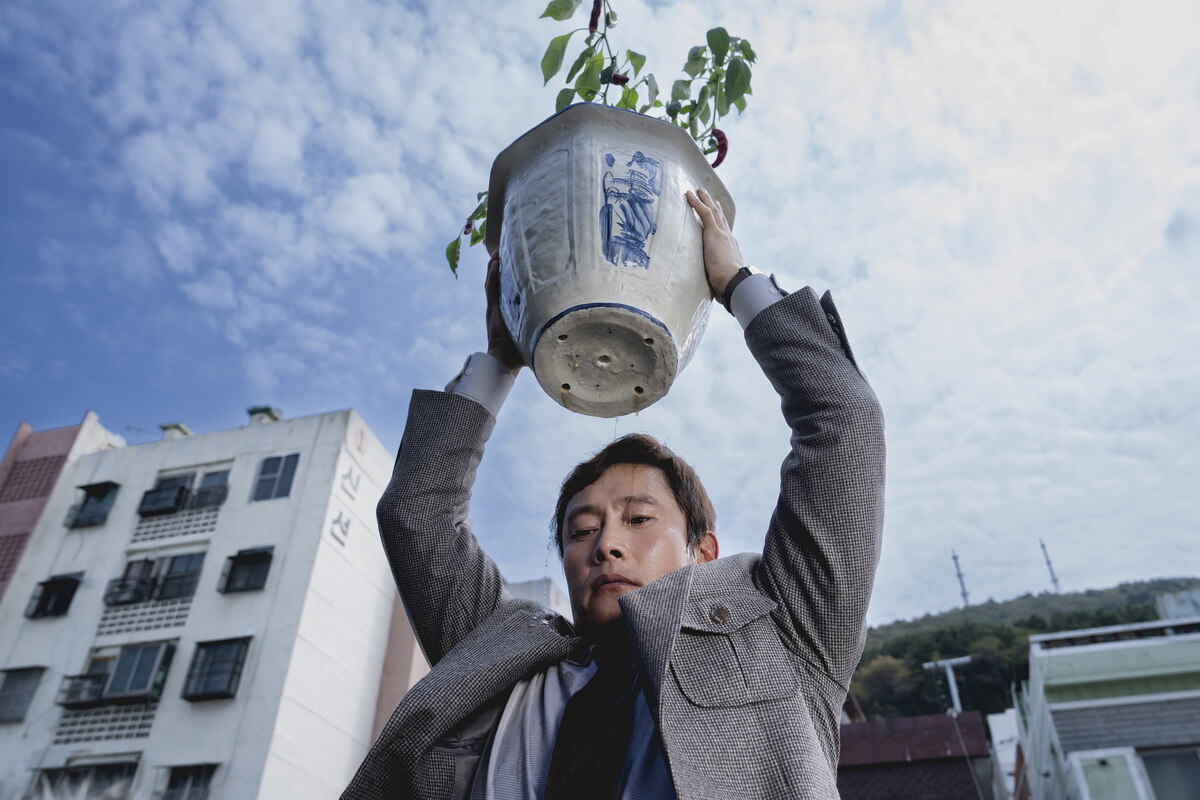
This pattern is also evident in Park Chan-wook’s bitterly funny thriller: manager Yoo Man-su (Lee Byung-hun) is fired after more than 25 years in the South Korean paper industry.
Because he refuses to create a list of “dispensable” employees, his own name ends up on it. The new US owners of Solar Paper explain, ultimately unimpressed, that they simply have no other choice.
The cheap formula also speaks more of a conviction than a necessity: that what serves profit and its maximization is the only sensible thing to do – and therefore even large-scale layoffs hardly need any justification. It is not for nothing that etymologically reason is already buried in “rationalization”.
Park Chan-wook takes the alleged lack of alternatives at their word: in the aptly titled “No Other Choice” adaptation of the 1997 novel “The Ax,” he takes it to the extreme with satirical consistency.
What begins with a termination sets in motion a chain of increasingly fatal decisions. In the light of perverted thinking that derives a person’s importance from their economic usefulness, these appear almost rational – or even without alternative.
Until now, Yoo Man-su had thought he was on the right side of the balance. His life bears the reassuring trappings of secure middle-class circumstances: a well-kept house with its own greenhouse in the garden, an elegant and devoted wife named Mi-Ri (Son Ye-jin), a notoriously annoyed teenage son who looks up to him, and a withdrawn, musically gifted young daughter.
It is an everyday life, the harmony of which the South Korean filmmaker Park Chan-wook arranges almost clearly at the beginning at a picturesque barbecue, accompanied by Mozart’s Piano Concerto No. 23. Of course, Man-su’s “I have everything!” uttered in the exuberance of familial harmony must be followed. the case will follow soon.
Contrary to his mantra of finding a new, promising job within three months, he is still stuck in retail over a year later. He has to assert his own suitability in seemingly Kafkaesque job interviews.
The film follows Man-su’s plan with a mixture of almost childlike ingenuity and cool precision
At home, wife Mi-Ri begins to rationalize away what was once taken for granted: first the second car, then the piano, the dining table, the shared dance class, her tennis lessons, the Netflix subscription, and finally the house. Even the golden retrievers become bargaining chips.
Paper beats people
With each position eliminated, not only does the property shrink, but also the space in which life had previously spread as a matter of course. Man-su experiences this process less as a sudden fall than as a gradual redefinition of his existence. The world that once valued him begins to reassess him.

At the beginning, Park Chan-wook makes the middle-class luck almost abundantly clear: After that, the fall must come
Photo:
Plaion
When his wife Mi-Ri finally accepts a position as a dental hygienist in the practice of a young, strikingly attractive doctor, the silent humiliation is complete – and Man-su has made up his mind: in order to improve his chances in the fight for employment and recognition, he has “no other choice” than to eliminate competing applicants.
We would like to show you external content here. You decide whether you also want to see this element:

With a mixture of almost childlike ingenuity and cool precision, “No Other Choice” follows the plan that Man-su then comes up with: He places a seductively worded advertisement for a highly paid position in a fictitious paper company.
He then meticulously sifts through the CVs, sorts out the promising ones and – not even particularly discreetly – pursues those candidates who appear to him to be the most suitable and therefore the most dangerous.
Play off against each other
When directing the execution of this project, Park Chan-wook surprises with slapstick scenes and an almost physical comedy. This gives “No Other Choice” a much greater tendency towards silliness than one would imagine South Korean films like “Parasite” (2019) in which socially critical sharpness is balanced with a much darker, mocking humor.
As a result, analytical bite is sometimes lost: Man-su gradually kills men who not only share his already rare passion for paper, but also share the same precarious situation and have become addicted to alcohol out of concern for their existence. Like him, they struggle to ensure a better future for their own children or no longer feel desirable in the eyes of their wives: Park Chan-wook doesn’t always manage to show the tragedy that resonates clearly enough in this.
This omission is regrettable: “No Other Choice” appears at a time when a style of politics has come back into fashion that sells cuts in the welfare state or cuts in workers’ rights under the label of “no alternative” and fuels a very similar dynamic, both rhetorically and practically: This consists of playing workers off against each other or turning the middle’s fear of social decline against those at the bottom, i.e. directing it at the economically weakest rather than at those who benefit from it still benefit from this dynamic.
The indomitable competitor
But this tragedy shows itself in a different form in the bitter finale of “No Other Choice”. A competitor appears that cannot be easily “eliminated” and is also used with the reassurance that “we have no other choice” in terms of competitiveness: artificial intelligence.
If you will, the film itself seems like a work against this logic. On the one hand, because “No Other Choice” is about the fascination with paper, this analogue relic in the noise of the tech boom.
„No Other Choice“. Directed by Park Chan-wook. With Lee Byung-hun, Son Yejin and others South Korea 2025, 139 min.
But also because Park Chan-wooks Kino stands for the love of artistic craft like no other: through precisely composed images (Ryu Seong-hee), carefully used music (Jo Yeong-wook), cuts (Kim Sang-beom) with rhythmic will and a camera (Kim Woo-hyung) that does not capture but creates.
This captivatingly beautifully arranged film breathes the majesty of a work that derives its value precisely from being the result of diverse human dedication and interlocking crafts. Perhaps therein lies the quiet recognition of the end: that in the face this opponents finally reach their limits. When faced with AI, there may be no other choice than to see irreplaceability as a joint project.